Building partnerships through collaboration.
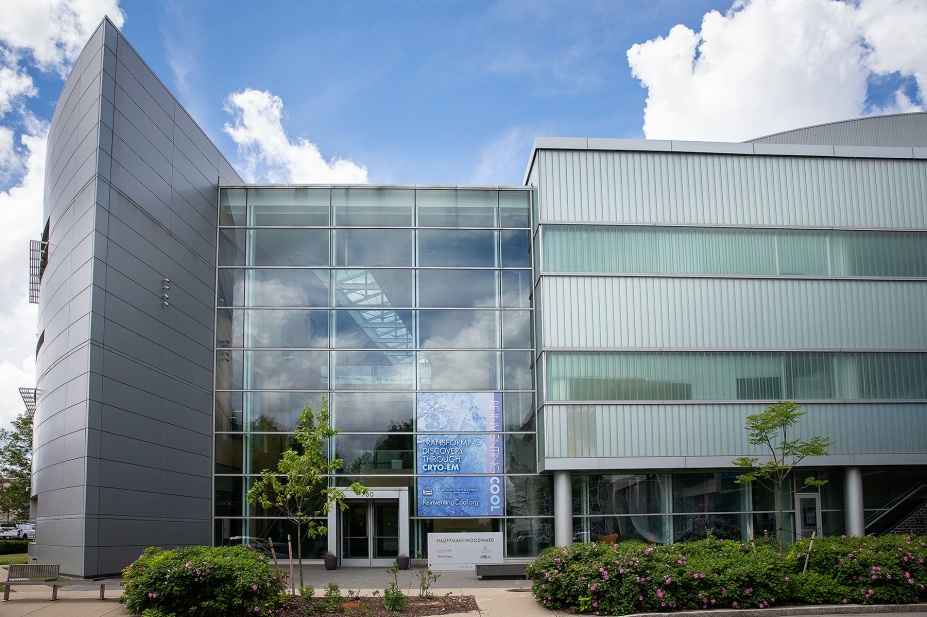
Hauptman-Woodward Research Institute Building
Overview
FacilityHWINumber0537FunctionResearchGross Square Feet88,678Construction Cost$22,000,000CompletedMay 2005ArchitectCannon DesignFunction
The Hauptman-Woodward Research Institute Building at 700 Ellicott Street houses the institute known as the University at Buffalo Hauptman-Woodward Research Institute (UB-HWI).
Namesake

![Herbert Hauptman.]()
The Institute was founded as the Medical Foundation of Buffalo in 1956 through the vision of Dr. George Koepf and the generosity of Helen Woodward Rivas.
In 1970, Dr. Hauptman joined the crystallographic group of the Medical Foundation of Buffalo, becoming Research Director in 1972 and, later, its President. Dr. Hauptman used probability theory to develop mathematical techniques called direct methods. He used these methods to interpret diffraction patterns and translate them into a structural map that revealed the location of individual atoms. Initially met with much skepticism in 1985, while at the Institute, Dr. Hauptman’s revolutionary methods made him the first mathematician to win a Nobel Prize in chemistry.
In 1994, the Medical Foundation of Buffalo was renamed the Hauptman-Woodward Medical Research Institute, recognizing the partnership of science and philanthropy. Dr. Hauptman continued to work daily at the Institute into his nineties. He passed on October 23, 2011, but his legacy continues.
Location map