
Governance

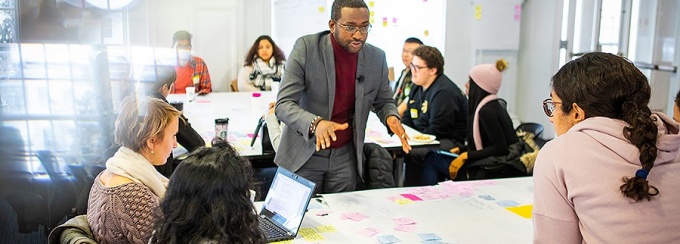
The Community for Global Health Equity also supports faculty whose work more broadly influence the policies, systems, and norms that reinforce inequities. Their work enhances the work of our Big Ideas teams and ensures we are thinking about and acting upon the true causes of health inequity.
In this discussion, Dr. Tia Palermo, associate professor of epidemiology and environmental health, and Dr. Gauri Desai, clinical assistant professor of epidemiology and environmental health speak with three University at Buffalo faculty panelists about our role in global health as researchers and practitioners in the Global North. The panelists include:
- Nadine Shaanta Murshid, Ph.D., Associate Professor of Social Work and Interim Associate Dean of Equity Diversity and Inclusion
- Jinting Wu, Ph.D., Assistant Professor of Educational Culture, Policy and Society
- Emmanuel Frimpong Boamah, Ph.D., Assistant Professor, Department of Urban and Regional Planning
Structural violence is defined as the discriminatory social arrangement that, when encoded into laws, policies and norms, unduly privileges some social groups while harming others. Buyum and colleagues recently wrote that our “current global health ecosystem is ill equipped to address structural violence as a determinant of health, and the system itself upholds the supremacy of the white saviour.”
Two leading voices in this space, Drs. Seye Abimbola and Madhu Pai recently wrote, “What we know as global health today emerged as an enabler of European colonisation of much of the rest of the world…A crucial first step is recognising that ours is a discipline that holds within itself a deep contradiction—global health was birthed in supremacy, but its mission is to reduce or eliminate inequities globally.”
The panelists discuss how individuals interested in global public health at the University at Buffalo (and the Global North more generally) can make positive contributions and not perpetuate structural violence. This discussion was co-sponsored by the Global Public Health Course in the undergrad program at the University at Buffalo and the Community for Global Health Equity.


