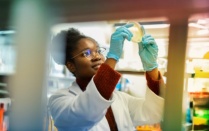
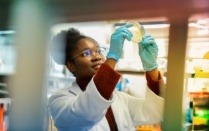
UB is leveraging its acquisition of the Hauptman-Woodward Medical Research Institute as an opportunity to move research more quickly from concept to application.
Plan for ‘UB-HWI Bridge’ Initiative Takes Shape
By Jay Rey
Published June 11, 2026
UB is capitalizing on its acquisition of the Hauptman-Woodward Medical Research Institute by using it as an opportunity to move research more quickly from concept to application.
The “UB-HWI Bridge” initiative combines historical strengths in structural biology and artificial intelligence by creating a more connected and collaborative ecosystem within the HWI building and Center for Excellence in Bioinformatics and Life Sciences.
The two buildings are across the street from each other on the Downtown Campus and connected by a bridge over Ellicott Street.
“Really, in a nutshell, what we’re trying to do is take historical strengths in structural biology and AI and enhance our biomanufacturing capability, and bring them into one ecosystem that is cohesive and thoughtful across the university,” says Provost A. Scott Weber, PhD.
Weber spoke about UB-HWI Bridge during the UB Council meeting on June 1.
The university-wide initiative is based on the idea that today’s scientific challenges require close connections between computational design and AI, experimental validation, imaging, analytics, modeling and biomanufacturing.
“So, think about all of these, and what we’re trying to do is take them out of their silos, even though they are not completely siloed, but push them together in a very fast sort of cycle,” Weber says. “I think now we have the capability to do that.”
Founded in 1956 as an independent biomedical research facility, the Hauptman-Woodward Medical Research Institute officially joined UB in January 2025, cementing their long-time partnership in research and education in structural biology.
The initiative will tap into $50 million awarded by New York State during the last budget cycle to enhance research facilities and equipment at the university.
The long-term vision, Weber says, is to attract major research center grants, strengthen partnerships with industry and government and raise UB’s national profile in the life sciences.
The initiative aligns closely with the federal government’s AI Genesis Mission, which seeks to use AI, supercomputing and federal datasets to accelerate scientific discovery.
UB-HWI Bridge will be led by Venu Govindaraju, PhD, senior vice president for research, innovation and economic development.
While UB-HWI Bridge is still in its early stages, university leadership and faculty have been refining the initiative, which should begin to take shape this summer.