University at Buffalo (UB)
Azza El Siddique

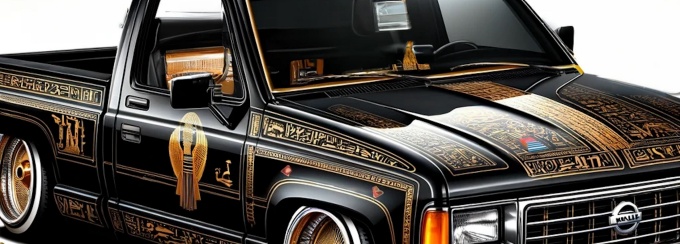
The Edifice of Tirhaga
At its core, The Edifice of Tirhaga is not just a personal act of mourning but a reflection on broader societal and political questions surrounding death, memory, and power. The project interrogates how cultural practices around death are shaped by systems of power and control, from the monumental tombs of ancient pharaohs to contemporary institutions that regulate how we mourn and remember the dead. In this way, the project becomes a critique of both historical and modern structures of authority, questioning who gets to be remembered and how.
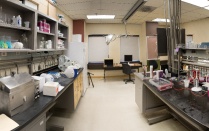
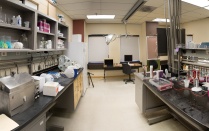
The Edifice of Tirhaga is a mobile mortuary temple that reimagines my late brother Teto’s 1993 Nissan pickup truck as a multisensory monument to mourning and regeneration. Supported by Creative Capital and the Guggenheim Foundation, this project merges ancient Egyptian and Nubian mummification rituals with contemporary Sudanese Muslim burial traditions and the aesthetics of lowrider car culture. By bridging these practices, it becomes both a deeply personal act of grief and a broader meditation on cultural memory, death, and the invisible architectures of loss. Teto was an artist whose presence lingers in the objects he touched—most poignantly in his truck. This vehicle becomes a sacred vessel, retrofitted into a traveling reliquary that moves through urban and diasporic landscapes. At the heart of this work lies an intimate and speculative gesture: the extraction of Teto’s DNA from the truck’s interior surfaces. Here, DNA is not just biological material—it is a sacred residue, a molecular archive of love, presence, and memory. Through the Coalesce Residency, I aim to collaborate with molecular biologists and genomic
researchers to ethically engage with this material. Together, we will explore how scientific protocols can be reimagined through culturally specific rituals of care. My practice often employs water, steel, scent, rust, and clay to explore entropy and renewal. With The Edifice of Tirhaga, this vocabulary expands into the molecular, treating car parts like canopic jars—containers for life’s remnants, handled with reverence and complexity. This project does not seek to instrumentalize science but to question it—to infuse its methodologies with intimacy and responsibility, particularly in relation to BIPOC communities historically marginalized in biomedical research. The DNA may manifest as integrated material, or it may surface in scent, sound, or gesture. Its presence, if found, will be subtle—a whisper rather than a spectacle. The process itself becomes the ritual.
Azza El Siddique
Azza El Siddique (b. Khartoum, Sudan) creates immersive, room-sized sculptural environments from welded steel that explore themes of entropy, impermanence, and mortality. She holds an MFA from Yale and a BFA from OCAD University. Her work has been supported by the Guggenheim Foundation, Creative Capital, and The Herb Alpert Foundation, and she has participated in residencies at Skowhegan, Amant Foundation, and the John Michael Kohler Arts/Industry program. El Siddique has exhibited at the MIT List Center, Mattress Factory, MOCA Toronto, and other institutions, with features in the New Yorker, Artforum, and Canadian Art.