News & information from UB, New York's flagship university
How New York City’s brownstones would react to the Virginia earthquake


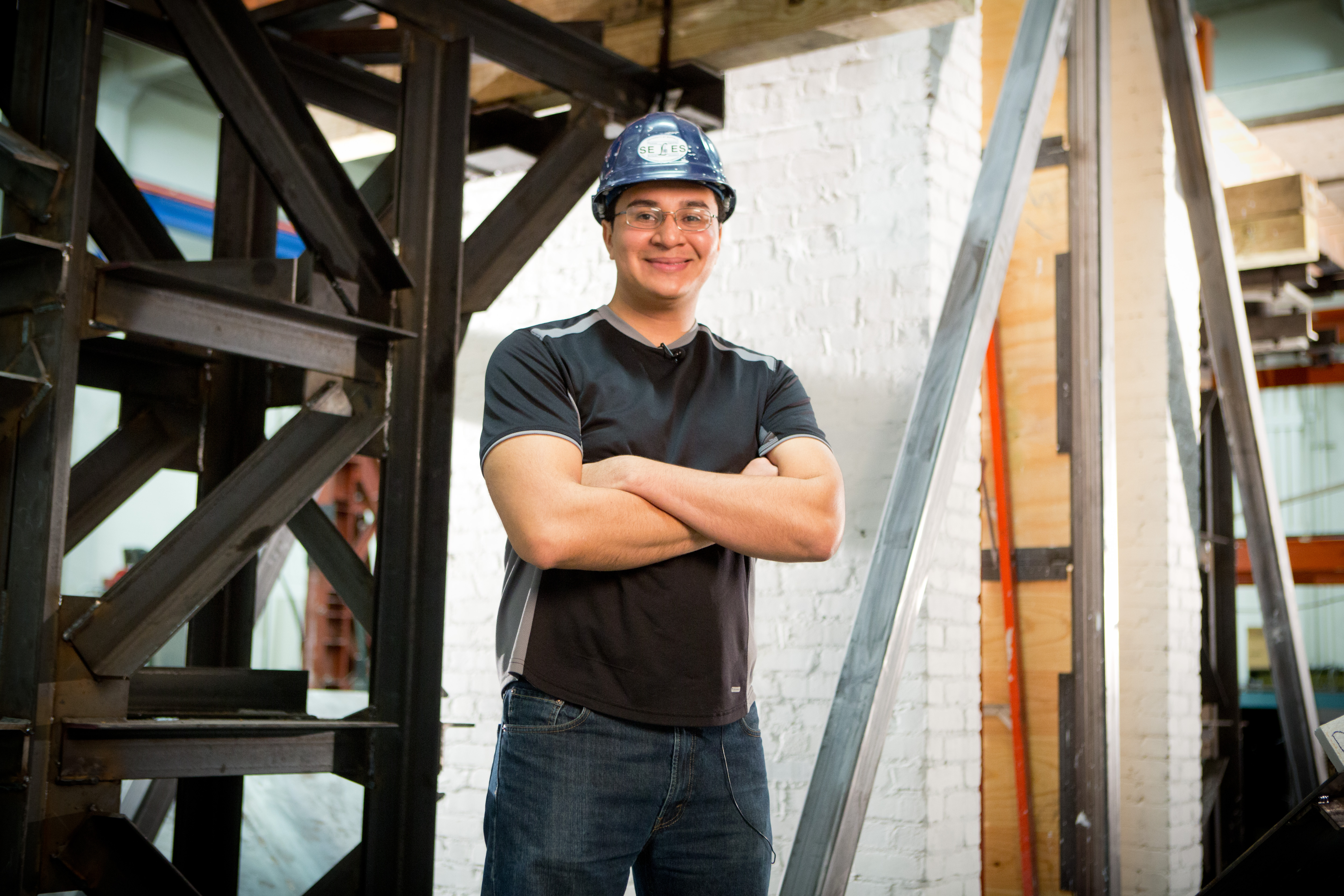
Juan Aleman, a PhD candidate and Fulbright scholar in the Department of Civil, Structural and Environmental Engineering, worked with Andrew Whittaker and Gilbert Mosqueda on the Feb. 19 shake test.
Researchers simulate the earthquake on walls that mimic what’s found in turn-of-the-century row houses
Release Date: February 28, 2013 This content is archived.
BUFFALO, N.Y. – A brick wall imitating part of a New York City row house (often called a “brownstone”) suffered minor damage but remained intact during a simulation of the 2011 Virginia earthquake, according to a preliminary analysis of tests conducted Feb. 19 at the University at Buffalo.
The tests — a rarity given the perceived low risk of East Coast seismic activity — will be used to validate numerical models that will help estimate potential human casualties, property losses and business interruption costs, said Andrew Whittaker, director of MCEER, the university’s research center for earthquake engineering and extreme events.
To see a video of the tests, follow this link: http://youtu.be/hbz3ib3oAeE.
“There’s very little information on the seismic behavior of unreinforced masonry construction in eastern North America and no validated numerical tools for structural engineers to use to analyze the brownstones,” said Whittaker, also professor and chair of UB’s Department of Civil, Structural and Environmental Engineering.
The lack of information is a problem because earthquakes, as evidenced by the Virginia quake and a 5.5 magnitude temblor that struck the New York City area in 1884, do occur, Whittaker said.
Large cities pose significant risks because of high population density and aging infrastructure. For example, a 2002 study by the New York City Area Consortium of Earthquake Loss Mitigation (NYCEM) found that unreinforced masonry buildings account for nearly 80 percent of the city’s housing stock.
To conduct the tests, researchers built two 14-foot walls using materials such as 100-year-old brick designed to imitate existing buildings. One wall was typical of New York City buildings while the other (common on the West Coast) was reinforced with steel rods and bolts that positively connected the flooring to the wall.
Using data from the U.S. Geological Survey, they programmed an earthquake shake table to mimic ground accelerations observed during the 5.8 magnitude Virginia quake. Both walls moved but held together.
A second series of tests mimicking ground accelerations from a 6.3 magnitude quake in Christchurch, New Zealand, in 2011 produced a very different result. The parapet on the unreinforced wall collapsed, whereas the reinforced wall suffered some damage but remained standing.
“The data that we obtain from these tests is going to be used to develop and improve numerical models of these buildings to determine how vulnerable these buildings can be in earthquakes,” said Gilberto Mosqueda, a UB research professor and associate professor in structural engineering at the University of California, San Diego.
The tests were conducted in collaboration with the Structural Engineers Association of New York, the International Masonry Institute, International Union of Brick Layers & Allied Craft Workers – Local #3 NY, United Materials LLC, Scranton's Thruway Builders Supplies, and Reclaim Syracuse Inc.
A more detailed analysis of the results will be published in an MCEER report later this year and in peer-reviewed journals. MCEER is planning additional tests of unreinforced masonry buildings.
Media Contact Information
Cory Nealon
Director of Media Relations
Engineering, Computer Science
Tel: 716-645-4614
cmnealon@buffalo.edu