News & information from UB, New York's flagship university
One-of-a-Kind Smartphone Lab Takes Shape at UB
Hundreds of students will receive a smartphone and service in exchange for participating in research that will improve mobile devices and educate students
Release Date: August 30, 2012 This content is archived.


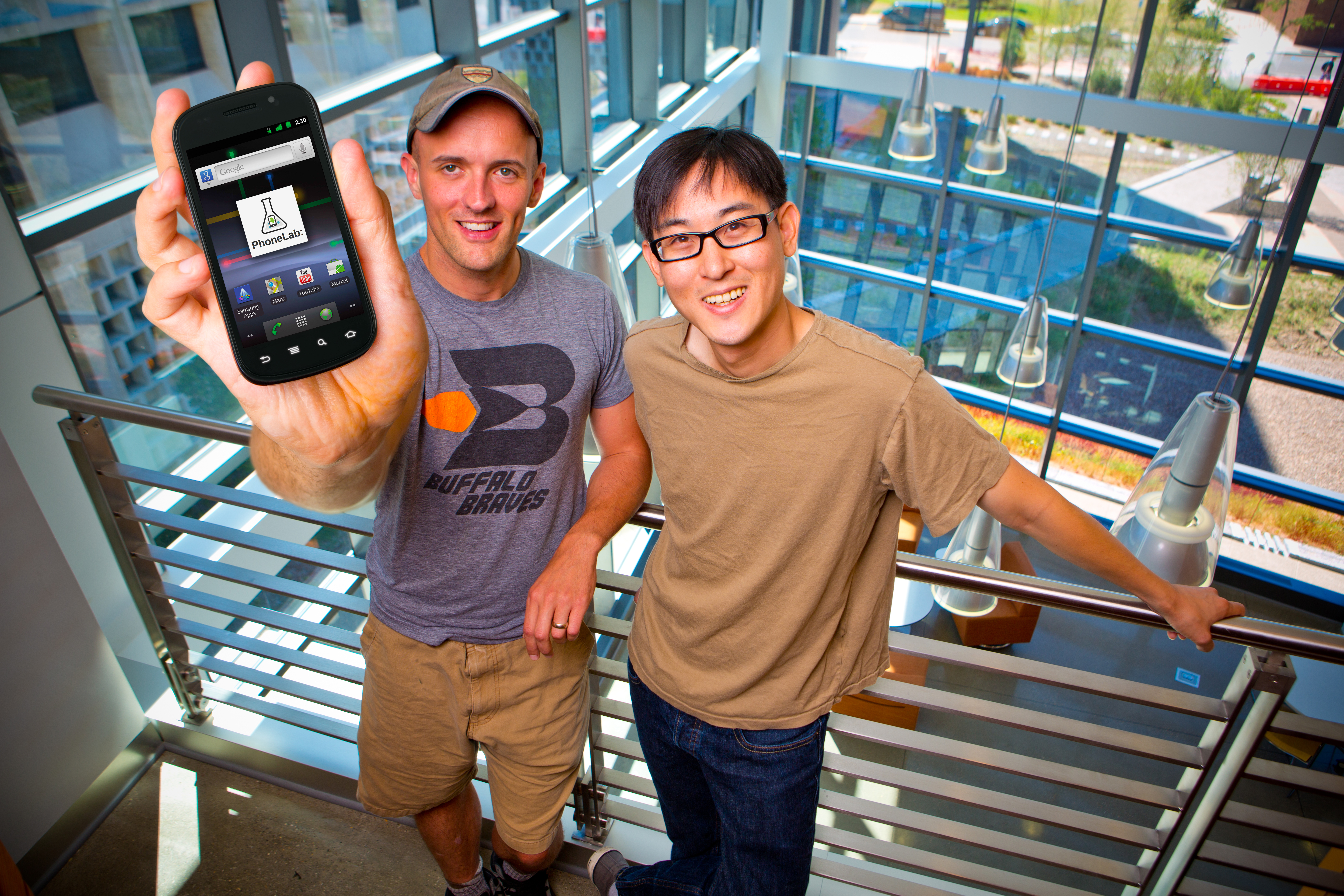
University at Buffalo researchers are enlisting hundreds of students to build an unprecedented smartphone network that will help scientists improve handheld computers and better understand how the devices are changing the world.
Dubbed PhoneLab, the forthcoming network is believed to be the world's largest collection of smartphone users assembled for large-scale experiments. It will help researchers build more powerful, secure and efficient smartphones and smartphone applications, improve wireless networking and educate students about mobile devices.
"We're trying to improve the smartphone experience. We want to make these devices work better," said Geoffrey Challen, assistant professor in UB's Computer Science and Engineering department, and principal investigator of PhoneLab.
While smartphone use is skyrocketing -- Forrester Research says 1 billion people will have one by 2016 -- experimentation on the devices is limited. Researchers either conduct tests in the marketplace, which constrains their access to the smartphone, or create their own test group, which is costly and time-consuming.
PhoneLab will solve both problems by offering unparalleled access to a ready test group and their smartphones, Challen said. Drawing interest from scholars worldwide from a variety of disciplines, PhoneLab is expected to push the boundaries of mobile device research.
Here's how it will work:
Using a $1.3 million National Science Foundation grant, UB will equip 200 students with new Google/Samsung-developed Android Nexus S smartphones. The students will receive one year of free service with Sprint featuring unlimited voice and data plans. Sprint is providing up to $384,300 per year in savings toward PhoneLab.
In exchange, UB students must participate in two hours of experiments every week. A student might be asked to perform simple tasks, such as completing a survey, or something more complex, like using a new geotagging application. After one year, students will receive discounted monthly bills of about $44. There is a potential savings of more than $2,000 if enrolled for four years. Students who leave PhoneLab after one year will not be penalized, but they will have to return the phone.
Student privacy will be protected. Experiments will be approved by an Institutional Review Board, a group of UB faculty members whose role is to safeguard the rights and welfare of research volunteers.
Students will receive an email prior to each experiment describing the research, what type of information it seeks and how it will be collected. If students are uncomfortable with an experiment, they can decline to participant. Research results will be shared publicly.
UB is seeking student participants, especially freshmen, sophomores and PhD candidates. For more information, visit: http://www.phone-lab.org/info.
While Google, Samsung and Sprint are providing goods and services toward PhoneLab, they will not influence the experiments, Challen said. PhoneLab will be available to accredited researchers at no cost, and UB will decide how experiments proceed.
Sprint will have access to smartphone data much like it does with its millions of customers. The PhoneLab team will also have access to the phones, but it will not constantly monitor them. Instead, the team will periodically check the phone's location, battery level and other components to ensure it is working properly. This information will not be released outside of PhoneLab.
Challen is joined by PhoneLab co-investigators: Professor Chunming Qiao, Associate Professors Murat Demirbas and Tevfik Kosar, and Assistant Professor Steven Ko. All are members of UB's Computer Science and Engineering department, which is part of the School of Engineering and Applied Sciences.
In addition to conducting research, the professors will develop undergraduate and graduate classes utilizing PhoneLab. UB students will learn how to program smartphones and smartphone applications, as well as better comprehend how this new computing paradigm is affecting society.
Anudipa Maiti, a PhD student and PhoneLab team member, said she's interested in how academics outside of computer science will use the network. "PhoneLab will allow researchers from different disciplines to run collaborative experiments," she said.
The professors also plan to work with middle and high school pupils at the Buffalo Academy of Science Charter School.
PhoneLab will expand to UB faculty and staff in August 2013, when an additional 250 smartphones are issued. UB plans to hand out another 250 phones in August 2014, growing PhoneLab to 700 participants. There are other smartphone labs -- also known as testbeds -- but none compare to the size planned at UB, Ko said.
"This is going to put the University at Buffalo at the center of smartphone research," he said.
Additional PhoneLab team members are: PhD students Lokesh Mandvekar, Rishi Baldawa, Fatih Bulut and Anandatirtha Nandugudi; master's students Bhaavyaa Kapoor, Michael Benedict, Vinu Charanya, Manoj Chandrasekaran, Jay Inamdar and Taeyeon Ki; undergraduates Mitch Nguyen and Sean Zawicki.
Media Contact Information
Cory Nealon
Director of Media Relations
Engineering, Computer Science
Tel: 716-645-4614
cmnealon@buffalo.edu