News & information from UB, New York's flagship university
Aerobic exercise promotes post-concussion healing, UB researchers find


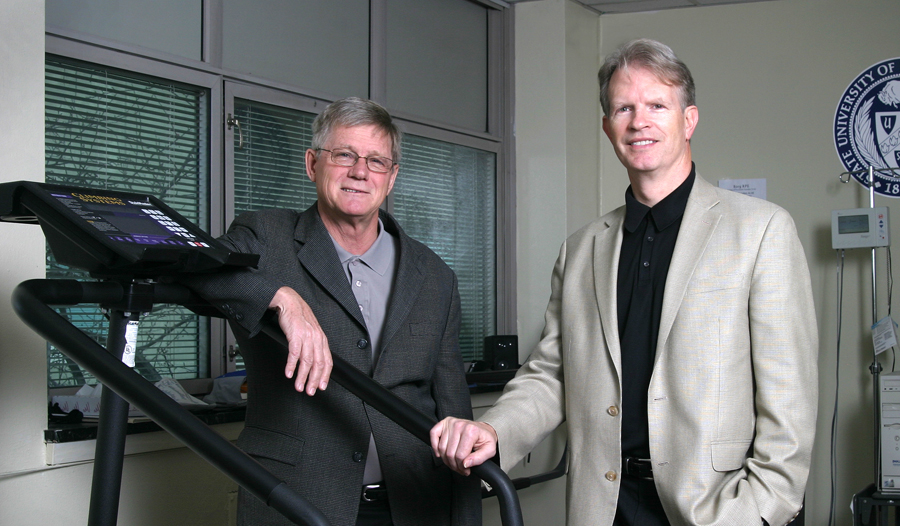
Research by John Leddy (right), Barry Willer and others has shown that aerobic exercise is effective in treating concussion patients.
Study reveals why post-concussion patients can perform cognitively but require far more mental resources to do so
Release Date: March 1, 2013 This content is archived.
BUFFALO, N.Y. – Further evidence that a program of controlled, progressive aerobic exercise may help restore normal cognitive function in patients who have sustained a concussion has been published by researchers at the University at Buffalo School of Medicine and Biomedical Sciences.
The research also may demonstrate why post-concussion patients can often perform cognitive tests as well as normal controls, but use far more mental resources to do so and patients are often exhausted afterward, the UB researchers say.
The paper, “Exercise Treatment for Post-concussion Syndrome: A Pilot Study of Changes in Functional Magnetic Resonance Imaging Activation, Physiology and Symptoms,” was published online in the Journal of Head Trauma Rehabilitation in December.
In the study, patients who had sustained a concussion were either treated with aerobic exercise or were treated with stretching exercises that did not raise heart rate.
The study used two primary indicators of success: daily symptoms and cognitive function as demonstrated on functional magnetic resonance imaging (fMRI) tests, while performing a simple arithmetic task.
At the start of the study, post-concussion syndrome patients in both groups showed abnormal function on the advanced imaging studies, but at the completion of the study, only the patients treated in the graded exercise program returned to normal. The UB researchers found that patients treated with graded exercise also had a significant decline in symptoms, such as improved sleep and concentration, when compared with the patients treated with stretching exercises.
"It is rare to have such significant findings with a small sample study and especially to find such powerful evidence that after a concussion, patients can actually return to normal brain function with graded exercise treatment," says John Leddy, MD, chief author on the paper and director of UB’s Concussion Management Program.
At the start of the study, functional imaging demonstrated that all 10 of the patients with post-concussion syndrome showed a hypermetabolic state revealing altered cerebral blood flow, compared to the sample of normal subjects, Leddy explains.
“Only the patients treated with graded exercise had normal functional imaging results,” he says. “The patients in the stretching exercise group have since been successfully treated with graded exercise."
Patients and normal controls were very similar in age, gender and athleticism.
“During the functional imaging study, everyone was given the same series of arithmetic tasks that could ordinarily be accomplished with ease by these young adults,” says Barry Willer, PhD, co-author, director of research for the UB Concussion Management Clinic and professor in the UB Department of Psychiatry.
“The accuracy and speed of the patients and the normal subjects was indistinguishable,” he says. “However, the normal subjects used a few specific regions of the brain to accomplish the task whereas the patients used multiple areas of the brain. Patients' brains were lit up like Christmas trees, reflecting hyperactivity of metabolism.
“This explains why patients with post-concussion syndrome look much the same as normal controls in terms of their performance on psychological tests, but when the test is over, the patient is exhausted,” Willer continues.
“We hear about this often from students suffering from post-concussive effects,” he continues. “They can make it through the first two classes of the day but their cognitive resources are all used up by the third class. It is wonderful when research evidence so carefully matches patients' realities."
Robert Zivadinov, MD, PhD, a co-author, UB neurology professor and director of the Buffalo Neuroimaging Analysis Center, says the study also points out some important differences in the brains of those with post-concussion syndrome not identified in previous research.
"Our patients with concussion had less activation in certain key areas of the brain compared with normal controls, such as the cerebellum, which is responsible for balance and coordination,” Zivadinov explains. “They also had less activation in an area of the brain called the posterior cingulate, which is often underactive in brain studies of patients with dementia. The posterior cingulate is a relay station for multiple cognitive functions."
"It is evident from this study that when diagnosed correctly, post-concussion syndrome results in a temporary change in how the brain works,” Leddy says. “These changes appear to arise from metabolic and physiologic changes rather than psychologic changes, as has been suggested in the past. In addition, the study shows that our graded exercise treatment appears to be able to restore normal function.”
In addition to those mentioned above, the research study represented a multidisciplinary effort, with major contributions from additional faculty members in the UB School of Medicine and Biomedical Sciences: David Pendergast, EdD, UB professor of physiology and biophysics; Jennifer L. Cox, in the Department of Neurology and now adjunct assistant professor in the UB School of Nursing; David Wack, PhD, research assistant professor of nuclear medicine; and John G. Baker, PhD, assistant professor of nuclear medicine.
Media Contact Information
Ellen Goldbaum
News Content Manager
Medicine
Tel: 716-645-4605
goldbaum@buffalo.edu