News & information from UB, New York's flagship university
Kaleida Health and University at Buffalo Officially Open Gates Vascular Institute/Clinical and Translational Research Center
Collaboration will deliver state-of-the-art clinical care, produce medical breakthroughs and spin-off biotech businesses
Release Date: May 24, 2012 This content is archived.


BUFFALO, N.Y. -- The effort to transform Buffalo into a world-class health care destination and expand the University at Buffalo's (UB) campus in downtown Buffalo took another major step forward today as Kaleida Health and UB opened its new 10-story vascular institute and research building.
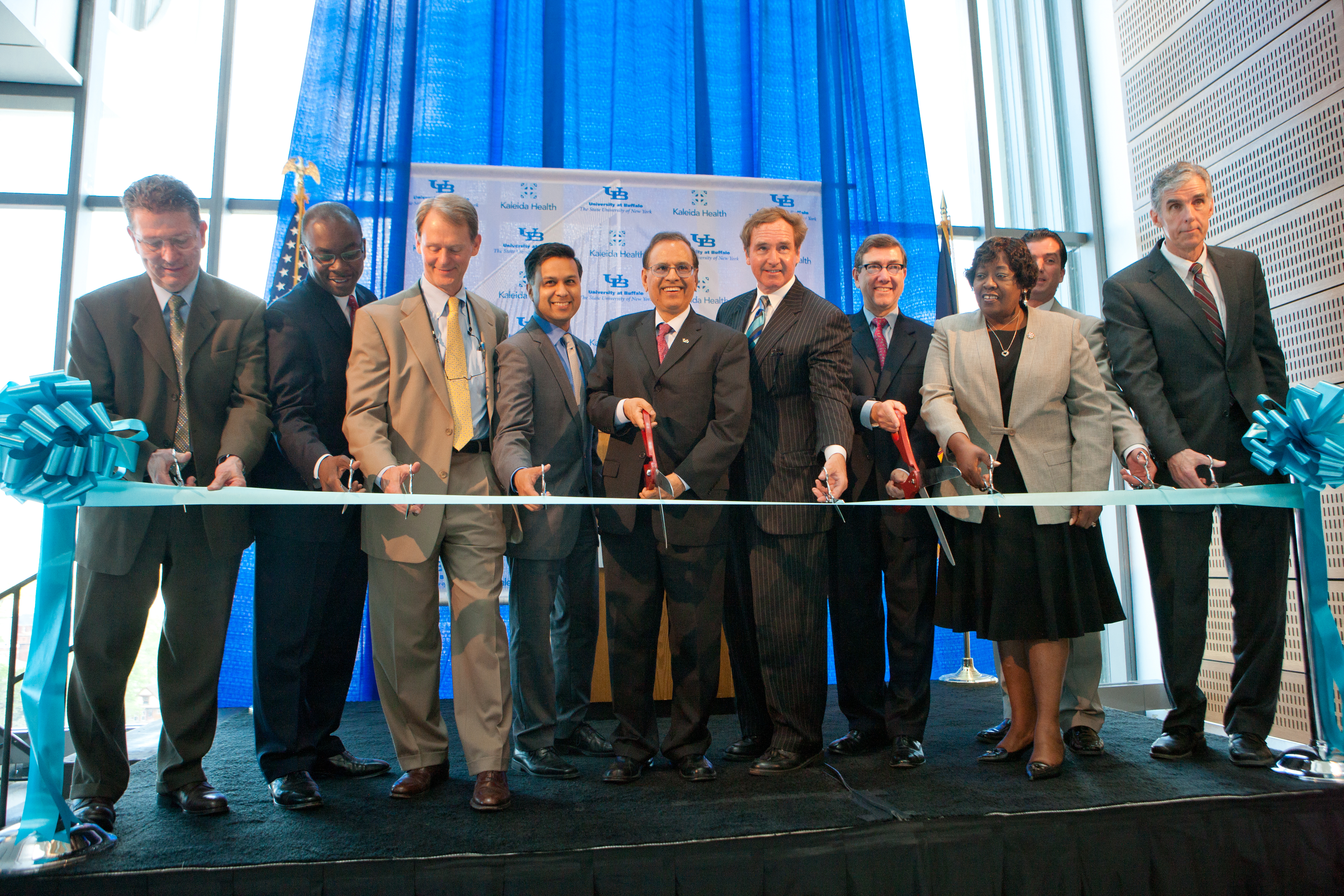
A grand opening ceremony and ribbon cutting was held today for the new Gates Vascular Institute (GVI) and the University at Buffalo's Clinical and Translational Research Center (CTRC).
The $291 million combined facility, located next to the Buffalo General Medical Center (BGMC), brings together Kaleida Health physicians and UB researchers in a collaborative effort to deliver state-of-the-art clinical care, produce major breakthroughs on the causes and treatment of a broad range of human disease and spin-off new biotechnology businesses and jobs.
"This physician-led plan is revolutionizing health care in our community," said James R. Kaskie, the president and CEO of Kaleida Health. "This is a historic achievement for our organization, for UB and most importantly, for all of Western New York. We have taken what we have, which is very good, and we are making it better for those we serve. In essence, we're building a healthier future through a collision of talent and knowledge; bringing the brightest medical minds together on behalf of the patients of Western New York."
UB President Satish K. Tripathi said the opening of the GVI/CTRC marks "the beginning of a very exciting new chapter for UB, Kaleida and our partners on the Buffalo Niagara Medical Campus."
He added, "More than that, it's the start of a new era for our Western New York community. Over the years, we've been working together to transform Buffalo into a major destination for world-class health care delivery and research. This is no longer just a vision of the far-off future—that vision is steadily becoming a reality, and this state-of-the-art joint facility is a vital element in this success."
Construction of the building also helps advance the UB 2020 strategic plan, which is focused, in part, on constructing a new home for the UB School of Medicine and Biomedical Sciences in downtown Buffalo advancing UB's strength in the biomedical sciences and other research fields and increasing the university's economic impact in Buffalo. Moving the UB medical school to downtown Buffalo would improve medical education for students and bring an estimated 1,200 UB faculty, staff and students downtown every day.
The Gates Vascular Institute features four floors that are dedicated to the surgical and interventional management of cardiac, vascular and neurological conditions, as well as a 16-bed highly specialized intensive care unit, and a 62-bed short-stay suite. The combined buildings of the Gates Vascular Institute and BGMC) house a brand new emergency department, a new helipad, 610 beds, 28 operating rooms, 17 interventional labs, four CT scanners and four MRIs.
"Quite simply we are delivering the health care of the future at the new Gates Vascular Institute," said L. Nelson Hopkins III, MD, the Chief of Service, Neurosurgery, Kaleida Health, Professor and Chairman of Neurosurgery, University at Buffalo and Chair, Gates Vascular Institute (GVI) Physician Board. "There's no place else that can match this … anywhere. We have the only center in Western New York that is completely comprehensive, has all of the latest technology, and the largest and best team of people."
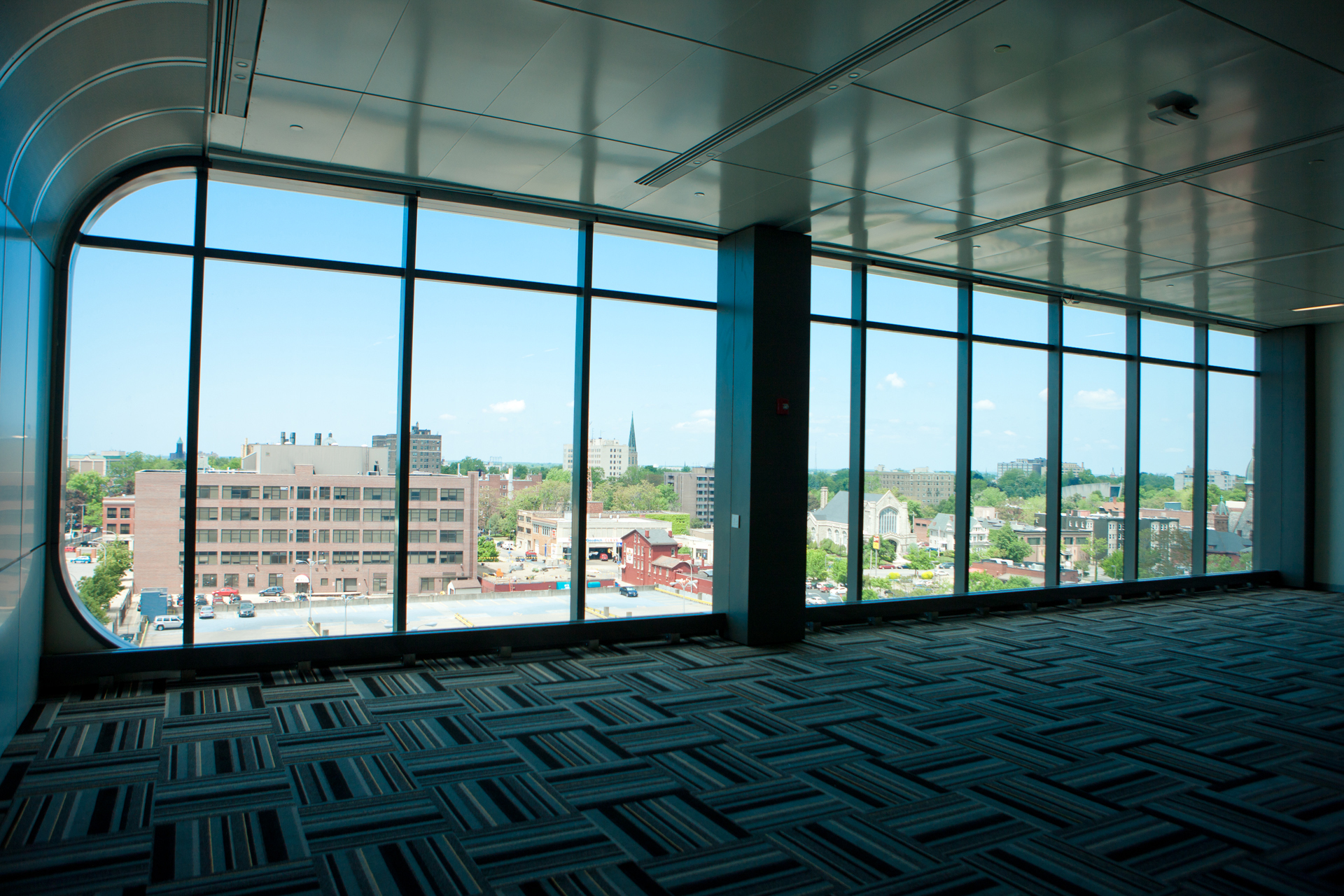
The University at Buffalo's CTRC will occupy the top four floors of the building. It will expand the university's focus on translating basic medical research into new treatments and technologies made available for patients. Research done here will help lead to medical breakthroughs, innovative treatments and new economic opportunities. The Jacobs Institute on the fifth floor is named in honor of the late Dr. Lawrence D. Jacobs, a world-renowned neurologist with ties to UB and Buffalo General.
Construction of the building, designed by Cannon Design, took approximately two years to complete. Turner Construction and LP Ciminelli served as contractors for the project.
The co-location of Kaleida Health physicians and UB researchers and faculty in the facility is expected to bring about advancements in care and treatment -- and development of new medical technologies -- that would not happen in isolation.
"On behalf of Governor Cuomo, I congratulate Kaleida Health and the University at Buffalo on the opening this transformational health care facility for Western New York," said New York State Health Commissioner Nirav R. Shah, MD, MPH. "Collaborations like this are truly the wave of the future. By bringing together world-class physicians and researchers, this facility will not only advance excellence in patient care, it will support leading-edge research that will reaffirm New York's reputation as a leader in innovation and discovery in health and health care."
In 2007, the Commission on Health Care Facilities in the 21st Century, also known as the "Berger Commission," ordered the closure of Millard Fillmore Gates Circle Hospital. In response, Kaleida Health decided to shift the hospital's cardiovascular and stroke-related services to a new facility on the Buffalo Niagara Medical Campus.
The new building advances the goals of the Berger Commission, which mandated Western New York organizations to significantly improve the quality and availability of health care by ending expensive duplication of services, filling gaps in our region's health care system, recruiting top-level researchers and physicians and providing state-of-the-art training to UB medical students.
Kaleida Health and UB officials say the new building will help transform Buffalo into a regional destination for excellence in health care, on par with medical research centers available in Cleveland and Pittsburgh. Moreover, the collaborative work being done in this building will play a major role in the continued growth of a life-sciences industry in Buffalo and the creation of a knowledge-based economy leading to the creation of thousands of new jobs in the region.
The Biosciences Incubator will provide laboratories and office space, and start-up services to companies spun off from UB medical discoveries.
The opening of the GVI and CTRC represents a wonderful accomplishment resulting from the partnership between UB and Kaleida Health," said, Timothy F. Murphy MD, Director, UB Clinical and Translational Research Center and SUNY Distinguished Professor of Medicine. "The CTRC is a state of the art translational research center that will allow us to perform research that will result in better ways to treat, diagnose and prevent disease. This building places cutting edge clinical and translational researchers adjacent to top notch clinicians in one only a handful of such facilities in the country."
Made possible by a unique partnership between UB, a public university, and Kaleida Health, a private entity, this partnership saved taxpayers $21 million through reduced construction costs and operational efficiencies.
Media Contact Information
Ellen Goldbaum
News Content Manager
Medicine
Tel: 716-645-4605
goldbaum@buffalo.edu