News & information from UB, New York's flagship university
MLK Speech in Buffalo 45 Years Ago is a Legacy for UB's Annual Commemoration Lecture
Release Date: February 6, 2012 This content is archived.


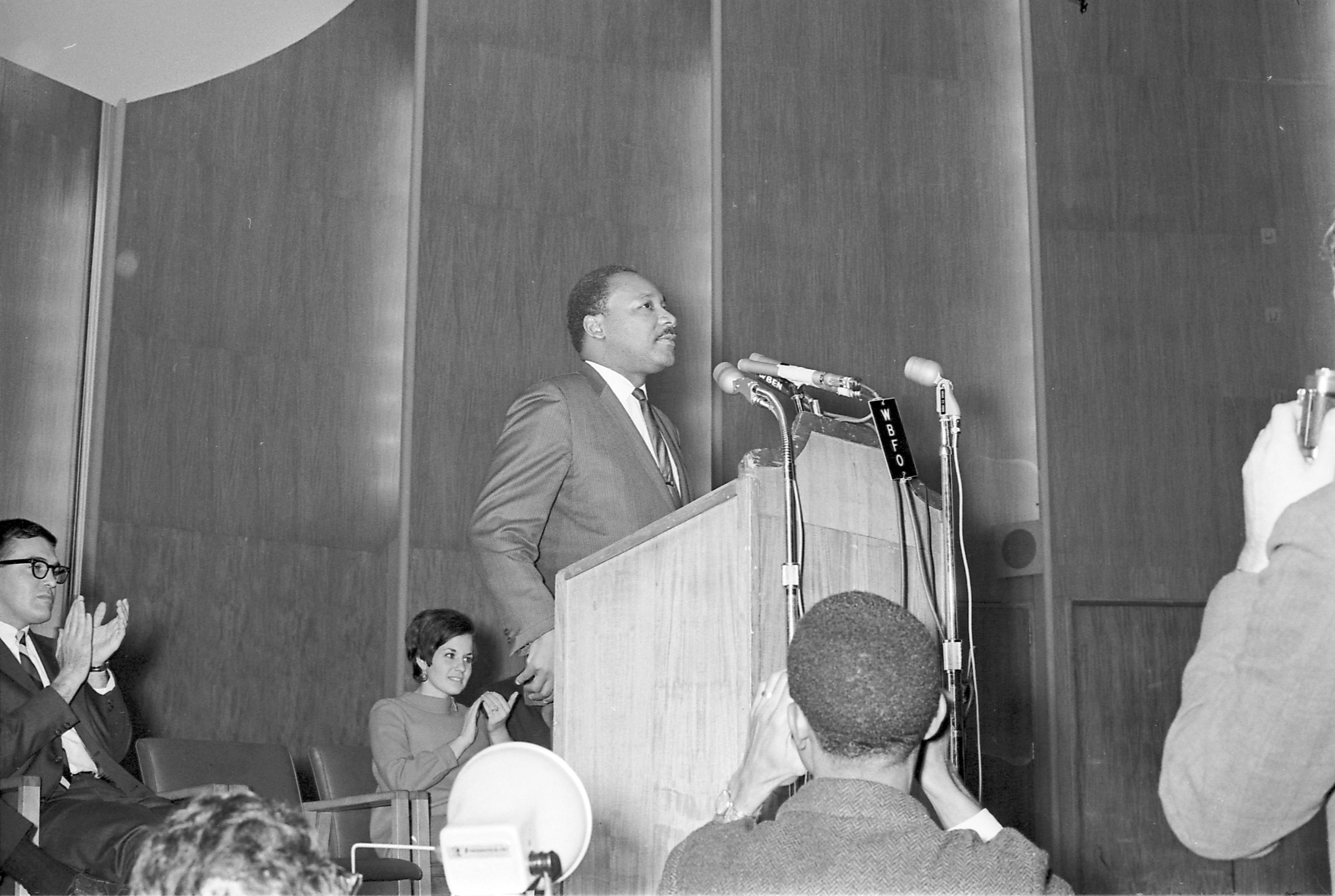
BUFFALO, N.Y. -- On Feb. 16, popular author and broadcast journalist Soledad O'Brien will deliver the University at Buffalo's 36th Annual Martin Luther King Jr. Commemoration Lecture at Buffalo's Kleinhans Music Hall. Her talk comes 45 years after King himself addressed an audience at Kleinhans at the invitation of the UB Graduate Student Association (GSA).
That address, on Nov. 9, 1967, five months before his assassination, was titled "The Future of Integration," and was presented before an audience of about 2,100 in Buffalo. King spoke extemporaneously that day, not only about the importance of education and voting to the black community, and to the racial violence then raking the country, but to a topic of great importance to his UB sponsors -- his opposition to the Vietnam War.
The UB Archives, which maintain the university's historical records, include a number of photos taken at Kleinhans that evening and an audio cassette of King's talk, as well as correspondence regarding plans for King's appearance, the formal invitation to King from the UB GSA, and press clippings from The Buffalo News, the Challenger and other press sources.
We celebrate King as a hero today, a secular saint. But there were 700 empty seats in Kleinhans that night, in part because his strong opposition to the war marked him as "radical" and "communist" in the parlance of the day. As a result, many in the community reviled him, whether they understood his position or not.
Joseph Nechasek, PhD, one of the UB GSA board members who hosted King's visit to Buffalo, recalls that, "A lot of Buffalo politicians and civic leaders declined to attend the talk. I don't remember an outpouring of support from the black community or from UB, either." In fact, leading black Baptist ministers did stay home, objecting to the contentiousness of King's position that America was more concerned with winning "an ill-considered and unjust war...than in winning the war against poverty at home."
In fact, King had publicly broken with the Johnson administration over its Vietnam policies in a now-famous April 4, 1967, speech to an audience of clergy at New York City's Riverside Church.
"I think the April 4 Riverside Church talk actually was his greatest speech," says John Marciano, EdD, the second host from the UB GSA executive board. Marciano was a founding member of the UB chapter of Students for a Democratic Society (SDS), one of the main icons of America's New Left. Since 1965, Marciano had been a strong opponent of the war. In fact, he had marched with King in an anti-war demonstration in New York City.
Nechasek, says, "King gave many significant talks throughout his career, but the speech in Buffalo wasn't a very powerful example. It wasn't a rousing, stand-up-and-cheer speech. I thought it was academic; less exciting than prior speeches.
"But King had an amazing ability to fit himself to the audience," Nechasek says. "He could preach in a church, give a major Washington speech, argue with LBJ, come to Buffalo and speak to students. So regardless of the size of the audience or the low-key nature of the speech, it was a very exciting time for us.
"King had no handlers, no personal security," says Nechasek, "although I think every black police officer in town was there to protect him.
"One reason we invited him," he recalls, "is because the core of the GSA were people who had grown up into an anti-war atmosphere and were well aware of King's position on Vietnam as well as on race, poverty and other significant social justice issues. We supported him completely."
Marciano agrees that the 1967 King was a much more radical figure than he previously had been.
"His turn to the left," Marciano points out, "caused him to be vilified by major publications -- The New York Times, Newsweek -- and by many national political leaders. We discussed this with him when he was here."
King's anti-war stance was prescient. After the Tet Offensive, only two months later, opposition to the Vietnam War would explode and the conflict eventually would be derailed, largely because of the populist uprising against it. King was assassinated in April of 1968, however, and would not live to see that.
Marciano says, "We were so excited to have him come here. We peppered him with questions and he answered all of them," he says. "I remember him as a quiet, thoughtful man who was gracious and patient. He was a very impressive person."
Former Buffalo Common Council President George K. Arthur, who met with the civil rights leader that day, said recently that King's anti-war position was persistent and consistent.
"If he were alive today," Arthur said, "he would be saying, 'Let's get the hell out of Afghanistan.'"
Another message King delivered on Nov. 9 is "the ballot is one of the keys to the door of freedom" and that that those who have no vote are powerless. Black voters, he said, should use their vote to move their agenda forward and get out of their economic trap.
And, as Arthur says, "Today there are more blacks in key political positions across the country because of the ballot and Dr. King's teachings."
King also spoke in Buffalo in defense of non-violence. Eight race riots had occurred in the U.S. between 1964 and 1967 and 11 more erupted in the summer of 1967, including one in Buffalo. While condemning the violence, King vigorously attacked conditions that provoked it.
"Violent revolts grow out of revolting living conditions," he said, "Violence is the language of the unheard." Summer riots, he said, are caused by "winters of delay" and underscored the point that "Negroes did not create" slavery, slums or unemployment. King questioned whether the nation would ever defeat poverty or save its cities.
After King's death came the deluge of civil rights court cases and physical battles -- 100 more race riots would erupt in mid-1968 -- as well as even more aggressive opposition to the war and a deeper realization of King's power as an icon of social justice.
One member of the Buffalo audience that night, longtime Western New York community activist Ruth Bryant, retired associate dean of the UB School of Architecture and Planning, says, "You could feel his power that evening, his greatness. He filled the room. He inspired us all." Certainly this was true, but King's death heralded his apotheosis.
He had already won the Nobel Peace Prize, but he received a post-mortem Presidential Medal of Freedom, the Margaret Sanger Award, even a 1972 Grammy Award (for his recorded speech "Why I Oppose the War in Vietnam") and hundreds of other honors over the ensuing years. His boyhood home became a national historic site, thousands of civic monuments bear his name and Martin Luther King Day is a national holiday, celebrated on a date near his Jan. 15 birthday.
In 1976, UB became part of that process when it inaugurated the Martin Luther King Jr. Commemoration Lecture with a talk by George Arthur. Speakers of national and international stature have followed: Nobel laureates Derek Walcott and Wangari Maathai, Danny Glover and Felix Justice, Morris Dees of the Southern Poverty Law Center, King's close friend Harry Belafonte Jr., Johnnie Cochran Jr., Tavis Smiley, Sidney Poitier, Newark Mayor Cory Booker, rapper KRS-ONE, Cornel West and many more distinguished jurists, authors, social activists, scholars, musicians and actors, as well as two of King's children, Rev. Bernice King and Martin Luther King III. And later this month, CNN correspondent Soledad O'Brien.
The UB series has insured that King's philosophy and message to his nation and the world remains alive in this community and is loudly and clearly applied to contemporary conditions and issues that affect us all, just as King's philosophy served as a call to action to many who heard him speak in Buffalo more than four decades ago.
John Marciano, now a professor emeritus at SUNY Cortland, for example, has spent four decades as a prominent political activist, author, teacher and scholar in the antiwar/social justice movement. He is the author of "Lessons of the Vietnam War" and is noted for teaching "The People's History of the United States," by his friend, the late historian and activist Howard Zinn.
Joe Nechasek, later a professor and dean of the College of Allied Health and Nursing at the University of Bridgeport, also has remained an advocate for social justice, addressing in particular, racial and ethnic barriers in health care systems.
Ruth Bryant, who was in her 20s in 1967, later became president of the UB Minority Staff Association, and the first person of color to staff the UB Professional Staff Senate. She was a founding member of the National Coalition of 100 Black Women and for decades has been a highly respected and deeply committed community and political activist on many fronts in Buffalo and Western New York.
Media Contact Information
Patricia Donovan has retired from University Communications. To contact UB's media relations staff, call 716-645-6969 or visit our list of current university media contacts. Sorry for the inconvenience.