News & information from UB, New York's flagship university
Concussed Triathlete Back to Winning Races with Help of New Treatment Protocol
By Brian Peters
Release Date: December 8, 2011 This content is archived.


BUFFALO, N.Y. -- Former Olympian Jarrod Shoemaker was in the middle of the swimming portion of a triathlon in Hamburg, Germany, when the swimmer in front of him accidentally kicked him in the face. Shoemaker finished the race, but could tell something was wrong with how his body was working. Three weeks later, he crashed hard from his bike onto wet pavement during a race in London, adding to his list of injuries.
"Upon returning home I knew that something was wrong besides me just feeling lethargic, apathetic and generally off," says Shoemaker, a resident of Sudbury, Mass. "I wanted to make sure that there were no long-term problems, especially in a sport like triathlon, where perception and balance are key.
"My coach and I did some reading online about sports concussions and returning from them, and one of the names that we saw over and over was Dr. John Leddy. We did some research on Dr. Leddy and found that he was at the University at Buffalo. Coincidentally, we were headed to Buffalo for U.S. Nationals in two days. It was an amazing piece of fate for me."
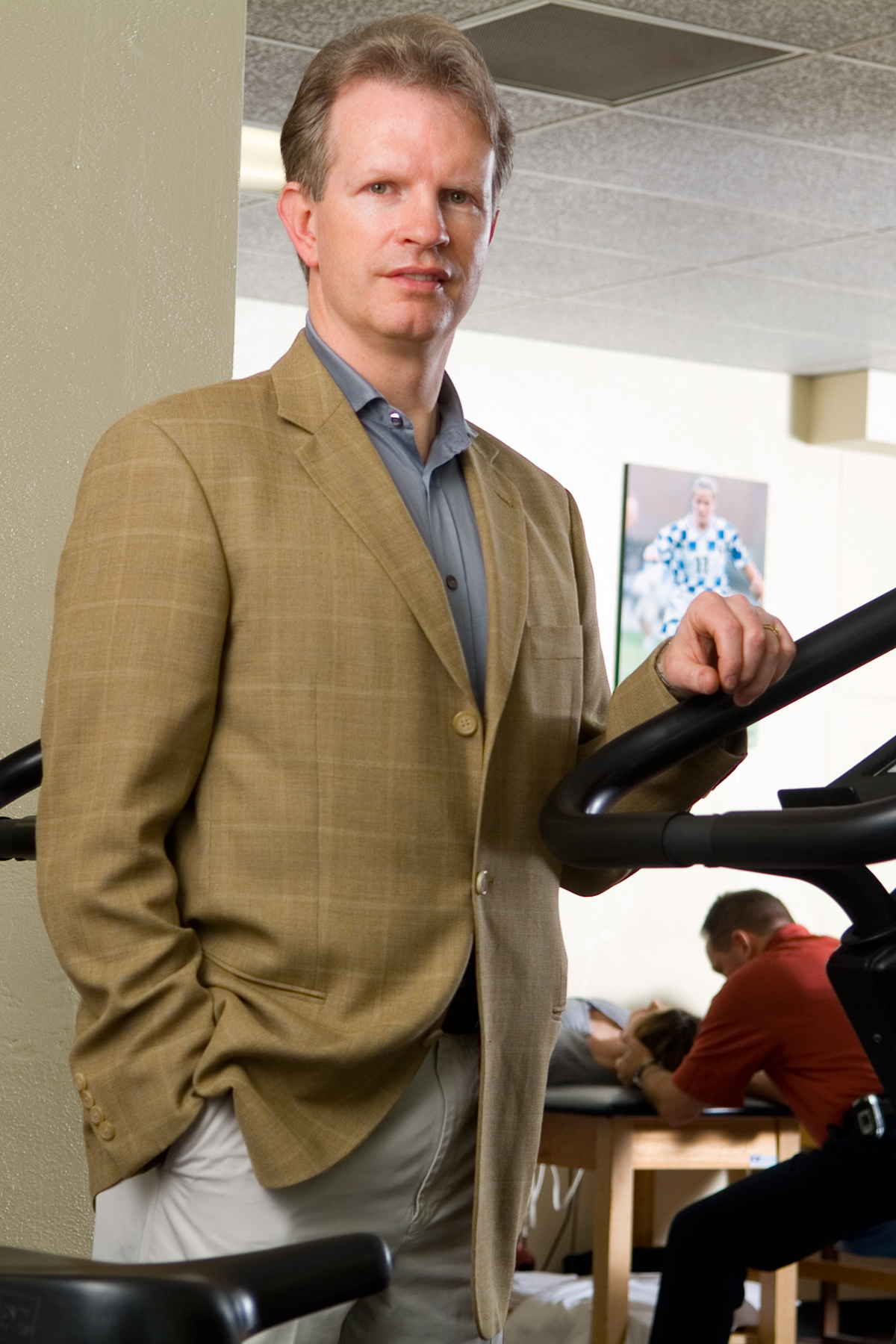
John Leddy, MD, internist, medical orthopedist and associate director of UB's Sports Medicine Institute, met with Shoemaker at the UB institute's Concussion Management Clinic to perform a series of tests to discover just how much damage had been done.
One such test involved Shoemaker choosing a target in the room, then shutting his eyes and moving his head, and then attempting to hit the target with a laser pointer while his eyes were still closed. This test measures how well a patient is able to tell where his or her head is facing, which is a sensation controlled by the neck.
"Jarrod could not run fast because his neck injury was aggravated by his posture and by the forces incurred during running," Leddy says. "Upper neck injuries can produce the same symptoms as a concussion, which is a brain injury."
Some of these symptoms include poor balance, poor sleep, personality change, nausea and headache, all of which are indicative of how the brain is affected by the injury.
"The brain is a unique organ," adds Leddy. "You only have one, and you need it for almost everything else."
After meeting with Shoemaker, discussing his symptoms and putting together the timeline of his injuries, Leddy concluded that Shoemaker's concussion occurred when he was kicked in the face, and probably was made worse by his crash to the pavement. "Until this time, I had not even thought about these two events as being related," Shoemaker says. "We came to the realization that the concussion and an upper cervical strain were causing me to have both physical and mental problems. I had never had a concussion before, but it was really interesting seeing how a concussion can really affect everything."
According to Leddy, athletes who suffer repeated concussions, who do not recover properly, then continue to play with symptoms, are at risk for having permanent brain damage complicated by premature cognitive and emotional dysfunction that affects their lives and their families.
"This can lead to premature death," Leddy explains. "There is no such thing as a minor concussion. All concussions are significant and must be treated appropriately by physicians familiar with concussion assessment and treatment. With such treatment, most athletes will recover, and be able to return to play safely."
UB's Concussion Management Clinic opened in 2007 and serves roughly 150 patients a year, including professional and amateur athletes and people injured at work, home or in car accidents.
When concussion is diagnosed, some patients, like Shoemaker, receive a standardized and scientifically validated exercise treadmill test to determine their degree of recovery from the concussion. Those with prolonged symptoms are prescribed an individualized exercise rehabilitation program based upon the results of the treadmill test.
Leddy and colleagues were the first to use the Balke treadmill protocol, a test usually used for cardiac stress testing, to help physicians determine whether an athlete is ready to return to play.
During the test, the incline of the treadmill is increased by a specific rate every minute. The athlete exercises until the point at which his or her concussion symptoms (headache, for example) become more severe.
"We feel that the best method of determining when athletes are physiologically ready to go back and play sports to maximum intensity is the treadmill test, because the exercise test replicates the physiology of what athletes have to do during sport," Leddy says.
Based on the UB research, team physicians from around the country are beginning to change the way they manage athletes who have suffered a concussion.
"Dr. Leddy said that I could continue to train, but had to be very careful with how much running I did because of the pounding on my neck," Shoemaker says.
"For me, taking the time out to finally figure out why my body was feeling so 'off' helped me make a big change in the last few races of my season," he adds. "I raced in Buffalo two days after Dr. Leddy and I met, and I was careful while running, but could feel my body protecting my neck and head. I raced again two weeks later and my body was feeling a lot more like normal. I actually ended up winning the race and winning the U.S. Elite Series."
The University at Buffalo is a premier research-intensive public university, a flagship institution in the State University of New York system and its largest and most comprehensive campus. UB's more than 28,000 students pursue their academic interests through more than 300 undergraduate, graduate and professional degree programs. Founded in 1846, the University at Buffalo is a member of the Association of American Universities.