News & information from UB, New York's flagship university
New Drug Target for Alzheimer's, Stroke Is Discovered by UB Scientists
Release Date: October 11, 2011 This content is archived.


Summary:
-- The NMDA brain receptor, critical to learning and memory, functions just the opposite of the way it was assumed to work.
-- The newly discovered site on the receptor is a promising new drug target for Alzheimer's and stroke.
-- This target presents new opportunities for rationally designing a very specific drug, reducing the potential for side effects.
BUFFALO, N.Y. -- A tiny piece of a critical receptor that fuels the brain and without which sentient beings cannot live has been discovered by University at Buffalo scientists as a promising new drug target for Alzheimer's and other neurodegenerative diseases.
The research on the NMDA (N-methyl-D-aspartate) receptor was published online Oct. 11 in Nature Communications.
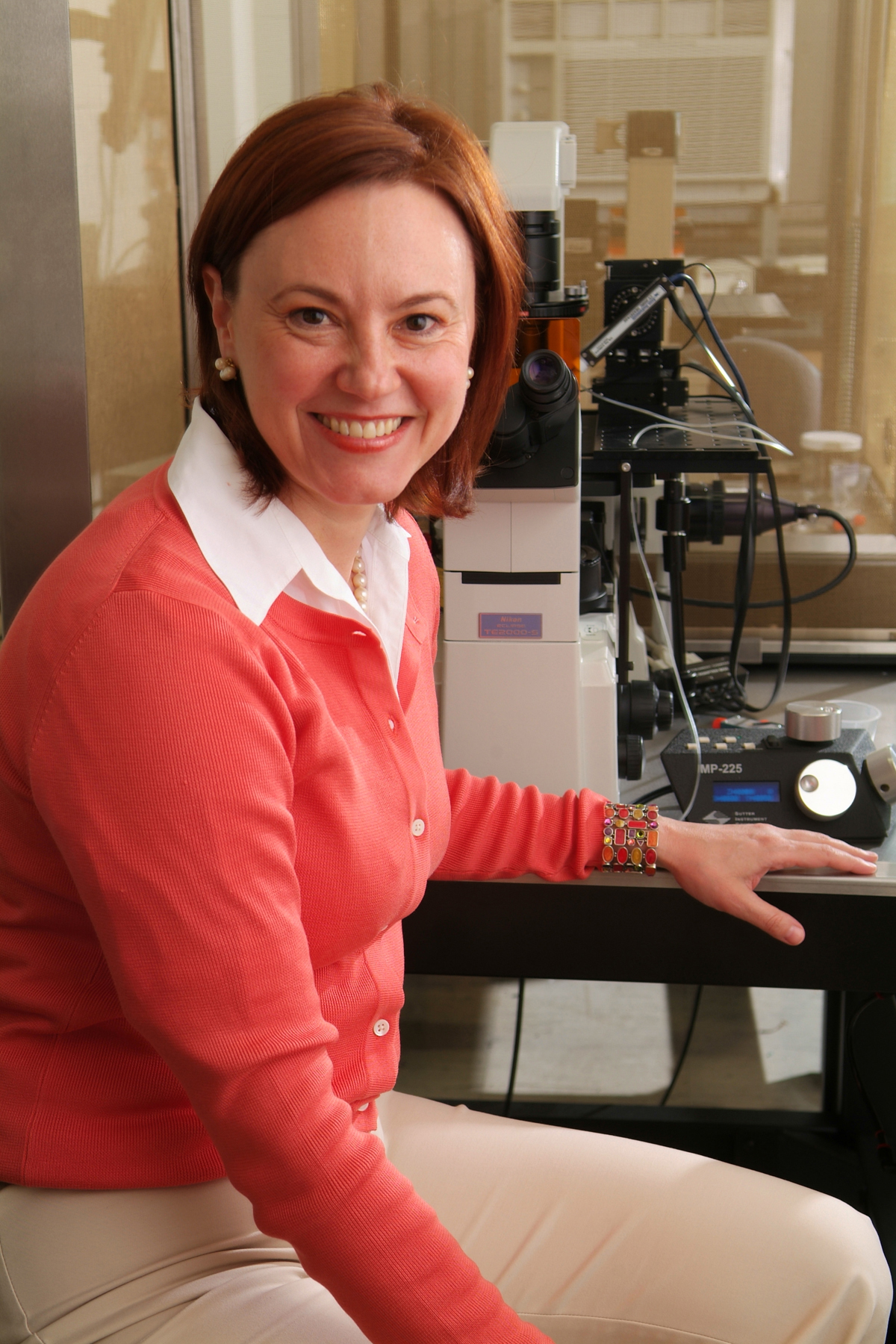
"This is the first time that this site has been shown to be useful as a drug target," says Gabriela K. Popescu, PhD, associate professor of biochemistry in UB's School of Medicine and Biomedical Sciences and senior author on the study.
"If we could find a drug that attaches itself to this site and locks together NMDA receptor subunits, that would be huge for fighting disability from stroke and Alzheimer's and other neurodegenerative diseases."
The research focuses on the brain's receptors for the neurotransmitter, glutamate, which is implicated in these diseases as well as in other conditions, such as glaucoma.
The two main glutamate receptors in the brain are NMDA and AMPA receptors, both of which play critical roles in human learning and memory. Both types of receptors are made of four subunits and within each receptor these subunits are organized in pairs called dimers.
Because these receptors are so similar in structure, Popescu explains, it was assumed that they function in much the same way.
"But when we altered the dimer interface, the site where two subunits come together within each pair, we found that the NMDA receptor works just the opposite of the way that the AMPA receptor works," Popescu explains. "Cementing this interface in AMPA receptors leads to more activity, whereas we found just the opposite to be true in NMDA receptors."
By locking the subunits together, the UB researchers were able to achieve a marked reduction in NMDA activity and, subsequently, a marked reduction in the amount of calcium that enters neurons in response to the neurotransmitter glutamate. Calcium overload due to overactive NMDA receptors is what eventually kills off neurons, Popescu explains, leading to the symptoms that occur after a stroke, and in Alzheimer's and other neurodegenerative diseases.
"The fact that by cross-linking the subunits, we could so dramatically reduce NMDA receptor activation demonstrates, for the first time, the tantalizing possibility that we may be able to develop new therapies that can much more effectively treat, or even one day prevent, some of these devastating diseases, like Alzheimer's and stroke," says Popescu.
And, because each type of NMDA receptor has a slightly different dimer interface, Popescu explains, this finding represents a new opportunity for rationally designing drugs that would preferentially inhibit only a select population of NMDA receptors in the brain, thus reducing the possibility of side effects.
Currently, the Alzheimer's drug called Namenda, one of the only existing pharmaceuticals that inhibit the NMDA receptor, targets a different site within the receptor.
"If a new drug could be developed to target the dimer interface, which we discovered to be inhibitory, it would allow more specific effects than current drugs," explains Popescu. "That's because at this particular interface, the interactions between these subunit interfaces are more precise than those currently being targeted."
Co-authors on the paper are: William F. Borschel and Swetha E. Murthy, both of whom are doctoral candidates in the UB Department of Biochemistry, and Eileen M. Kasperek, senior technician in the department.
Funding for the work was provided by the NIH National Institute of Neurological Disorders and Stroke.
The University at Buffalo is a premier research-intensive public university, a flagship institution in the State University of New York system and its largest and most comprehensive campus. UB's more than 28,000 students pursue their academic interests through more than 300 undergraduate, graduate and professional degree programs. Founded in 1846, the University at Buffalo is a member of the Association of American Universities.
Related story: Study Focuses on Brain Receptor Involved in Cognitive Disorders http://www.buffalo.edu/news/8101
Media Contact Information
Ellen Goldbaum
News Content Manager
Medicine
Tel: 716-645-4605
goldbaum@buffalo.edu