News & information from UB, New York's flagship university
UB Architects Exhibit Low-cost, Low-tech Design Solutions at International Festival
They carve warm, bright, attractive workspaces out of huge, uninsulated rooms
Release Date: July 13, 2011 This content is archived.


BUFFALO, N.Y. -- Two University at Buffalo architects presented a unique solution to the uncomfortably chilly temperatures of an old stone building in England as part of the sixth annual International Architecture Festival, Eme3, held July 1-3 in Barcelona.
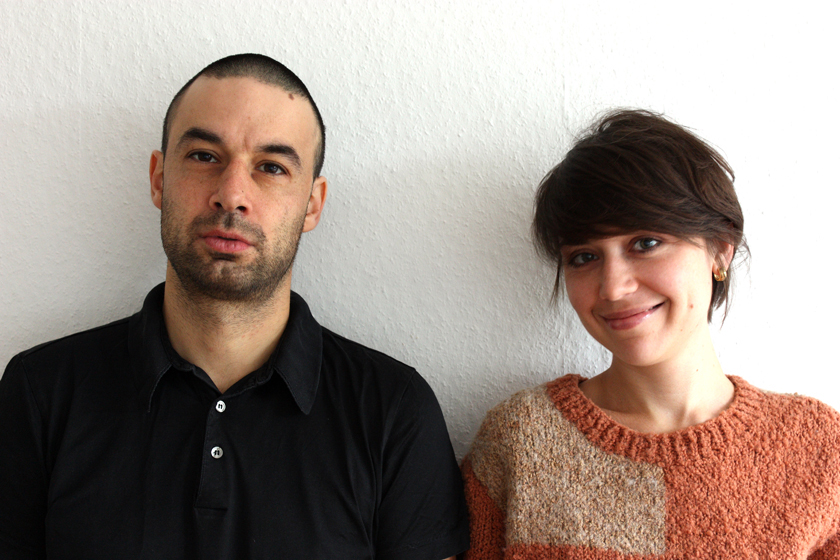
Georg Rafailidis, assistant professor of architecture, and Stephanie Davidson, clinical assistant professor of architecture, in the UB School of Architecture and Planning, were among a select group of professionals invited to participate in the festival, presenting "Selective Insulation," a project in which they culled intimate and comfortable microclimates from the vast, cold rooms of a 162-year-old building in Hexham, England.
The Hexham building is a masonry structure that now serves as an artists' facility. It is not insulated, and ordinarily would require intensive heating much of the year to maintain temperatures warm enough for its occupants.
A conventional approach to improving its thermal efficiency would have been to line the inside of the stone walls with a new layer of insulation, a measure that would result in a loss of all thermal mass in the stone but would create an equally distributed warm zone inside the building.
Davidson and Rafailidis, however, called for a more strategic approach to the problem. Rather than insulate and heat either the whole building or its individual rooms, the architects used selective insulation to define small areas in the structure that can be warmed easily during the cold months of the year and used as studio spaces.
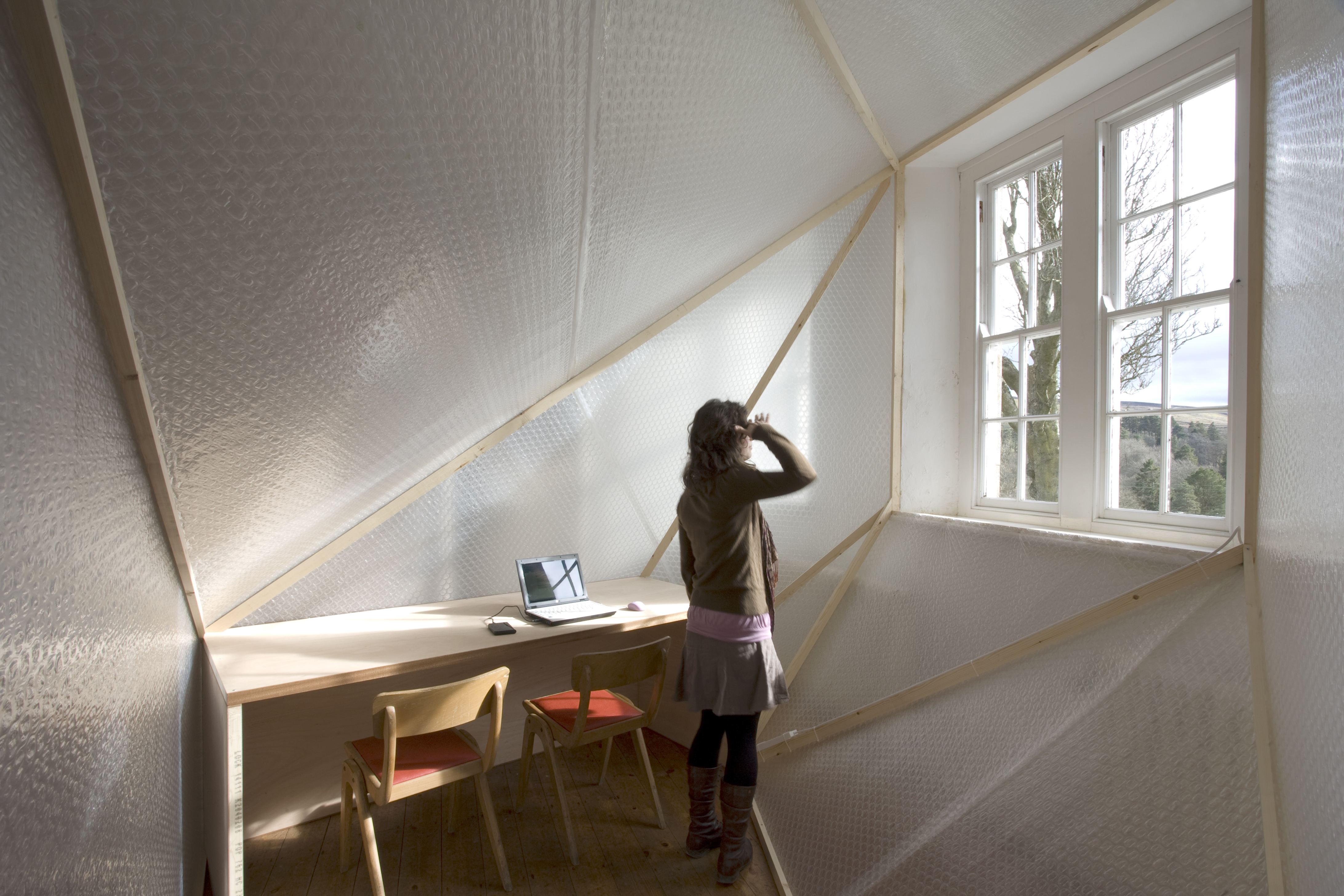
They employed simple wooden frames covered with two-ply bubble wrap (normally used to insulate greenhouses) to construct small, naturally lit and attractive sealed pockets of warmth within which artists can work.
The size and shape of the spaces are determined by the area needed for a particular work activity. One space, for instance, is defined by a desk for two people, a door and a window. The wooden frame and bubble wrap enclose an insulated working space for two people that is ample and pleasant.
The Eme3 festival, a market for avant-garde architecture, was founded in 1999 by the cultural association adn. This year, the festival addressed, among other topics, the contradictions between sustainable development and "greenwashing," the deceptive use of pro-green public relations or green marketing to promote a misleading perception that a company's policies or products are environmentally friendly.
Robert Shibley, dean of the UB School of Architecture and Planning, says, "These two faculty members are making a significant and artful contribution to the global discussion on sustainability, and make an important contribution to our faculty depth in this subject. Their participation in this festival recognizes the international interest their work is generating."
He points out that the festival is one that emphasizes architectural innovation marked by sustainability, space research, urban integration and the structure and technology of materials. It also presents challenging points of view on the relationship between architecture and society.
In addition to presenting an exhibition and lecture on their work, Davidson and Rafailidis participated in a panel discussion of greenwashing, an area of great professional interest to them.
They are principles of the Berlin architectural firm Davidson Rafailidis, where they developed a "Touchy Feely" branch that offers a platform for haptic design in architecture. Haptic technology is a tactile feedback technology that takes advantage of a user's sense of touch by applying a variety of possible forces, such as vibrations, cold, heat and texture.
The firm's Touchy Feely projects include "Trigger Points," rounded plastic molding forms that they say "can be integrated into a wall surface to create a gentle threshold between body and building and perform the necessary work of massage therapists when "users" move their backs against them.
"Public Heat," another of their haptic designs, was a public-service art installation in Milwawkee that featured warm patches on the surfaces of a publicly accessible façades that allowed people to "lean, snuggle and warm themselves during the chilly months of fall and winter."
A third example is "Urban Cushions," which used industrial processes and materials to find ways of integrating impressions made by human bodies into public furniture.
The University at Buffalo is a premier research-intensive public university, a flagship institution in the State University of New York system and its largest and most comprehensive campus. UB's more than 28,000 students pursue their academic interests through more than 300 undergraduate, graduate and professional degree programs. Founded in 1846, the University at Buffalo is a member of the Association of American Universities.
Media Contact Information
Patricia Donovan has retired from University Communications. To contact UB's media relations staff, call 716-645-6969 or visit our list of current university media contacts. Sorry for the inconvenience.