News & information from UB, New York's flagship university
UB Geographers Help Map Devastation in Haiti
Release Date: February 8, 2010 This content is archived.


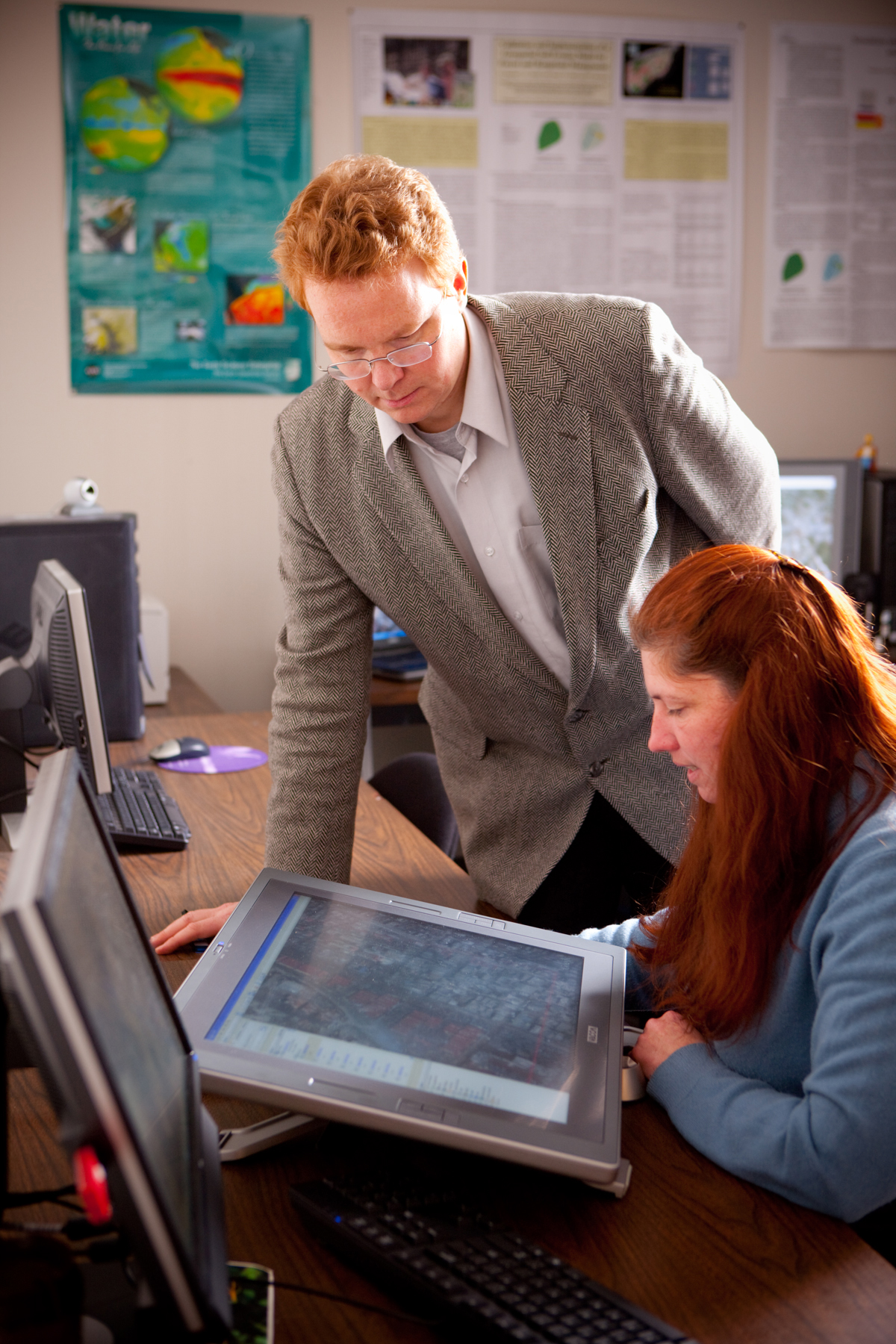
BUFFALO, N.Y. -- In the wake of the earthquake in Haiti, University at Buffalo geography students are participating in a global effort to enhance the international response and recovery effort by helping to assess damage, using images hosted by Google Earth and the Virtual Disaster Viewer, which shares imagery of disasters from various sources.
Eight graduate and undergraduate students are conducting the research, under the direction of Chris Renschler, UB associate professor of geography, in his Landscape-based Environmental Systems Analysis and Modeling Laboratory (LESAM) in UB's Department of Geography in the College of Arts and Sciences.
A research scientist with the National Center for Geographic Information and Analysis at UB, Renschler also is a member of the Remote Sensing Task Force of the Multidisciplinary Center for Earthquake Engineering Research (MCEER), headquartered at UB, to conduct research on the resilience of communities to extreme events, that is, how well they can recover after a disaster.
"During the days and weeks since the Haitian earthquake, UB students and researchers have been part of an effort organized by ImageCat Inc., an MCEER affiliate, involving more than 500 individuals from 100 organizations around the world, representing academia, government agencies, non-profit organizations and private industry, all of whom are working to classify the damage in Haiti," says Renschler.
As a result, he says, by Jan. 25, more than 10,000 buildings had been identified as having been either totally destroyed or heavily damaged.
Renschler and his students used the European Macroseismic Scale to classify images according to the amount of damage seen in them.
Those images, some of which were gathered by the Wildfire Airborne Sensing Program developed by Rochester Institute of Technology, are now being made available to the international emergency response community through the Virtual Disaster Viewer, an Internet-based graphical user interface developed by ImageCat Inc., a California-based advanced technology company that is an industry partner in two LESAM research projects.
According to ImageCat, World Bank representatives in the field and at its headquarters, have been using these images as soon as they became available on Google Earth shortly after the earthquake.
"The initial satellite-based damage assessments, along with the more detailed aerial data, are together helping to provide a detailed picture of damage assessment to help create a picture of reconstruction and recovery needs and to inform the World Bank response," says Beverley Adams, managing director at ImageCat Inc.
The classification effort is helping the international community to better understand the scale of the disaster in Haiti and how best to begin recovery and reconstruction, Renschler says.
"This extreme event occurred in one of the least resilient communities in the hemisphere with such enormous force that it is likely to emerge as the most tragic disaster since the 2004 Indian Ocean tsunami," says Renschler. "As active collaborators in the extreme events community, we knew we had critical capabilities that could provide enormous short- and long-term benefits to the emergency response in Haiti, as well as to the country's ongoing recovery and reconstruction effort."
In a related effort, Renschler and his MCEER colleagues, David Parisi, senior systems analyst, and Jane Stoyle Welch, publications manager, helped provide high resolution remote sensing and topographic imagery of a World Bank-ImageCat-RIT reconnaissance mission arranged by the Information Products Laboratory for Emergency Response. IPLER is a National Science Foundation-funded partnership between UB and RIT, dedicated to innovation in disaster management.
The UB-RIT researchers coordinated the transfer of hundreds of recently gathered high-resolution images and topographical data of the areas affected by the earthquake from RIT to MCEER's Virtual Disaster Viewer at http://vdv.mceer.buffalo.edu.
"This has been a huge team effort between RIT, UB and a host of collaborators," says Jan van Aardt, associate professor of imaging science and director of the Laboratory for Imaging Algorithms and Systems at RIT. "If it had not been for this close-knit collaboration between the various teams, we never would have pulled this off," van Aardt adds.
Currently, Renschler is working with colleagues at MCEER on research funded by the U.S. National Oceanic and Atmospheric Administration to develop a community resilience index for communities along the U.S. Gulf Coast that were severely impacted by Hurricanes Rita and Katrina. The index will be based on survey data, publicly available resources and GIS and environmental models.
UB graduate students in the Department of Geography who participated in assessing damage seen in Google Earth images of Port-au-Prince are: Emmanuelle M. Ameroso, Jorge V. Bajo, Heather A. Collins, Amy E. Frazier, Sue Roussie, Jiue-an Jay Yang and Yan Yang. Ryan Mendieta, a UB undergraduate majoring in geography, also participated in the research.
The work that Renschler and others at UB are doing on the earthquake in Haiti reflects UB's strategic strength in mitigation and response to extreme events that has been identified in the UB 2020 strategic plan being implemented by the university with the goal of rising among the ranks of the nation's public research universities.
The University at Buffalo is a premier research-intensive public university, a flagship institution in the State University of New York system and its largest and most comprehensive campus. UB's more than 28,000 students pursue their academic interests through more than 300 undergraduate, graduate and professional degree programs. Founded in 1846, the University at Buffalo is a member of the Association of American Universities.
Media Contact Information
Ellen Goldbaum
News Content Manager
Medicine
Tel: 716-645-4605
goldbaum@buffalo.edu