News & information from UB, New York's flagship university
Behavioral identification can help stop terrorists like Abdul Mutallab, researcher says
Ignoring behavioral techniques puts us in peril
Release Date: January 6, 2010 This content is archived.


BUFFALO, N.Y. -- The effective use of multiple layers of intelligence gathering, including existing behavioral identification programs, could have excluded the murderous Farouk Abdul Mutallab from travel before he got anywhere near Northwest Flight 253.
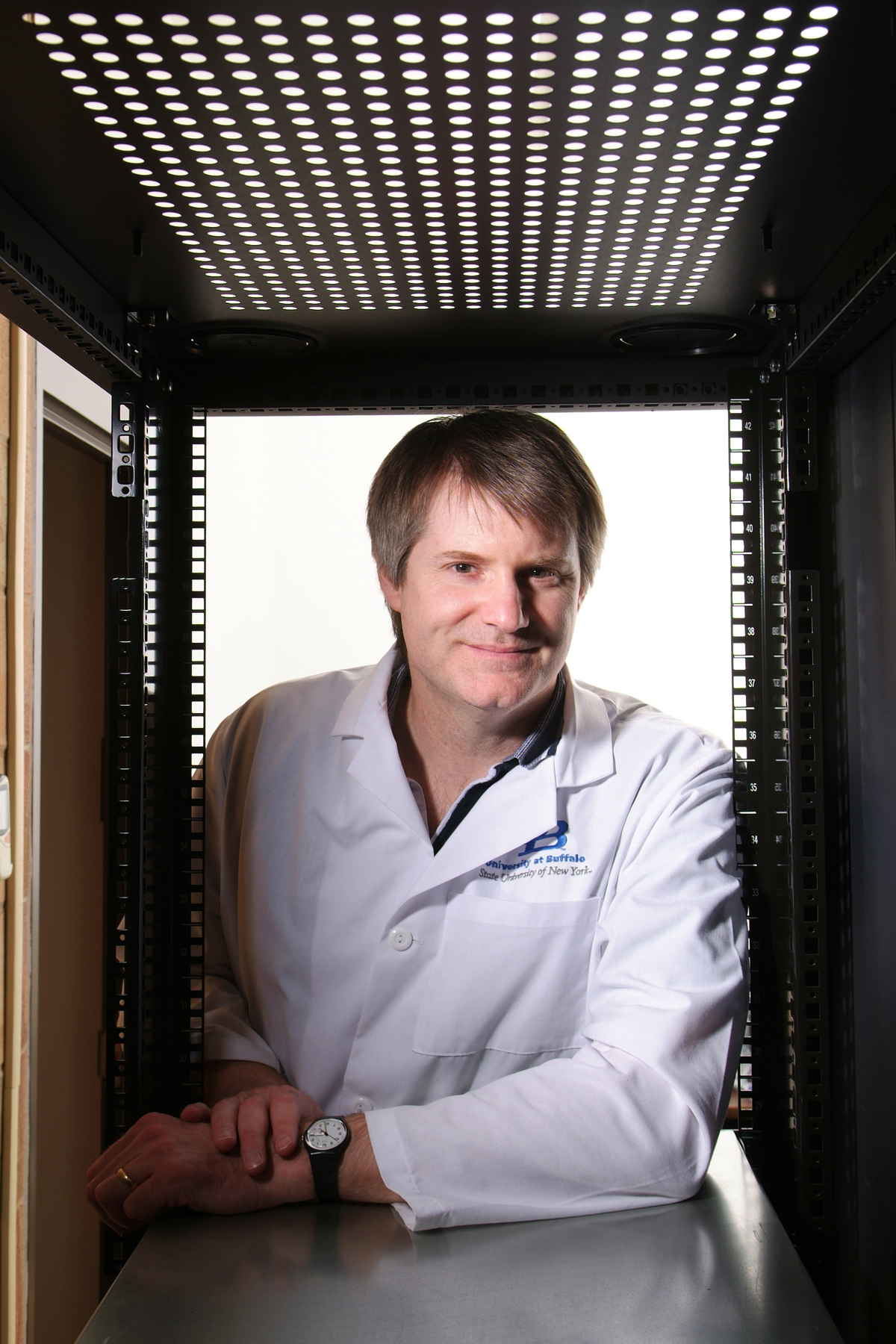
So says University at Buffalo behavioral scientist and security researcher Mark G. Frank, PhD, who explains, that although Mutallab got through some security levels, "Behavioral science techniques could have detected him once he got to the airport."
Frank says, "There have been many scientific advances in technology coupled with understanding such people and their behavior -- and programs exist that put that into action -- to help identify them. Unfortunately, they are not being used widely enough."
Frank, who has advised on behavioral identification programs with the Department of Homeland Security, agrees with security experts who maintain that security is best achieved in a layered approach to the examination of would-be airline passengers.
"No single security technique, on its own, is a panacea, although that would be great," Frank says. "But no technique need be 100 percent accurate to be deployed effectively. Each imperfect layer complements the next because the goals of security screening are actually more modest than people assume.
"The goals are, first, to employ intelligence and investigatory processes to dissuade or disrupt a would-be terrorist from traveling at all," he says.
If a terrorist suspect gets through the first layer of security and travels anyway, Frank says, then the goal is to force him or her into a group marked for intense secondary screening.
"At this point," Frank says, "there exist excellent scientific techniques to spot such suspects, and they don't employ ethnic screening or the random screening of passengers, processes that are not effective and to which Americans object.
"We ignore these scientific techniques at our peril," he says.
Frank points out that multiple layers of security each have strengths and weaknesses, and any layer is able under some circumstances to identify a terrorist, "So it is necessary to put resources into each layer."
One such layer uses effective behavioral techniques, and includes the Department of Homeland Security's SPOT and FAST programs.
"Both of these are observational systems with strong scientific foundations that are effective in identifying suspicious behaviors and strongly increase the odds that a would-be terrorist would be forced into yet another level of scrutiny."
Frank, an original member of the FBI's Terrorism Research and Analysis Project (TRAP), which combines academic researchers with counter-terrorism professionals, serves as a consultant to the Department of Homeland Security for the SPOT and FAST programs.
"SPOT (Screening of Passengers by Observation Technique)," he says, "is a behavioral observation technique employed by Transportation Security Administration. It is based upon a successful Israeli program derived from that country's direct experiences with terrorists and current behavioral science.
"FAST -- an acronym for Future Attribute Screening Technology -- is a sensor-based program currently in development that reads body reactions indicative of hostile intention and uses these to develop stronger algorithmic predictions as to whom should be sent on to additional screening.
"Both programs should be applauded for seeking the strong, direct involvement of scientists and both have benefited accordingly. Appropriately utilized, I believe they would have permitted us to spot the Northwest Airlines terrorist," he says.
"The immutable fact is that any effective international terrorist security system must address myriad psychological, social and political issues," Frank says.
"The cause of terrorism and its cures are very complex and require a multi-layered and multi-pronged approach," he says, "but I want to emphasize that we already have many of the technologies and techniques -- with more to come -- vetted by scientific research, to better identify and stop these people all along the way."
Frank is an associate professor of communication at UB, where he serves on the advisory board of the Center for Unified Biometrics and Sensors. He has published research in nonverbal communication and deception, and has worked with many government agencies on interviewing and deception detection through research and training. His research has been funded by the Department of Homeland Security, Department of Defense and the National Science Foundation and he has consulted with, advised or trained members of law enforcement, security and judicial agencies throughout the world.
The University at Buffalo is a premier research-intensive public university, a flagship institution in the State University of New York system and its largest and most comprehensive campus. UB's more than 28,000 students pursue their academic interests through more than 300 undergraduate, graduate and professional degree programs. Founded in 1846, the University at Buffalo is a member of the Association of American Universities.
Media Contact Information
Patricia Donovan has retired from University Communications. To contact UB's media relations staff, call 716-645-6969 or visit our list of current university media contacts. Sorry for the inconvenience.