News & information from UB, New York's flagship university
Law School Report Urges State Plan to Harness Offshore Wind Power
Wind turbines in lakes Erie and Ontario would create renewable energy, new jobs
Release Date: May 16, 2008 This content is archived.


BUFFALO, N.Y. -- New York State should take advantage of a golden opportunity to become a leader in developing clean, renewable offshore wind power, an alternative energy source that could trigger an economic renaissance and a greener image for the Western New York community, according to a report by a University at Buffalo Law School clinic.
The report, prepared by the Environment and Development Clinic in the UB Law School, proposes a strategy that would capitalize on what its co-authors call "enormous" potential to harness offshore wind power.
The report outlines a blueprint for developing clean, renewable wind power from turbines located in Lake Erie and Lake Ontario in a prudent, efficient way that would benefit the public and individual communities. The strategy would create a demand for wind-power energy, as well as large-scale manufacturing of wind power turbines and components in Western New York.
"New York's Great Lakes offer the potential for clean, renewable energy, as well as an opportunity to develop a new industry for the 21st century," says Robert S. Berger, UB Law School professor and director of its Environment and Development Clinic.
"Western New York's proximity to the Great Lakes," the report states, "provides an opportunity to again become a leader in the generation of clean, renewable energy as an engine for regional economic development and to leverage the region's technology and manufacturing infrastructure to further an economic renaissance centered on alternative energy and a reputation as a clean, livable community."
Berger said the opportunity and interest to build these wind turbines in lakes Erie and Ontario already exist, and stressed others will take advantage of that opportunity whether New York develops a coordinated plan or not. But his report suggests a comprehensive strategy in which New York can systematically determine how and where to put wind turbines in Lake Erie and Lake Ontario for the greater good of the community and its residents.
"Rather than have the uncoordinated process where private developers just try to place them in whatever way they decide," Berger says, "we're advocating a coordinated, comprehensive process that will allow all interested groups -- citizens, environmental groups, fishermen -- to come together to develop the best environmental and civic plan."
The report, released today, does not recommend how many or where the wind turbines should be built. Instead it points out the vast energy potential of an industry just beginning to have an impact on the state's energy needs.
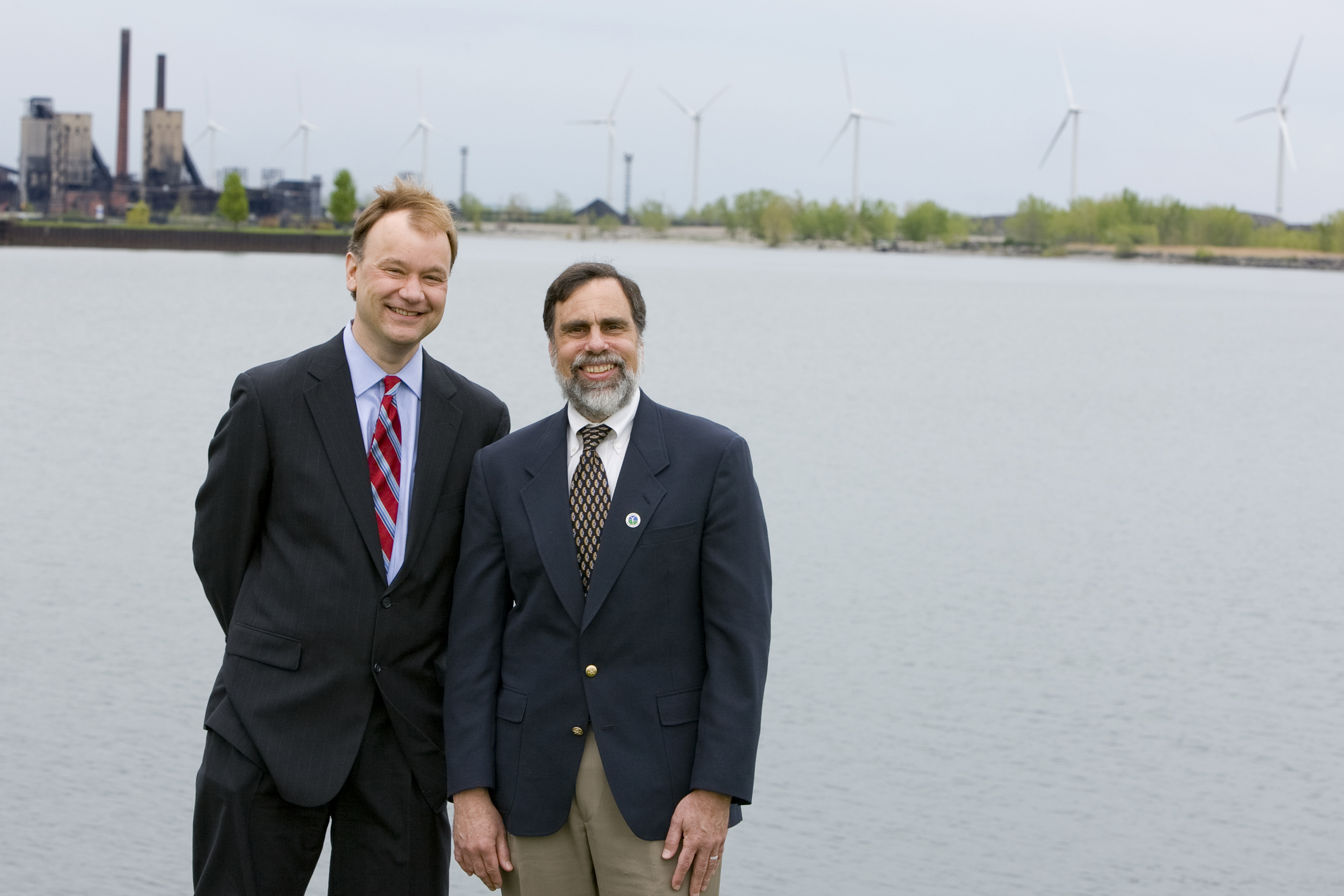
Berger and UB clinic student Dwight Kanyuck, co-authors of the report, said a similar number of new turbines anchored in the water could produce several times the power generated by the eight turbines now operating at the Steel Winds farm located on the former site of Bethlehem Steel in Lackawanna. The eight turbines of Steel Winds are rated at 20 megawatts of power -- 2 ½ megawatts each -- which supply annual power for about 9,000 homes, according to the UB Law team. If more turbines are built, the capacity to produce power increases proportionately.
Even if only 10 percent of the wind power potential for Lake Erie and Ontario was used, about 8,200 megawatts of electricity could be harnessed for private and commercial use, according to Kanyuck. That's more than 400 times the capacity of the eight turbines operating at Steel Winds, enough power to meet the annual needs of about 360,000 homes, using the existing scale of demand.
"Eighty-two hundred megawatts would be equivalent to adding the renewable energy capacity of more than three power plants the size of the Robert Moses Niagara Hydroelectric Plant," according to the report. "This level of development would significantly offset the greenhouse gas, sulfur dioxide, nitrogen oxide and mercury emissions associated with coal power generation and provide a stably priced supply of energy for years to come."
The report also stresses the economic development opportunities for communities that embrace offshore wind power. Quebec, for example, expects to attract more than $4 billion in investment and generate 1,500 fulltime jobs, with significant expansion possible, according to the authors.
The report stops short of specific recommendations on how many or where the turbines should be built. And the report stresses the environmental implications, including migratory bird paths, recreation and fishing, of building these wind turbines in the water.
"The need for a full discussion of these issues is particularly important because wind turbines would be placed in bodies of fresh water that are sources of drinking water for millions of people," the report states.
But it is unequivocal in its urgency to look at the energy and economic opportunities as soon as possible. The report also designates two agencies -- New York State Energy and Research Development Authority and New York State Power Authority – as the groups that should implement the policies. The report also recommends the Wind Action Group, a local wind power organization that asked UB to prepare the report, should act as an educator and advocate to move this plan forward.
"We are excited about the idea of fostering a community-based discussion of how we as a region and state can make the most of this natural resource," says Robert. Knoer, chairman of the Wind Action Group, "all in harmony with all of our other goals as a state and region."
There currently are no offshore wind facilities operating in the United States. There are offshore projects generating about 1,000 megawatts of power in Europe, according to the UB team.
The UB report also urges the state to provide financial incentives and power purchase agreements to encourage the appropriate development of the state's Great Lakes' wind power.
"We're suggesting that there actually be a requirement for local content that the state puts in its purchase agreement that would then jump-start a wind turbine manufacturing plant with the associated component parts," Berger says.
Copies of the executive summary, as well as the full report, are available at http://www.greengold.org/wind/documents/113.pdf.
The University at Buffalo is a premier research-intensive public university, the largest and most comprehensive campus in the State University of New York. UB's more than 28,000 students pursue their academic interests through more than 300 undergraduate, graduate and professional degree programs. Founded in 1846, the University at Buffalo is a member of the Association of American Universities.
Among American colleges and universities, UB is recognized as a leader in reducing energy costs through extensive and innovative conservation measures and in promoting alternative energy sources, steps. In 2007, the university highlighted and celebrated its environmental commitment in a semester-long observance, "The Greener Shade of Blue." During the semester, President John B. Simpson committed UB to continuing its leadership role in fighting global warming by signing the American College and University Presidents Climate Commitment to achieve "climate neutrality." As part of the development of a comprehensive physical plan to guide the growth of its North, South and Downtown campuses in conjunction with the UB 2020 strategic plan, UB has created a Committee on Environmental Stewardship, underscoring the fact that environmental stewardship is a university-wide responsibility and effort.
Since its founding in 1887, the University at Buffalo Law School -- the State University of New York system's only law school -- has established an excellent reputation and is widely regarded as a leader in legal education. Its cutting-edge curriculum provides both a strong theoretical foundation and the practical tools graduates need to succeed in a competitive marketplace, wherever they choose to practice. A special emphasis on interdisciplinary studies, public service and opportunities for hands-on clinical education makes UB Law unique among the nation's premier public law schools.
Media Contact Information
Charles Anzalone
News Content Manager
Educational Opportunity Center, Law,
Nursing, Honors College, Student Activities
Tel: 716-645-4600
anzalon@buffalo.edu