News & information from UB, New York's flagship university
Law School Clinic Helps People Secure Housing, Independence
Affordable Housing Clinic assures $150 million in housing financing during past 17 years
Release Date: February 18, 2005 This content is archived.


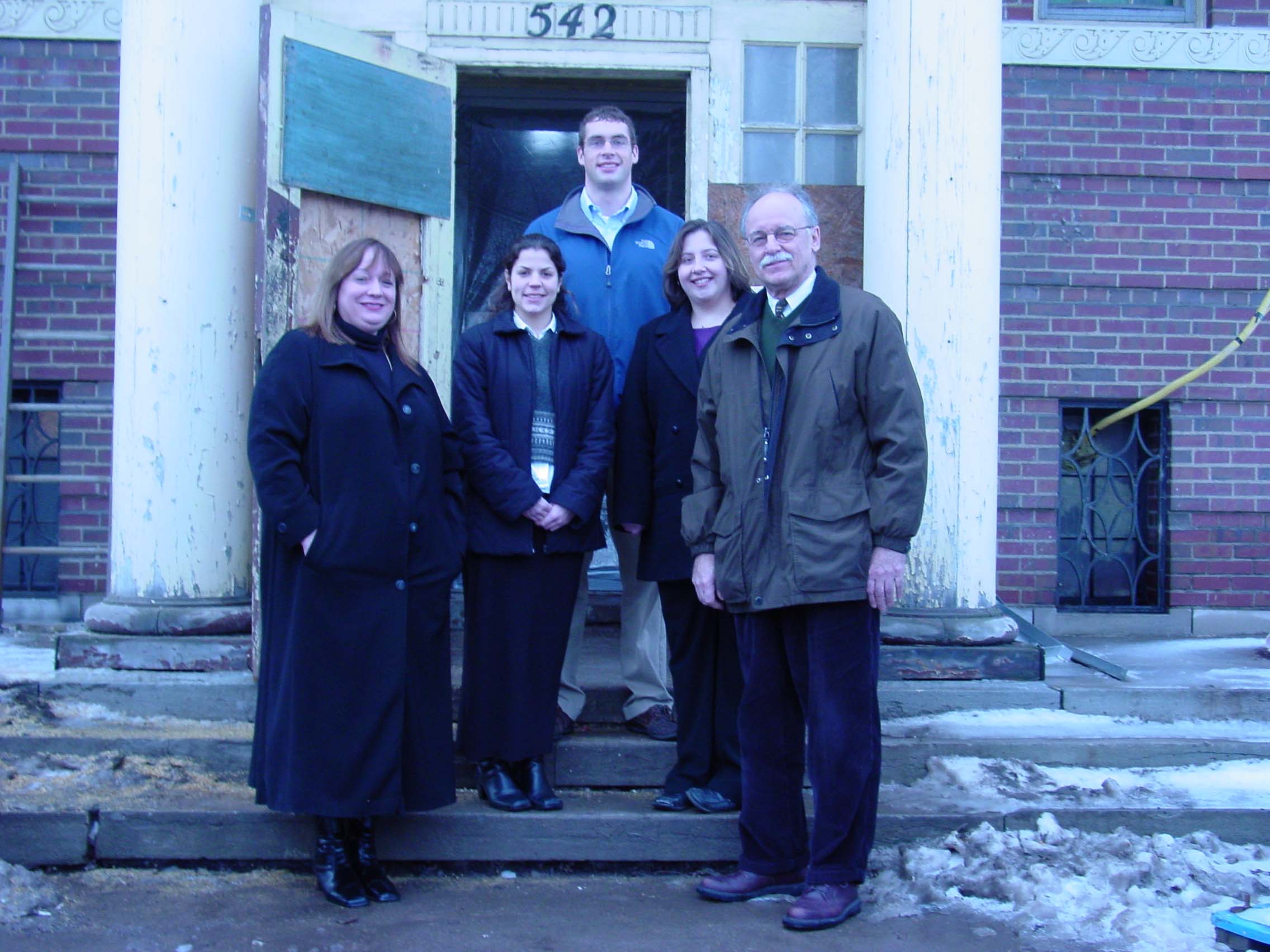
BUFFALO, N.Y. -- In a run-down section of city street in Niagara Falls, N.Y. -- flanked by abandoned homes and across from a shuttered hospital -- a dilapidated old dormitory for nurses is getting a new start as transitional housing for homeless women and their children.
The building's rehabilitation is being made possible, in large measure, by the efforts of University at Buffalo law students attracted to an unglamorous, roll-up-your-sleeves niche of law practice known as affordable housing, which focuses on helping nonprofit and community organizations obtain financing to create low-income and special-needs housing.
"Affordable housing is for students looking for more substantial elements of law beyond the flash of litigation," explains law professor George Hezel, director of the UB Law School's Affordable Housing Clinic. "These students learn to negotiate sensitive issues, plan and advocate for people, which is really 90 percent of what lawyers do -- they don't spend all their time litigating."
When the refurbished four-story building is opened in August by the YWCA of Niagara, it will bring to $150 million the amount of affordable-housing financing secured by students and faculty members through UB's Affordable Housing Clinic, says Hezel, who has run the clinic for 17 years.
"The trick of this project was securing about $1 million in historic-preservation tax credits," Hezel explains. "Finding that million paid for amenities that the state Homeless Housing and Assistance Program and Division of Housing were reluctant to pay for. It lessened their burden and made the project doable."
In all, Hezel, clinic co-director Sara Faherty and UB law students secured $5.6 million in financing for the YWCA project from a mix of tax credits and federal, state and city funding. The 19-unit facility will be called Carolyn's House in memory of Niagara Falls lawyer Carolyn Van Schaik, killed in a car accident last year, who helped initiate the YWCA project.
In addition to one-, two- and three-bedroom suites, the new facility will contain a daycare center and a culinary-arts training center, which will prepare women for jobs in restaurants around and in a new casino, located just a few blocks from the facility.
"This is not just housing," says Kathleen Granchelli, executive director of the YWCA of Niagara, who has spearheaded the project. "The most important component is moving families from dependence to independence. They'll have all the support services they need, in one facility, to move on to the next phase of life with dignity.
"This has been an amazingly successful collaboration with the UB Law School and several other partners," Granchelli adds. "We had a vision, it didn't seem like it was going to happen at one point, but now it is. There's no other housing like this in the entire county."
Created in 1987, the UB clinic is the granddaddy of affordable housing clinics at U.S. law schools. Its national prominence is why the clinic was selected as the home base for the American Bar Association's Journal of Affordable Housing & Community Development Law.
Today there about two dozen affordable-housing clinics in operation nationwide, but in the late '80s clinics at UB, Yale and Seton Hall University pioneered the field, championing a movement to bring practical work experience into the classroom, while providing students with meaningful ways to improve their communities. The UB Law School also offers several other clinics, including ones addressing family violence, the environment, elder law and securities law.
"UB's Affordable Housing clinic has long been recognized as an innovator and a leader, with a record of outstanding accomplishments," says Robert Solomon, director of clinical studies at the Yale Law School. "I had the pleasure several years ago of visiting with the clinic and I was incredibly impressed and inspired by the clinic's work."
With the YWCA project nearly completed, the UB clinic is deeply involved in the "most challenging and ambitious project" in its history, according to Hezel. In partnership with the Buffalo City Mission, the UB clinic has secured $9.3 million in financing for creation of a new three-story residence for women who have substance-abuse problems and their children. Construction of the 122-unit Cornerstone Manor Transitional Housing facility, to be located on the edge of the Buffalo Niagara Medical Campus (BNMC) on North Street in Buffalo, will begin in April and is slated to be completed 10 months later.
With its on-site medical, counseling and educational facilities, and its enclosed courtyard playground, the new facility will replace and significantly expand services offered at the current 60-unit Cornerstone Manor, where overcrowding is a recurring problem.
What's more, demolition of the outdated 60-unit facility -- located within the Buffalo Niagara Medical Campus -- will open the door to future development on the medical campus, which, in turn, spurs continued growth of Buffalo's emerging life-sciences industry, Hezel points out.
"I like that this project removes an obstacle to economic development in Buffalo, while providing something better for Cornerstone Manor and Buffalo City Mission," he says.
As a side benefit, notes Hezel, proceeds from the sale of the current manor to the BNMC -- along with a $600,000 developers' fee earned by the UB clinic and donated to the mansion -- will contribute to the new facility's operating budget.
"Getting approval for this project involved a fairly sophisticated bit of persuasion," says Hezel, who personally pitched the project to state housing agencies in Albany. "It's taken a couple of years to put all the pieces together and convince the political power in Western New York and Albany that this should be a priority.
"This project reflects the clinic's appetite for more and more interesting and difficult projects," he adds. "And it's a great teaching event for students."
For their part, UB law students are attracted to the clinic's work for practical and philosophical reasons. Some students like E.J. Snyder, a second-year student, mainly enjoy the hands-on, problem-solving challenges of assembling complex financing packages; while other students like Melinda Grabowski and Lisa Goodberry, a former social worker, also enjoy helping people reach their goals.
"I'm thinking about affordable housing as a career," says Grabowski, who is senior editor of the Journal of Affordable Housing & Community Development Law. "I like figuring out methods for people to be able to afford what they envision as their goal."
Adds Goodberry, "I love the dynamics of it. I was searching for something in law that would make a difference in people's lives."
Because of the UB clinic's national reputation, many UB law graduates move easily into careers in affordable-housing practice with law firms and real-estate development companies throughout the state and around the country. UB Law School graduate Juila Solo, for example, is an associate at New York City's Nixon Peabody LLP, which has a large national affordable-housing practice, representing nonprofits, developers and investors.
"For me, studying law was only an option if I could use it to improve the status quo," Solo says. "Housing is very basic. If people can afford safe and sanitary housing, many other aspects of their lives can improve too. It's a building block to a better life, a better society."
Soon, the UB clinic may expand from affordable housing to other types of community development projects, Hezel says. He and his students are investigating development of a free medical center on Buffalo's East Side.
Media Contact Information
John Della Contrada
Vice President for University Communications
521 Capen Hall
Buffalo, NY 14260
Tel: 716-645-4094 (mobile: 716-361-3006)
dellacon@buffalo.edu
X: UBNewsSource