News & information from UB, New York's flagship university
Media Advisory: HiggsFest! Physicists to Celebrate Discovery of Higgs Boson
Meet the UB Higgs hunters who contributed to the search for the subatomic particle, which helps explain why objects have mass
Release Date: December 4, 2012 This content is archived.


BUFFALO, N.Y. -- The Higgs boson has been grabbing international headlines since July, when scientists announced that they may have caught a glimpse of the elusive particle after years of searching.
Now, Western New Yorkers will have the chance to learn about the Higgs firsthand -- directly from local researchers who helped track the particle down. Find out why news outlets from CNN to TIME have been reporting on the hunt for the Higgs, and why the particle's discovery counts as one of modern science's most exciting achievements.
WHAT: University at Buffalo physicists who contributed to the hunt for the Higgs boson are hosting "HiggsFest," a free, public celebration. The event will include short presentations -- in plain English -- on the famed boson and its discovery.
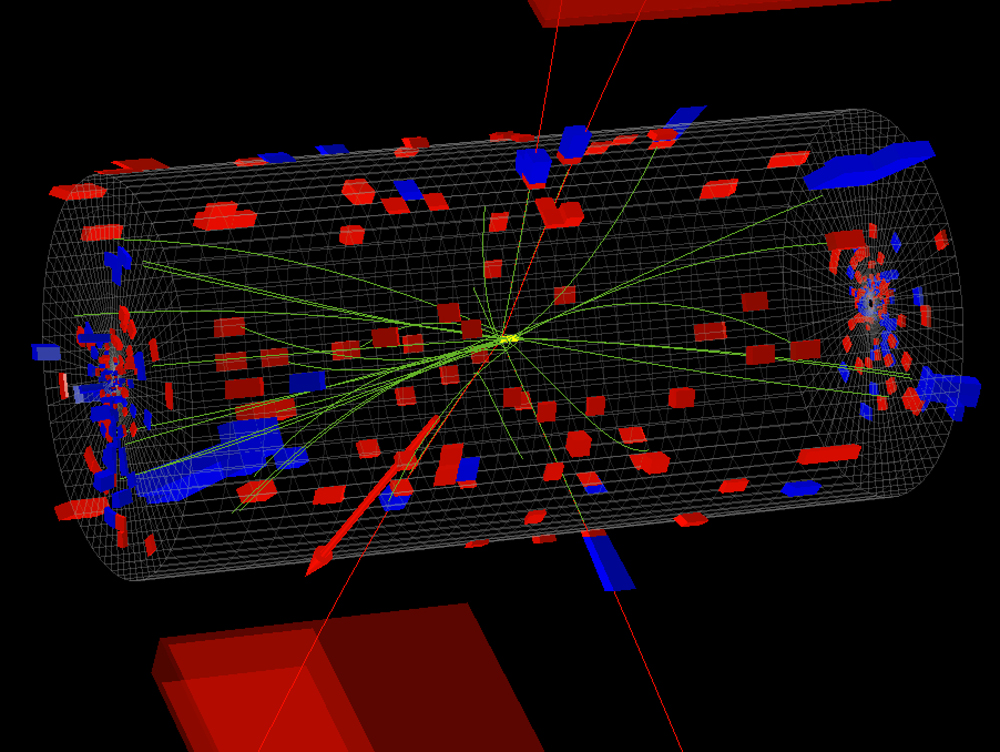
Media will have the opportunity to interview the researchers and view an interactive graphic illustrating the particle collision experiment that led to the discovery of the Higgs. A tiny particle detector will be on display. Physics-related craft activities are planned for kids.
WHEN: Thursday, Dec. 6 at 5 p.m.
WHERE: Room 205 in the Natural Sciences Complex on UB's North Campus. The Natural Sciences Complex is building No. 22 in the yellow area of this map: http://www.buffalo.edu/buildings/maps/NorthCampus.pdf.
WHY: The Higgs boson is a subatomic particle that helps explain why objects have mass. The particle is a crucial piece of the Standard Model of particle physics, which physicists use to describe how the world around us works.
For many years, the Higgs was the only Standard Model particle that researchers had not observed. That changed this summer, when scientists at the Large Hadron Collider particle accelerator reported seeing something that looked tantalizingly like the Higgs. At a conference in Japan this November, experts presented further evidence that the particle they glimpsed was indeed the long sought-after boson.
HiggsFest organizers include:
-- Associate Professors Ia Iashvili and Avto Kharchilava, who helped plan and build the Large Hadron Collider particle accelerator's Compact Muon Solenoid detector (CMS), which scientists used to hunt for the Higgs.
-- Assistant Professor Sal Rappoccio. Like Iashvili and Kharchilava, Rappoccio is a member of the CMS collaboration, one of two research groups that reported discovering a particle consistent with the Higgs.
-- Associate Professor Dejan Stojkovic and Professor Doreen Wackeroth, theoretical physicists who have been studying Higgs-related physics for many years.
All five faculty members are expected to be on site. To learn more about their participation in the Higgs search, visit http://www.buffalo.edu/news/13528.
Media Contact Information
Charlotte Hsu is a former staff writer in University Communications. To contact UB's media relations staff, email ub-news@buffalo.edu or visit our list of current university media contacts.