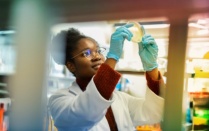
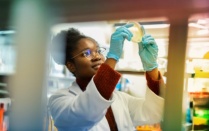
Yongho Bae, PhD, associate professor of pathology and anatomical sciences, has been awarded a Meyerson Award for his deep commitment to undergraduate students and personalized mentoring.
Bae Awarded for Teaching, Mentorship of Undergrads
By Keith Gillogly
Published January 15, 2026
In recognition of his exceptional mentorship and commitment to undergraduate students, Yongho Bae, PhD, has been named a recipient of the 2025-26 President Emeritus and Mrs. Meyerson Award for Distinguished Undergraduate Teaching and Mentoring at the University at Buffalo.
Bae, who is associate professor of pathology and anatomical sciences in the Jacobs School of Medicine and Biomedical Sciences, has been on faculty since 2017. Since then, he’s mentored 26 undergraduates in his lab studying cell mechanobiology, cardiovascular disease, and glioblastoma.
The Meyerson Award was established through a generous gift from the late UB President Emeritus Martin Meyerson and his wife, Margy Ellen. It’s the highest university award recognizing faculty excellence in undergraduate teaching and mentoring.
Customizing Each Student’s Experience
Bae’s focus on undergraduate mentorship stems in part from his own experiences, he says. When studying biotechnology during his undergraduate years, he didn’t receive the sort of formal, focused mentorship that can be so beneficial.
Now, Bae wants his undergraduate mentees’ experiences to be different. From the start of their mentorship in Bae’s lab, undergraduate students focus on their futures. Bae conducts extensive interviews with students interested in joining his lab to delve into their plans and career aspirations.
He then works to customize each student’s experience and learning opportunities based on their interests and career goals. Students seeking commercial positions focus on biochemistry, bioinformatics, and microscopy techniques applicable to more technical roles.
Undergraduates planning to pursue graduate degrees and considering academic careers gain first-hand lab work experience and participate in many scholarly activities, Bae says. They work with graduate student mentors in Bae’s lab on writing abstracts and manuscripts and also create presentations and fellowship plans. Several of the undergraduate students Bae has mentored have been first authors on publications and many have been co-authors.
Nurturing Critical Thinking, Problem-Solving, and Confidence
As an undergraduate educator, Bae has overseen many senior independent studies and capstone projects. In his lab, undergraduate students have come from various UB schools, with backgrounds in biomedical engineering, pharmacology, biochemistry, biomedical sciences, and other areas of study.
All undergraduate students start out reading and discussing scientific literature, Bae says, to help lay the foundation before learning investigatory techniques and lab processes surrounding cell mechanobiology, cardiovascular diseases, and glioblastoma.
“Dr. Bae nurtures not only technical skills but also critical thinking, problem-solving, and scientific confidence,” says one of Bae’s colleagues from pathology and anatomical sciences who wrote to recommend him for the Meyerson Award. “He goes beyond routine training by encouraging students to secure research funding, present their work at regional and international meetings, and refine their communication skills.”
Bae says he prefers to work with students long-term, for at least a year or two, to help solidify their skills and give them the confidence and abilities to fully grasp and discuss their science.
“I always want to have long-term students,” he says. “All of my students are actually able to talk about their science because of their long-term training.”
“Yongho does not merely give an undergrad a simple task to keep them busy,” notes another pathology colleague who recommended Bae for his award. “He engages fully with the student to learn about their ambitions and needs at the start of their tenure and then meets with them regularly to monitor progress and adjust goals and approaches as necessary.”
Award Reaffirms Commitment to Mentoring
Since mentoring his first undergraduate student in 2017, Bae and his lab have obtained consistent funding from the university and SUNY system to support student research and activities.
Since 2024, Bae has earned three consecutive SUNY Undergraduate Research and Creative Activities Program awards totaling $55,920 to support six undergraduates and their research activities in his lab.
These SUNY-wide awards have been key to students’ learning to plan experiments, analyze data, and interpret results. In Bae’s lab, this funding has supported research on how arterial and cardiac stiffening affects vascular smooth muscle cell and cardiac fibroblast mechanotransduction, the roles of stiffness-sensitive proteins in cell mechanics and behavior, and the development of potential therapeutic strategies, among other topics.
Former undergraduate mentees from Bae’s lab have gained acceptance to prestigious graduate programs at the University of Pennsylvania, the University of Texas at Austin, and other schools. Six of Bae’s mentees have chosen to continue their research in his lab as UB master’s students.
Other graduates of Bae’s lab have obtained positions at Regeneron Pharmaceuticals, Thermo Fisher Scientific, and Roswell Park Comprehensive Cancer Center, among other major companies and research centers.
Upon recommending Bae for the Meyerson Award, one former undergraduate noted the technical skills, writing abilities, and professional confidence he gained while part of Bae’s lab. “From my first week in the lab, I was given meaningful intellectual responsibility. I was invited to propose projects, received one-on-one meetings to refine those ideas, and was coached through the process of critically evaluating experimental design and feasibility.”
Bae says he’s working to grow his industry contacts at scientific companies in order to help more students find jobs in commercial roles. He’s also looking into additional funding from the American Heart Association to support undergraduate mentorship.
In short, he’s not slowing down.
“This award has motivated me a lot,” Bae says. “After getting this award, I will do more.”
Other recipients of a 2025-26 Meyerson Award are Shira Gabriel, PhD, professor of psychology in the College of Arts and Sciences; and Igor Žutić, PhD, SUNY Distinguished Professor of physics in the College of Arts and Sciences.