Where students with enormous potential achieve exceptional success.
From Enslavement to Mass Incarceration
By Yanzin Shrestha, Daniel Acker Scholar, Criminology and Law Double Major, Prison Studies Certificate


This Alternative Break trip, titled “From Enslavement to Mass Incarceration,” allowed me to explore how the history of slavery connects to today’s criminal justice system. The experience was designed and led by Mary Nell Trautner, director of the UB College in Prison Program and associate professor in the Department of Sociology and Criminology and accompanied by Veronica Horowitz, assistant professor of sociology and criminology, and Susan Weeber, teaching assistant professor of English. Throughout the trip, I visited sites that preserved the experiences of enslaved people, engaged directly with incarcerated individuals and learned about nonviolence and social justice movements. In this reflection, I discuss my visits to Whitney Plantation and the Louisiana State Penitentiary, my experience at the Selma Center for Nonviolence, Truth and Reconciliation, and my time in Montgomery, Alabama, where I visited the Legacy Museum, the National Memorial for Peace and Justice, and the Freedom Monument Sculpture Park. I cannot cover my entire experience in this short reflection, but I have included the most impactful moments I will remember forever.
I visited Whitney Plantation in Louisiana, where the tour focused on the lives of enslaved Africans through preserved artifacts on the plantation. I saw preserved homes, the kitchen, and large bells placed throughout the plantation. There was a grand mansion in the front yard that showed the owners’ wealth, while the slave quarters were in the back. The wooden houses had gaps in their roofs and showed signs of leaks, reflecting the harsh living conditions endured by enslaved people. The plantation used to be a large sugarcane plantation, and I also saw the sugar kettles used to process sugarcane juice into sugar. I learned that in the past, enslaved people who tried to escape or gather were often separated and sent to different plantations. During the Jim Crow era, many formerly enslaved people were jailed and, under the guise of punishment, were leased out for forced labor.
My favorite part of the trip was visiting the grounds of the Louisiana State Penitentiary, also known as the Angola Prison. The maximum-security prison is very large and built on around six plantations, with prison buildings spread out in clusters. The area is full of green grass and horses, along with a plantation that helps feed the prison. It was the complete opposite of what I thought a maximum-security prison would look like. I spoke with death row inmates and said hi to many people we passed by while touring the grounds. At first, I was nervous, but the conversation became easier with my colleagues around me, and some inmates were very open to conversation. This experience changed my expectations and made the environment feel more comfortable than I initially imagined.
We then traveled to Selma, Alabama and received training on nonviolence at the Selma Center for Nonviolence, Truth and Reconciliation. There, I learned the six steps of Kingian nonviolence and the difference between dialogue and debate. Activities such as moving in a circle and answering questions within a few minutes helped me express my inner thoughts more openly and honestly.
At the end of the trip, we spent three days in Montgomery, Alabama. I visited the Legacy Museum, the National Memorial for Peace and Justice, and the Freedom Monument Sculpture Park. The Legacy Museum highlights the history and legacy of slavery in America, from slavery and Jim Crow to lynching and mass incarceration.

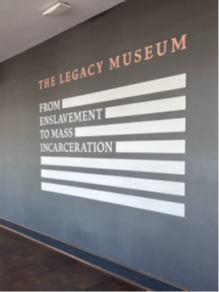
At the end of the trip, we spent three days in Montgomery, Alabama. I visited the Legacy Museum, the National Memorial for Peace and Justice, and the Freedom Monument Sculpture Park. The Legacy Museum highlights the history and legacy of slavery in America, from slavery and Jim Crow to lynching and mass incarceration.
The Legacy Museum was my second favorite part of the trip. The museum included interactive learning experiences, such as being on the phone with incarcerated individuals and looking through prison bars at a hologram of an enslaved person addressing you. I remember one person expressing fear of being sold and separated from their family. There was also a telephone booth where I listened to Anthony Ray Hinton speak from inside prison. Earlier that day, my colleagues and I had met him and heard about his experience with the criminal justice system. His persistence was recognized by an attorney from the Equal Justice Initiative, who represented him in court and helped overturn his conviction. Anthony Ray Hinton spent 30 years on death row in Alabama for crimes he did not commit. That day at the museum, my emotions were overwhelming, and I am so grateful to have experienced the reality of it.
Overall, this trip helped me better understand the connection between past and present systems of inequality. Seeing these places in person, speaking with incarcerated individuals, and learning about nonviolence made the experience both educational and emotional. It allowed me to reflect more deeply on justice, history, and the importance of continuing conversations about change. Other students would also benefit from this trip, as it offers a powerful, real-world understanding of history, justice, and social change. Visiting places like Whitney Plantation and the Legacy Museum, and reflecting on them with my peers at the end of the day, helped me gain a deeper awareness of the ongoing impact of inequality.