Where students with enormous potential achieve exceptional success.
A Meaningful Conversation with Dean Alford, School of Social Work
By Suraphael Barton, Daniel Acker Scholar, Neuroscience Major

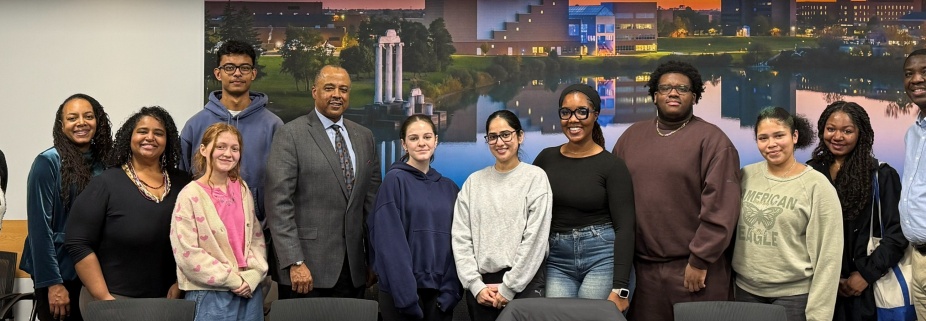
The Cora P. Maloney Center invited all members to a discussion about the School of Social Work featuring Keith Alford, the Dean of UB’s School of Social Work. Our discussion titled “Conversations with Faculty” began with Alford sharing stories from grade school.
Unsurprisingly, his first thought was English; he explained that people with a strong background in literary subjects can carry themselves with a sense of intelligence, wit and modesty—which Alford radiated just minutes into our discussion. Deviating from the subject of English altogether, Alford spoke about the emotional impact his English teacher had on him, saying that the empathy his teacher showed in both his academic and personal lives deepened his love for the subject. As I ponder Alford’s message, I realize I relate to it deeply. My love for math and science, combined with the emotional empathy my teachers showed me, heavily influenced my desire to pursue healthcare.
As the conversation shifted gears, I learned about Alford’s education and his area of specialization. Living in South Carolina, racial groups (as he also referred to as “populations”) were blatantly evident.
As he grew up, Alford was deeply influenced by the Reverend Jesse Jackson, who had recently passed away before our discussion. Jackson’s focus on racial justice and activism, along with the influence of others in the South, helped shape Alford’s career trajectory and overall passion for social work. As he progressed to shadowing social workers, he witnessed the unapologetic truth of this field. Recalling a memory of one of the homes he and his colleagues visited during an internship, Alford recalled visiting children who were quickly labeled by his partners as being neglected/abused by the rest of the family. With a sense of confusion, Alford tried to wrap his head around the hasty conclusion of his fellow social workers. “What about this family’s income? What does their neighborhood look like?” These questions helped me understand the sheer depth of Dean Alford’s empathy. His first thought, to understand the underlying causes of the issue, enables him to help the person address their problem. “Understanding the person before the patient” is a classic quote that can equip people to examine the root cause of an issue before making quick assumptions.
Nearing the end of our session with the Dean, I made a point that I was confident he would agree with. It was that “the characteristics of a social worker should apply to all aspects of healthcare.” For example, how primary care workers diagnose their patients can often be based on surface-level presumptions based on their appearance (especially in stressful, high-paced work environments). This is a common issue that could be easily resolved if the core values of social work were consistently taught through medical schools. Still, they are unfortunately sacrificed, prioritizing mass knowledge over emotional values.
A major reason I was interested in attending the event was to understand what my grandmother learned in her education as a social worker. Deborah Allen (my grandmother) graduated from UB’s School of Social Work in 2005 and was awarded the Dorothy L. Lynn honorary award “in recognition of consistently outstanding performance in class and field.” She has since applied her educational, emotional and spiritual knowledge to her current role as a hospital chaplain in upstate NY. I was able to draw parallels in Alford’s and my grandmother’s personal qualities (respect, humility, and pride in their work). I believe my grandmother, at 78, continues her work not because she needs the income, but because social work is rewarding, despite the strong mental fortitude it takes to pursue it. She is an inspiration to my family and me, and I hope to embody her qualities as I continue my journey in healthcare.
I think it is paramount that we take Dean Alford’s words to heart, not just in the fields of social work and healthcare, but also in how we treat our neighbors. The impact we have on people when we take the time to listen and understand them, especially when society has put labels on them, can mean the world.