APY 388-Field Research Archaeology
UB Anthropology Field School

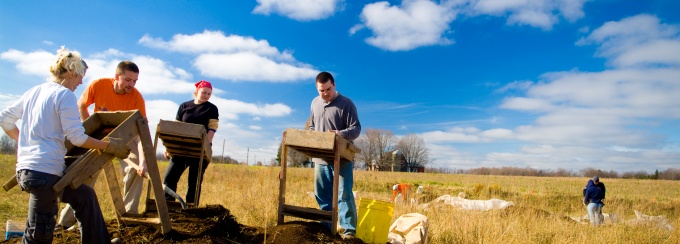
Learn archaeology by doing archaeology
Spend your summer investigating archaeological sites in Western New York while building skills in excavation, mapping, artifact analysis and field research. The UB Anthropology Field School is an immersive six-week experience that combines hands-on fieldwork, laboratory training and professional archaeological methods.
You may investigate evidence of Indigenous communities, analyze ancient pottery and stone tools and explore how people adapted to life in Western New York centuries ago.
Students will help investigate and interpret a real archaeological site while using professional methods and technology. Working alongside faculty and fellow students, you will gain experience in every stage of the archaeological process.
You will learn how to:
- Locate and survey archaeological sites
- Excavate sites using professional archaeological methods
- Document field discoveries and site conditions
- Create maps and site records using professional equipment and technology
- Identify, process and analyze artifacts
- Collect and analyze soil samples
- Reconstruct artifacts and interpret how people lived in the past
- Present archaeological findings through reports, presentations and digital media
- Understand how collections are preserved and managed in museum settings
Students do not learn through simulations alone. During the field school, you will help locate, document, excavate and interpret a major archaeological site in Western New York.
As you work alongside faculty and classmates, you will investigate how people lived in the region centuries ago by studying artifacts, settlement patterns, food remains and evidence of daily life.
Field sites are located throughout Western New York, typically within one hour of UB's North Campus.
Field Days
Field school meets Monday through Friday during the six-week summer session, with most days spent in the field.
A typical field day includes:
- 9 a.m. team meeting to review goals and assignments
- Travel to the excavation site
- Excavation, mapping and site documentation activities
- One-hour lunch break
- Continued fieldwork and data collection
- Return to campus between 3:30 and 4 p.m.
Students should bring lunch, water and weather-appropriate clothing on field days.
Lab Days
Not every day is spent in the field. Archaeologists also analyze, organize and interpret what they find.
Lab activities may include:
- Artifact cleaning and processing
- Artifact identification and analysis
- Flint-knapping demonstrations
- Site documentation and record keeping
- Historical research
- Reading and discussion of archaeological methods
- Project planning and budgeting exercises
- Lectures and presentations
Most lab days run from 9 a.m. to 4 p.m.
Through field and laboratory work, you will develop skills in:
- Site survey and archaeological reconnaissance
- Excavation techniques
- Mapping and spatial documentation
- Soil sampling and environmental analysis
- Artifact processing and cataloging
- Artifact identification and interpretation
- Archaeological reporting
- Multimedia and digital presentation tools
- Team-based research
Students should be prepared for both outdoor fieldwork and indoor laboratory activities.
Required
- Daily journal or field notebook
- Pencils with erasers
- Pointed archaeological trowel
- Metric tape measure
- Compass
- Water bottle
- Sunscreen
- Sturdy footwear suitable for excavation
- Comfortable outdoor clothing
- Lunch for field days
Required textbook
"The Archaeologist's Field Handbook" by Heather Burke, Claire Smith and Larry Zimmerman.
Recommended
- Work gloves
- Additional water bottles
- Rain gear for changing weather conditions
If you are interested in archaeology and want hands-on experience in the field, the UB Anthropology Field School offers an opportunity to build professional skills while contributing to active research projects.

