
Queen City Hub Revisited
This strategic planning initiative will review the progress made and utilize data to refresh the strategies necessary to achieve the vision of the city’s 2003 Queen City Hub Plan in light of the hidden challenges created by the COVID-19 pandemic.
Overview
The Queen City Hub Revisited initiative, spearheaded by the Mayor’s Office of Strategic Planning, in partnership with Buffalo Place, aims to produce insights from data and observations from a diverse group of downtown stakeholders through a series of engagements and interviews. This strategic planning initiative will review the progress made and utilize data to refresh the strategies necessary to achieve the vision of the city’s 2003 Queen City Hub Plan in light of the hidden challenges created by the COVID-19 pandemic.
This collaborative strategic planning initiative will:
- Underscore the Queen City Hub’s recognition of downtown as the regional hub vital to the prosperity of city neighborhoods and all of Western New York
- Highlight the continuing progress in downtown
- Provide a holistic understanding of current conditions
- Culminate in an action plan that strengthens the region’s historic center
- Present a cohesive development strategy outlining roles for City, County, State and Federal government, and private organizations
RBC Project Team
Camden Miller (lead), Bob Shibley, Matt Roland, Conrad Kickert, Hiro Hata in collaboration with partners listed at the bottom of this page.
Activities
Downtown Dashboard development, web communication, project management, strategy development,
community engagement
Outputs
Implementation Strategy for Downtown Consortium, City of Buffalo, and Erie County. Prepare a data
dashboard, gap-financing toolkit, case study precedent collection, consortium engagement plan, and
advocacy strategy
2003 Queen City Hub Plan
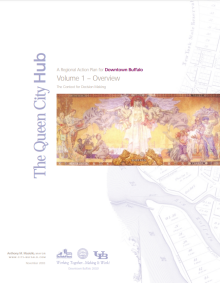
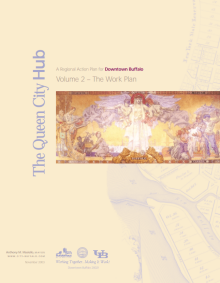
The Queen City Hub plan told us what to do and where – as well as what not to do – to advance Downtown as a regional center and as the neighborhood of neighborhoods for our city in the early 2000s. The vision organizational structure, implementation plans, and resources described in The Queen City Hub remains critical to the future success of Downtown Buffalo.
The Queen City Hub has been recognized as a nationally award-winning plan by the American Planning Association in 2005 and the Congress for the New Urbanism in 2009.
Related Plans and Inititatives




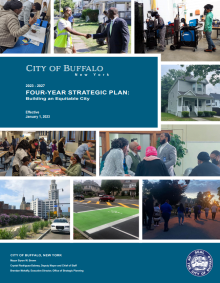
What Have We Accomplished Since the 2003 Queen City Hub Plan?
Major Infrastructure & Streetscapes Projects:
- 2011 Michigan Avenue Streetscape (Broadway to Goodell) at $1.8 million
- 2014 600 Block of Car Sharing Main at $7.7 million
- 2015 500 Block of Car Sharing Main at $21 million
- 2016 Niagara Street Gateway Streetscape $2.45 million
- 2016 Pearl Street Two-way Conversion at $2.5 million
- 2016 Genesee St Gateway Streetscape (Main to Michigan) at $3.26 million
- 2020 Skyway Lighting Improvements at $365,000
- 2021 Entertainment District Streetscapes (Chippewa, Franklin, Court) at $8.5 million
Major Development Projects in Strategic Priority Areas:
- 2006 Downtown Public Safety Campus Project
- 2010 Acquest Development Project
- 2011 Federal Courthouse at $137 million
- 2011 Genesee Gateway Project at $12 million – included 60,000 sq ft of commercial space
- 2017 500 Pearl Project at $70 million – adding 110 hotel rooms, 12 housing units, office space and commercial
- 2017 Seneca One Tower Redevelopment at $120 million – adding 115 new housing units
- 2019 Canalside Longshed Building & Heritage Carousel at $8.6 million combined
- 2019 201 Ellicott Project at $75 million – adding Braymiller Market and 201 new affordable housing units
- 2020 Police Apartments Project at $16 million – adding 129 new housing units
- 2021 Former Tent City Property Redevelopment Project, now Wurlitzer Flats and 42 North Brewing
- Planned - Marine Drive Apartments Redevelopment
- Planned - Mohawk Ramp Redevelopment
- In Progress- Trico Building Redevelopment at $82 million – adding 243 new housing units
Other accomplishments completed:
- Revise zoning code, decrease parking minimums, Green Code complete and parking minimums eliminated
- Implement ‘You Are Here’ maps, ongoing as a part of Car Sharing Main
- Events at the waterfront, Canalside programming
- Ensure public access to the waterfront, Downtown Waterfront Improvements Plan is complete
- Focus on Washington Street, which was reimagined as a part of the Smart Streets Design Plan
QCHR Consortium Members





















Take the QCHR Survey