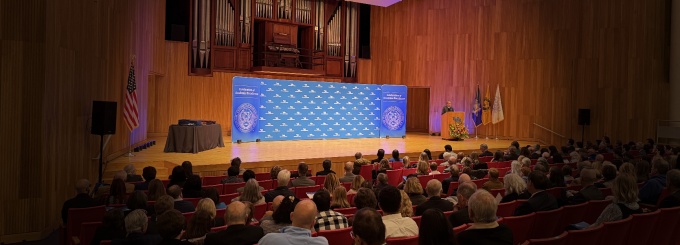

SUNY Chancellor's Award for Excellence in Teaching
Established in 1973, this award is presented to scholars who bring broad academic interests; rigorous and innovative teaching methodology; and current, far-reaching knowledge to their classes. Their concern for students is evidenced by the individual attention they accord each student and by their commitment to helping students to enhance their scholarly and creative abilities and attain academic excellence.
2024-25 Honorees
Sarah E. Handley-Cousins
Department of History
Sarah Handley-Cousins, PhD, is an associate teaching professor of history. A scholar of disability, gender, and war and former middle and high school educator, Handley-Cousins has cultivated a pedagogical approach that not only inspires students and elevates the department’s teaching methods but also makes history approachable and enticing for academic and non-academic audiences alike. She teaches a wide range of courses and creates classroom exercises that bring history to life for her students, teaching them historical and critical thinking skills in the process. This includes her innovative Reacting to the Past course, which utilizes role-playing games to embed students directly in historical events and processes. Handley-Cousins’ teaching extends beyond the classroom. Since 2017, she has been one of four producers of Dig: A History Podcast, which translates academic historical scholarship into an engaging audio format to bring history to public audiences.
A-Z
Filip Stefanovic
Department of Biomedical Engineering
Filip Stefanovic, PhD, is an assistant professor in the Department of Biomedical Engineering. He is a committed educator and innovative scholar who enhances student learning by expertly weaving traditional classroom methods with experiential learning to prepare the next generation of engineers. Stefanovic has made a significant mark on his department by designing four new 400- and 500-level courses. While his courses provide the necessary theoretical information for students to progress in their education, he also ensures that students know how to transfer their knowledge to real-world situations. Stefanovic’s pedagogy has given students the opportunity to analyze movement in UB’s SMART Motion Capture Lab, learn about rehabilitation technology at Kaleida Health’s Gates Vascular Institute, and design and test 3D-printed prosthetic devices.