Graduate Groups

Connect with the graduate community
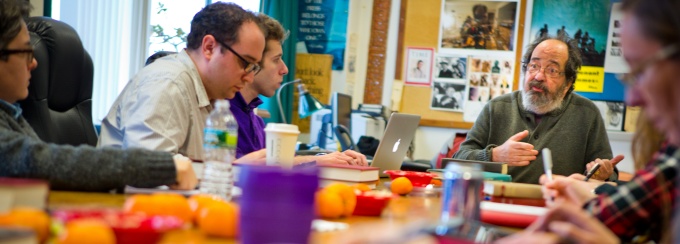
Graduate study in English extends beyond the classroom. Join student organizations and reading groups where you can exchange ideas, explore shared interests, connect with fellow scholars and take an active role in the intellectual life of the department.
The English Graduate Student Association (EGSA) is an organization devoted to developing a vibrant graduate presence within the English department. It serves as a liaison between faculty and students, and is an important mouthpiece for student concerns, both informally and in departmental meetings. It is a key source of funding for graduate student activities, organizations and facilities. Each year the EGSA holds elections both for EGSA officers and for members of the many graduate student/faculty-run committees within the English department. All graduate students in the English Department belong to the EGSA and are encouraged to take advantage of the many services the organization offers.
The Graduate Poetics Group (GPG) is a student organization whose purpose is to support Poetics activities, poetry scholarship, and literary arts related activities at the University at Buffalo. It is open to all graduate students at UB, including MA students and currently has students from many departments including Comparative Literature, English, Media Study, Philosophy, and others. The GPS contributes to and supportes events such as the Oppen Centenary Conference, Pornetixxx, REFER (Poet-Scholar exchange) series, Small Press in the Archive, (co)ludere, Poets Theatre series, BYOB series, the upcoming Digital/Electronic Poetries Conference and many others. It also supports publications such as P-QUEUE, Wild Orchids, Erotic Economies, and the Visual Studies Catalogue, among others. The GPS also facilitates, and in some cases contributes, funding for graduate students who wish to undertake poetics-related activities such as hosting events, organizing symposia or conferences, and producing publications.
1. To focus on the primary texts in psychoanalysis including but not limited to works by Sigmund Freud, Jacques Lacan, Melanie Klein, Julia Kristeva, Jean Laplanche and others. These meetings sometimes run as a live-read model, sometimes as a prepared-reading model and sometimes as a combination of the two.
2. To keep up to date with the latest developments in psychoanalytic theory as it intersects with clinical work, philosophy, cultural studies, film theory, political theory and so on. At the moment, this means a regular commitment to preparing for visiting scholars and clinicians organized through the CSPC by reading their work, devising questions and broaching debates to better engage presenters and the wider membership during Center events. In preparation for and in the wake of the CSPC journal, Penumbr(a), the reading group also coordinates to read and discuss its research.
For more information or for any questions, please contact Richie Riley-Falquez (reriley@buffalo.edu) and Kamla Persaud (kamlaper@buffalo.edu).
Modernism Reading Group
We are a reading group for graduate students interested in modernist literature and culture. We will primarily be reading literary texts, but we will also consider ideas drawn from a range of other disciplines including the social sciences, art, architecture, music, film, critical theory, and more. We conceive of this group as a space for interdisciplinary exploration, and welcome participants from across departments. The group features a rotating leadership, giving every participant the chance to lead a discussion pertaining to their interests.
For more information or for any questions, please contact Tyler Hudson (tylerhud@buffalo.edu) and Alana Murphy (am443@buffalo.edu).
Finnegans Wake Reading Group
Buffalo, which houses one of the largest James Joyce collections in the world, has long been a hub of interest for modernist scholars in general and Joyceans in particular. As a result, there have been several iterations of Finnegans Wake reading groups in the city. With something like Finnegans Wake, where no single reader can possibly possess all-encompassing knowledge for exhaustive literary analysis, the reading group decenters the demands placed upon individual readers and instead serves as an opportunity to acknowledge the singular expertise that each reader brings to the table. Finnegans Wake, like the rest of Joyce’s oeuvre, revels in polyphony; instead of encyclopedic mastery, it encourages opening ourselves up to the voices around us, reading the music contained within the pages of a book together, and coming to a shared understanding of the text. The previous iteration of the Finnegans Wake reading group in Buffalo perished right before Covid. I wanted to revive the group with others who would be interested in sitting and reading the text word-for-word, line-by-line, at a variable pace. This group is not a coterie of modernist scholars—rather, anyone interested in reading together is welcome to join us! The members of this group are not required to have any prior expertise or familiarity with Joyce, the Wake, or even modernism in general. The goal, as I conceive it, is not to finish reading the book (for that would take much longer than what the constraints of grad school would allow), but rather to get together and have lots of fun with Finnegans Wake.
For more information or for any questions, please contact Shinjan Pramanik (shinjanp@buffalo.edu).
Theory Reading Group
Each semester the group votes on a theory text to read together. We typically read a chapter every two weeks or so, depending on the text. In our meetings, we essentially move page by page and try to work the text out as a group. All are welcome—no matter your background or experience! For more information or for any questions, please contact Seth Stobart (sethstob@buffalo.edu).
Early Modern Literature Colloquium (The EMLC)
The Early Modern Literature Colloquium is a monthly discussion hour dedicated to engaging with some of Shakespeare studies’ latest and most exciting scholarship. In our meetings, we’ve discussed everything from the field’s critical restructuring around #raceb4race to early modern trans studies to fanfiction in Shakespeare. We aim to discuss this scholarship in-person with refreshments, and we welcome graduate students, faculty, and all other interested readers to a friendly space for communal discussion involving some of our field’s biggest questions. Our overarching goal for our colloquium is to spend each semester posing an ongoing discussion around a “theme” or “topic” within current early modern scholarship, with our final meeting either being the culmination of that work with a talk from a visiting scholar, a works in progress, or, as we hope in coming semesters, a graduate student conference.
For more information, please feel free to contact Ciara Fulton (ciaraful@buffalo.edu) or Hal Nichols (emnichol@buffalo.edu).
UB Speculative Fiction Book Club
The UB Speculative Fiction Book Club, formed in Fall 2025, is hosted by the English Graduate Student Association. The book club is open to all undergraduate and graduate students at UB who are interested in reading speculative fiction. Speculative fiction may include novels such as science fiction, fantasy, futurism, or other fictional works that depart from realism.
The club will meet twice every semester to discuss the chosen novels. All meetings will have snacks and refreshments provided. We will read two books per semester, and physical copies of the text will be provided on a first-come, first-serve basis. Students with their own copies of the text, whether borrowed or personal, are also welcome to join.
The chosen books for the 2025-2026 academic year include: Friday Black by Nana Kwame Adjei-Brenyah, Annihilation by Jeff Vandermeer, A Wizard of Earthsea by Ursula K. Le Guin, and Song of Solomon by Toni Morrison.
If you have any questions about participating in the book club, email Kaitlyn Liu at keliu2@buffalo.edu
The Long and Wide 19th Century Group
This reading group aims to read more widely from the 19th century. We are primarily interested in reading longer works (novels and novellas) that represent literary traditions from around the world, especially those that may be less familiar to students of English literature.
“Long”? Excitingly, the 19th century has slowly but steadily gotten longer over the past few decades and now encroaches on the 18th and 20th centuries. This means we welcome suggestions anywhere from circa 1790 to anywhere circa 1910.
“Wide”? Many of us are familiar with only a very narrow canon (i.e. Anglophone novels from England and the US). This group aims to avoid these works, covered as they are by our regular curricula. As such, we prioritize works from other countries, especially those unheard of and in translation.
If you would be interested in joining us, please email one of us and let us know! Please feel free to contact either Isaac Kolding (isaackol@buffalo.edu) or Lethe Mei (lethe.like.the.river@gmail.com) if you want to know what we plan on reading next, or are interested in joining us.