This is where change begins.
The University at Buffalo GRoW Clean Energy Center

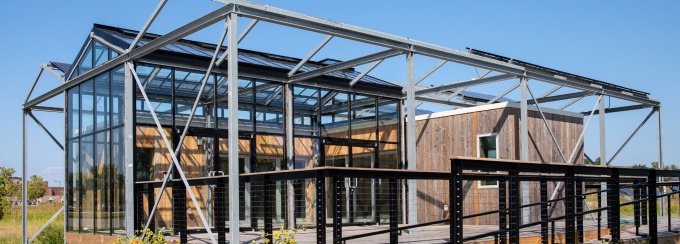
UB’s award-winning GRoW Home at its permanent location alongside the Solar Strand on North Campus in August 2021. Photographer: Meredith Forrest Kulwicki
The GRoW Clean Energy Center, located on UB's North Campus, serves the campus community as a small-scale meeting and event location and the gateway to UB's burgeoning Sustainability District.
ON THIS PAGE
Reserve GRoW
UB’s GRoW Clean Energy Center is available for use as a tour, meeting and event space for small groups.
Permanently situated at 150 Service Center Road on UB's North Campus on the edge of a 3,200-panel Solar Strand, this ultra-energy-efficient demonstration home was originally built by students, faculty and staff for a national competition and now serves as a clean energy education center.
The center’s standard indoor design accommodates up to 13-15 people. In good weather, the GRoWlarium can seat an additional 12 people. The space includes a conference room, a greenhouse and solarium called the GRoWlarium, a wraparound deck with outdoor seating, a kitchenette and a bathroom. Sliding open an accordion door turns the conference room into a larger presentation area with seating for an additional audience in the GRoWlarium, which was originally designed to be used to grow food year-round. Its highly insulated walls and windows regulate temperatures during cold winters and hot summers.
Tours of both the Solar Strand and GRoW Clean Energy Center can also be provided by graduate students within UB Sustainability for community and school groups.
Requests should be made at least two weeks in advance.
If you are a student, please reach out to Olivia Mccarthy at oliviamc@buffalo.edu to schedule arrangements.
GRoW Location
GRoW Home Timeline & History

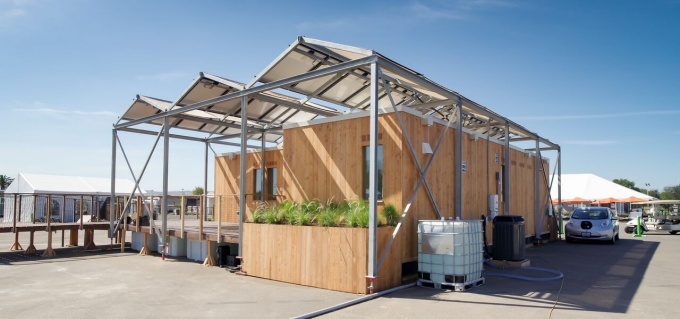
GRoW at the 2015 Department of Energy's Solar Decathlon competition.
- Fall 2015: Solar Decathlon Competition
- Winter 2015/16: Building returned to UB South Campus and stored
- October 2016: Planning and Scheduling for Exhibition Relocation Begins:
- February 2017: Student OSHA Training Completed and Construction Fence Erected
- March 2017: Authorization from School of A&P for Fall Studio for Permanent Siting
- April 2017: Exhibition Permit for Relocation Issued and Construction Underway
- May 2017: Fall Studio Recruitment
- June-July 2017: Fall Studio Preparation, Planning & Research
- Sept-December 2017: Fall Permanent Siting Studio
- September 2018: Exhibition Construction Completed and Certificate of Compliance Issued
- September 2018: Exhibition Building Activated for Tours and Meeting Space
- May 18-January 2019: Detailed Installation Plan Developed (Permanent)
- Summer 2020: GRoW Relocated to Permanent Location on North Campus
The GRoW (Garden, Relax, or Work) Home is a 1.100-square-foot structure and was the University at Buffalo’s groundbreaking and innovative submission to the U.S. Department of Energy’s 2015 Solar Decathlon. The DOE Decathlon is an international competition held every two years where the top collegiate teams are invited from around the world to design, build, operate, and market an ultra-efficient clean energy home. The competition challenges teams to develop a sustainable project that performs well in 10 individual contests, ranging from Architecture and Engineering excellence to Market Potential and Energy Performance. UB’s 2015 team was comprised of over 200 students, faculty from 13 different departments across 5 separate schools, and from 2 universities who came together to develop a comprehensive proposal to represent Buffalo on an international stage. This process was led by Martha Bohm, associate professor of architecture at UB. Through this extremely rare opportunity, the students were able to work in a highly collaborative and interdisciplinary fashion to gain real-world experience around a common objective, all before graduating. In this manner, the GRoW home served as an ideal model to bridge the gap between research-based academia and practice-based industry and demonstrate low-energy living to the campus and greater community.
Part of UB's work related to Localizing Buffalo’s Renewable Energy Future was to establish a Clean Energy Center on UB’s campus as an exemplary model of a solar powered community space by permanently installing what had been known as the GRoW Home to serve as the base of operations for our Localizing initiative. The purpose behind permanently siting the GRoW Home within Walter Hood’s 750 kW Solar Strand on UB’s North Campus was to leverage the region’s commitment to solar energy and highlight our ability to successfully generate solar power, and create a space that invites the community into one of the most publicly accessible renewable energy landscapes in the country.
Renamed as the GRoW Clean Energy Center (CEC), the building was relocated to its permanent location within the Solar Strand on UB's North Campus during the summer of 2020. GRoW CEC serves as a student engagement space for experiential learning activities related to clean energy. It is also used as a meeting space for sustainability-oriented groups on campus and a tour location for community groups.