News & information from UB, New York's flagship university
RNA droplets may have helped start life on Earth. A new study explains why they form

A University at Buffalo-led study is shedding light on why RNA has a tendency to assemble together into liquid-like droplets, a trait that may have allowed RNA to help kickstart life on Earth.
A tiny chemical difference helps make RNA better than DNA at condensing into liquid-like droplets under high temperatures and acidic conditions
Release Date: August 19, 2026


BUFFALO, N.Y. — It’s one of the origins of life’s chicken-or-the-egg problems: How could RNA have helped give rise to the first cells before there were cells to contain them?
Without the compartmentalization of a cell, it would have been extremely difficult for these vulnerable molecules to have found enough of each other in the proverbial primordial soup, let alone survive the harsh conditions of the early Earth.
The answer could lie in RNA’s ability to assemble together into liquid-like droplets, or condensates. These membraneless compartments could have concentrated RNA molecules, increasing opportunities for them to interact and potentially sheltering them from a hot and acidic environment.
Now, a new study led by the University at Buffalo is shedding light on what makes RNA particularly adept at forming these droplets. Published July 31 in Nature Communications under the journal’s early access guidelines, the study found that a tiny chemical difference between RNA and DNA helps explain why RNA more readily organizes into droplets when temperatures rise — and why those droplets are more prone to becoming rigid, gel-like networked structures.
“These findings reveal, for the first time, how remarkably small changes in molecular chemistry can control the emergence of much larger, self-organized biomolecular structures like RNA condensates,” says lead corresponding author Priya R. Banerjee, PhD, Twentieth Century Club Professor in the UB Department of Physics. “They could allow us to eventually address even deeper questions, like whether these condensates helped bridge the gap between simple molecules and the earliest forms of life.”
The study was done in collaboration with Jerelle Joseph, PhD, assistant professor of chemical and biological engineering at Princeton University. It was supported by the National Institutes of Health, the National Science Foundation, and Hypothesis Fund.
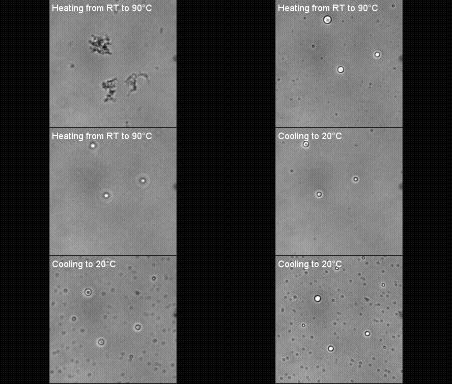
Heat transforms clusters of RNA into liquid-like droplets. The study found that temperature can alter the physical properties of RNA condensates, allowing a more networked structure to relax into rounded droplets. Credit: Priya Banerjee/University at Buffalo
Study addresses questions on RNA world theory
The work is part of Banerjee’s research related to RNA world theory, which suggests that RNA played a central role in originating life on Earth. RNA molecules can both carry genetic information and catalyze chemical reactions, which could have allowed them to perform the chemistry that eventually gave rise to DNA, proteins and the first cells.
But RNA world theory faces fundamental questions, including how unstable RNA could have persisted under harsh prebiotic conditions and how enough RNA molecules could have become concentrated in one place to interact before cells existed.
RNA droplets could provide an answer. A 2023 study led by Banerjee found that RNA has a tendency to organize itself into liquid-like droplets under high temperatures.
Building off that work, the current study compared RNA’s droplet forming abilities with single-stranded DNA containing essentially the same sequences.
In their experiments, Banerjee’s group showed that RNA began forming droplets at temperatures roughly 10 degrees Celsius lower than the corresponding DNA, showing that RNA had a stronger tendency to condense. They also found that RNA molecules more readily formed interconnected networks within the droplets, transforming the material from fluid-like to more gel-like, which could protect RNA better under harsh environmental conditions.
A key reason appears to lie in the fact that RNA and DNA differ chemically by just one oxygen atom per sugar unit. Each sugar unit in RNA contains a chemical group called a 2′-hydroxyl (2′-OH) that is absent in DNA.
Using temperature-controlled microscopy, small-angle X-ray scattering and molecular-dynamics simulations performed by the Joseph group, the team found that the 2′-OH appears to help RNA interact more strongly with magnesium ions and retain fewer water molecules around its backbone than DNA does. Those differences help RNA molecules come together more readily as temperatures rise, the researchers found.
The researchers further tested the 2′-OH's role by chemically modifying it to 2′-Ome, similar to what’s found in many natural RNA. Doing so weakened RNA's tendency to condense and altered whether the resulting condensates remained fluid or became gel-like.
“This single oxygen-containing group on RNA’s sugar has a surprisingly powerful effect on whether these molecules come together, remain dynamic or become arrested into a gel-like material,” says first author Gable Wadsworth, PhD, a postdoc in Banerjee’s lab who will join the University of Texas at El Paso as an assistant professor this fall.
The Banerjee lab is now taking the next step: engineering RNA droplets to perform some basic functions of cells such as biochemical reactions. They are attempting to program the droplets to function as active, dynamic, cell-sized compartments, providing a potential foundation for designing all-RNA synthetic cells.
“These kinds of self-organizing RNA compartments were possibly a step along the way to single-cell organisms,” Banerjee says.
Media Contact Information
Tom Dinki
News Content Manager
Physical sciences, economic development
Tel: 716-645-4584
tfdinki@buffalo.edu

