News & information from UB, New York's flagship university
Naturally occurring molecule can stop Alzheimer’s-linked fibrils from forming
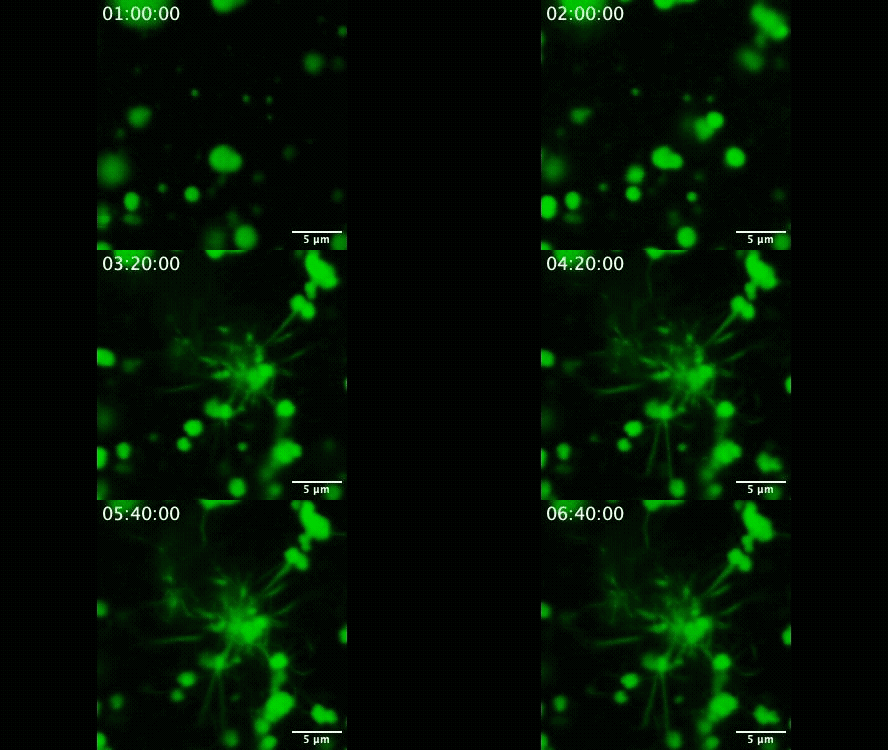
Tau protein droplets form fibrils, which then attach to neighboring droplets. A University at Buffalo-led team found that a naturally occurring small molecule enhances the stability of these protein droplets and protects them against fibril conversion. Credit: Priya Banerjee/University at Buffalo
Study finds metabolite can prevent fibril formation without interfering with protein droplets
Release Date: April 20, 2026


BUFFALO, N.Y. — Protein droplets serve important biological functions within cells, but in neurodegenerative diseases like Alzheimer’s, these liquid-like droplets can form solid-like clumps known as fibrils.
This disrupts the droplets’ normal physiological functions, including stabilizing microtubules that help transport materials within neurons.
So how can scientists prevent fibril formation while still allowing protein droplets to function?
University at Buffalo biophysicists report they have found a way to use a naturally occurring small molecule already present in cells. In a study published in Nature Communications, they show that the metabolite, L-arginine, enhances the stability of protein droplets, protecting them against conversion to amyloid fibrils and thereby preserving their ability to assemble and stabilize microtubules.
The study serves as a proof of principle for identifying small molecules that inhibit or delay pathological fibril formation without affecting droplet functions necessary for physiology.
“These findings show that functionally-relevant protein droplet formation and disease-linked fibril formation are two separable processes, and that our cells might have ways to let droplets be operational without leading to irreversible aggregation,” says the study’s corresponding author, Priya R. Banerjee, PhD, professor in the UB Department of Physics.
Banerjee’s work centers around droplets made from proteins, RNA, and DNA. Also known as biomolecular condensates, the droplets play a critical role in normal cellular processes but behave abnormally in many neurodegenerative diseases, as well as cancers.
One such protein, Tau, can form droplets that gradually convert to fibrils known as amyloids. These Tau fibrils are one of the hallmark protein clumps seen in Alzheimer’s disease, as well as a class of disorders called Tauopathies. But unlike the well-known amyloid-β plaques that form outside neurons, Tau fibrils accumulate inside neurons.
In this study, Banerjee’s team developed a bottom-up bioengineering approach using an engineered version of Tau to recreate how liquid-like protein droplets form and gradually convert into fibrils.
This model system revealed that fibril formation occurs at the surface of droplets rather than within them.
“This means that the inside of the droplet is liquid-like and functional, but the droplet interface poses a risk and likely promotes fibril formation,” says first author, Tharun Selvam Mahendran, a PhD student in Banerjee’s lab. “So it’s possible to keep the droplet intact while blocking fibril formation at the surface”
After screening several small molecules, including those found naturally within cells, the researchers uncovered that L-arginine can maintain protein droplets in a functional state while counteracting the formation of amyloid fibrils at the condensate interface.
“Healthy cells might already be using small molecules like L-arginine to stabilize functional droplets and prevent them from conversion to toxic assemblies that underlie several neurological disorders,” Banerjee says. “Potentially, molecules like L-arginine underscore the importance of the cellular microenvironment in keeping pathological processes at bay, and the proof-of-principle approach that we demonstrated could help guide efforts to develop small molecules that target fibril formation in Alzheimer’s disease.”
The work was supported by the National Institutes of Health, the National Science Foundation, St. Jude Children’s Research Hospital, the Welch Foundation, and the Chan Zuckerberg Initiative.
It was done in collaboration with the University of Texas at Austin.
Media Contact Information
Tom Dinki
News Content Manager
Physical sciences, economic development
Tel: 716-645-4584
tfdinki@buffalo.edu

