Marian E. White Research Museum and Resource Center

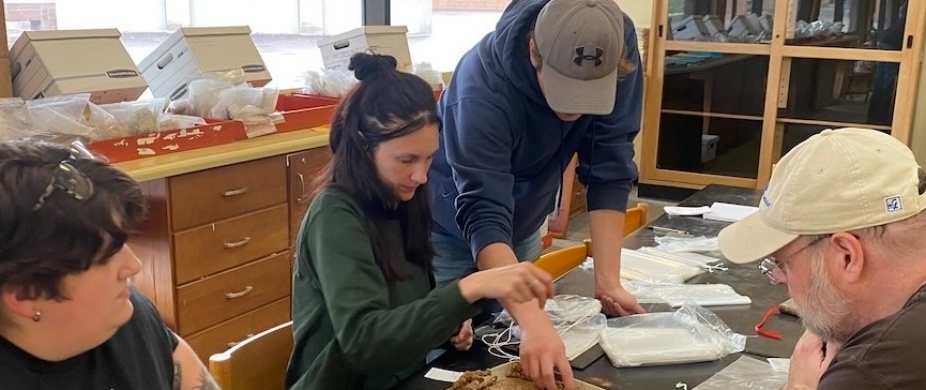
Formally opened to the public in 1979, the Marian E. White Research Museum and Resource Center features over 1 million artifacts from more than 1,500 sites — one of the most complete and extensive collections of Pre-Contact artifacts and site records in the WNY region.
Our Museum
Dr. Marian E. White (1921-1975), a well-known New York State archaeologist and Professor of Anthropology at the University at Buffalo, laid the groundwork for establishing this impressive museum.
Over nearly two decades, she excavated extensively in the Niagara Frontier region of Ontario and New York, concentrating her research on Iroquois agriculture, warfare and settlement patterns. The collections have been further enriched by UB field schools, including one at Old Fort Niagara, and by private donors who have made significant contributions of more exotic collections.
Today, the museum contains over 1 million artifacts from more than 1,500 sites ranging in age from Late Woodland to historic period (A.D. 700-1700s). Some artifacts are from earlier periods of occupation, as early as Archaic (7000 B.C.), while other artifacts represent groups referred to by archaeologists as the Neutral, Wenro, Erie and Seneca. The Seneca are the only contemporary Native American group, and they claim lineal relationship to the other groups.
The museum currently consists of 8,600-square feet of secure adjoining rooms in the Department of Anthropology on the UB North Campus.
Resource Center
The Resource Center is a unique public academic library dedicated to the preservation, study and celebration of the region’s deep anthropological and archaeological heritage. It focuses on the histories, cultures and contemporary lives of the region’s Indigenous peoples who have lived on these lands for centuries.
The Resource Center houses a rich and carefully curated collection of materials, including:
- Rare books, manuscripts, academic theses and scholarly journals
- Excavation reports and maps
- Digital archives and multimedia resources
The library prioritizes respectful collaboration with Indigenous nations and follows ethical guidelines around cultural stewardship and representation. Its mission is to promote understanding, preserve heritage and foster dialogue around the human history of Western New York.
Much of the collection is original source material found nowhere else. Designed as both a research facility and community learning space, the library is open to students, educators, researchers and the general public.
PLAN YOUR VISIT
The Marian E. White Research Museum and Resource Center is free of charge, but open by appointment only. Researchers, school groups of all levels and the general public are invited to take advantage of this incredible community resource.
To discuss your interests and needs, and to schedule a visit, contact Doug Perrelli at perrelli@buffalo.edu or call our office at 716-645-2297.
Dr. Marian E. White was a distinguished UB archaeology professor and an early proponent of archaeological site preservation and cultural resource management (CRM). She recognized the need for highly qualified professional archaeologists with local and regional perspectives to carry out research programs and to protect the dwindling and non-renewable archaeological resources of our community.
Background and Education
Marian E. White was born in Hartland (Niagara County), New York. In 1942, she graduated from Cornell University with a Bachelor of Arts in classical languages and a minor in anthropology. Her education was interrupted by WWII, during which she worked as an IBM Tabulator Machine Operator for the United States Army. She then worked as a tour guide at the Buffalo Museum of Science.
In 1952, Dr. White attended the University of Michigan, obtaining a Master of Arts in 1953 and a Doctor of Philosophy in 1956 after defending her thesis on Iroquois culture history in the Niagara Frontier area of New York State. She was the first woman to be awarded a PhD from the Department of Anthropology at the University of Michigan.
A Distinguished and Exemplary Career
She began her anthropology career at the Rochester Museum of Arts and Sciences in 1956 as a researcher. In 1958, Dr. White returned to the Buffalo Museum of Science as an assistant curator of anthropology, and she also was an assistant curator of archaeology at the Buffalo and Erie County Historical Society. In 1959, she became a researcher and lecturer at the University at Buffalo, and a professor in 1968.
During her career, Dr. White conducted research and excavations of archaeological sites determining the history of the Neutral Nation, Erie people and the Wenrohronon in the Niagara Frontier. She was known for her education and advocacy for the Indigenous groups she studied in the region. She also founded the highway salvage program at UB in 1969 to document archaeological sites threatened by highway projects in Western New York.
Dr. White created the New York Archaeological Council and served as president from 1972 to 1974. The council's purpose was — and still is — to advocate for and maintain the preservation of standards and quality control of the contract projects within New York.
Dr. White posthumously received the 1975 Cornplanter Medal, an award for scholastic and other contributions to the betterment of knowledge of the Iroquois people. In 1979, the University at Buffalo established the Marian E. White Research Museum in her honor.

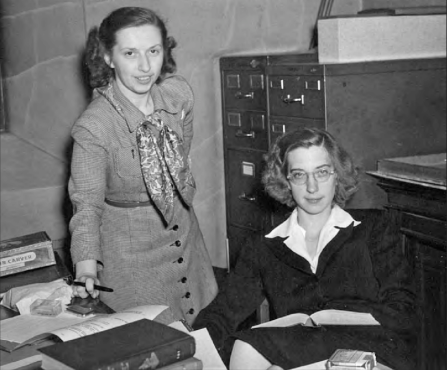
Marian E. White (right) and fellow Science Guide, Mary Templeton, in their office at the Buffalo Museum of Science. Photograph courtesy of the Buffalo Museum of Science.

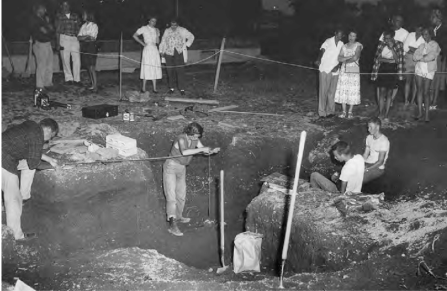
Marian E. White (center) in the summer of 1959. Excavations continued through the night at the Kleis site, Hamburg, NY, Niagara Frontier Archaeological Project. Photograph courtesy of the Buffalo Museum of Science.
Archaeological Survey
University at Buffalo
Department of Anthropology
380 Academic Center, Ellicott Complex
Buffalo, NY 14261-0026
Phone: 716-645-2297
Fax: 716-645-6371
Email: perrelli@buffalo.edu
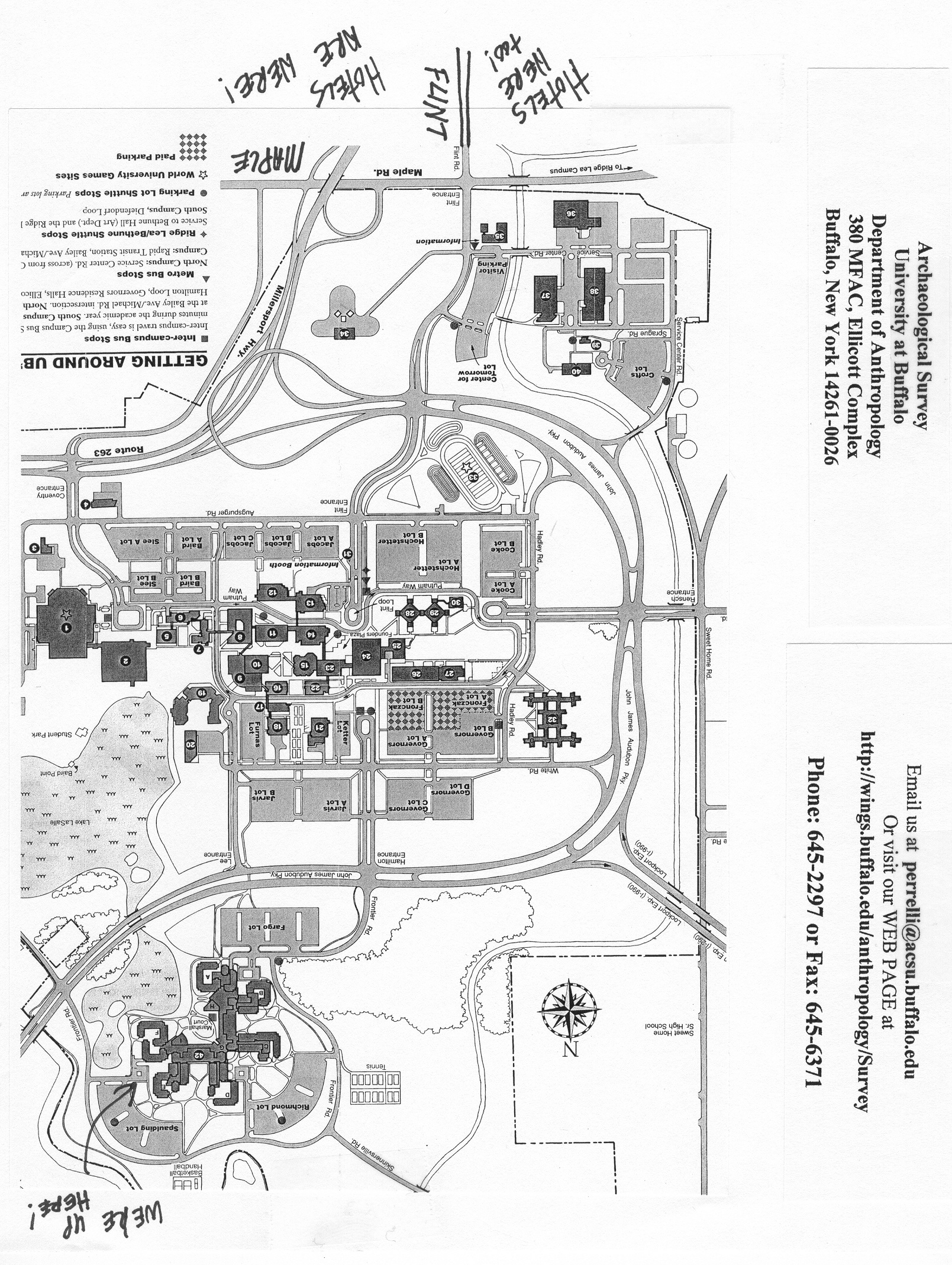
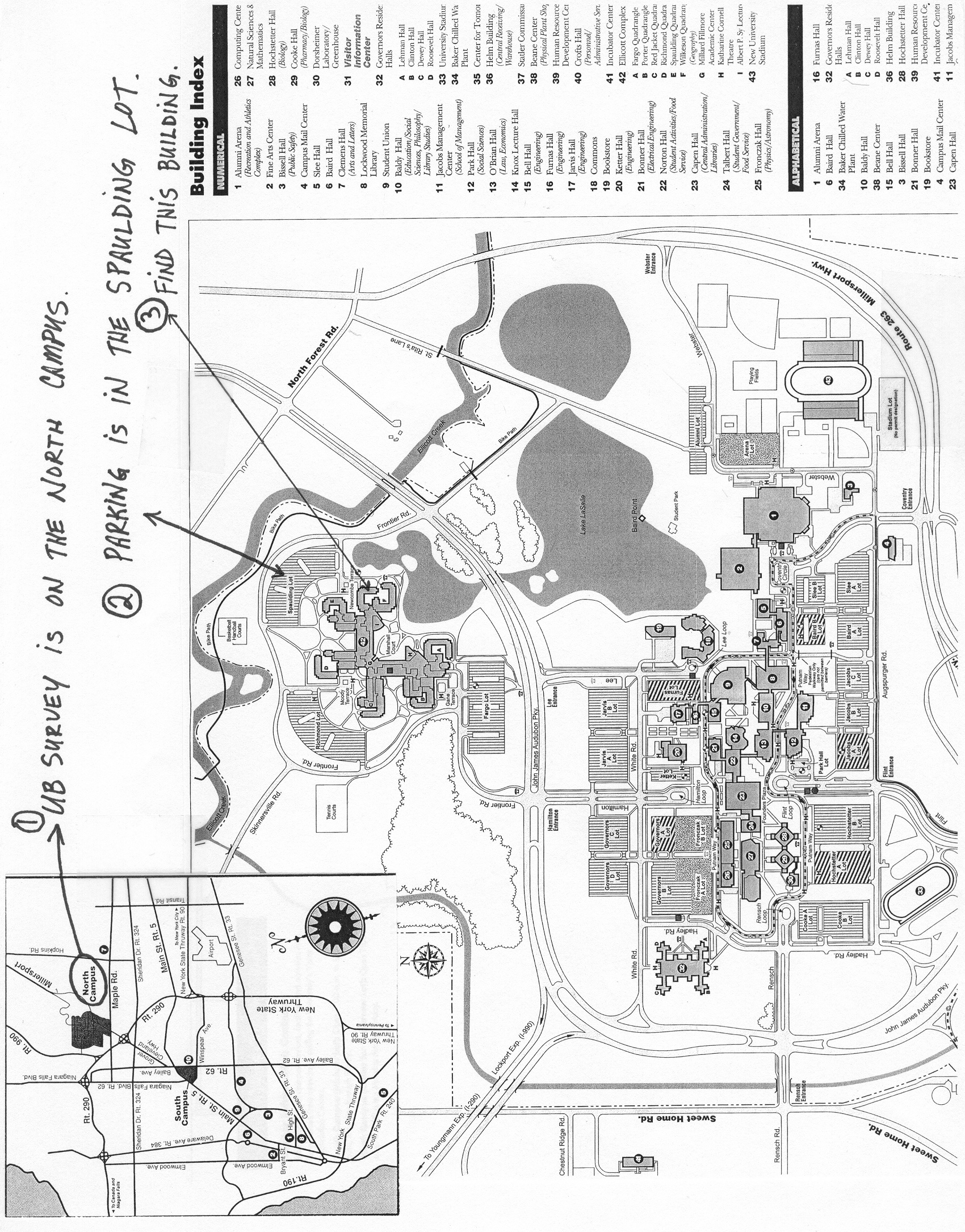
When you arrive at the University at Buffalo North Campus:
- Park in the Spaulding parking lot
- Walk towards Spaulding and Wilkeson Quads
- Enter Tunnel Road between Spaulding and Wilkeson Quads (This is the road/tunnel where the buses drive under the buildings)
- Head down sidewalk on left side of tunnel towards Academic Center
- Pass Wilkeson loading bay on your left
- Pass blue signs for Academic Center and Wilkeson on your left
- Pass double glass doors on your left
- Enter next single glass door on your left, labeled 261
- Immediately go upstairs, one floor, via brown door in vestibule on right
- Enter Archaeological Survey area through door labeled 261
- Turn to left and enter Archaeological Survey
Campus maps and specific directions to the Campus Spaulding Parking Lot [Campus Map 1 and Campus Map 2].