| VOLUME 31, NUMBER 2 | THURSDAY, September 2, 1999 |


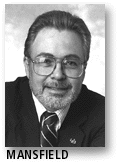
John Mansfield is director of the Campus Ministries Association in the Division of Student Affairs. After serving as chaplain at campuses that include Princeton, Cornell and the University of Rochester, he arrived at UB in 1979, making him UB's longest-serving campus minister.
What groups and denominations are served?
Others of our group are Christian associations that are not churches in themselves, but service many different churches (we usually call these "para-church organizations," which means they are "alongside" the traditional churches). My own position is that I am the local head of Campus Crusade for Christ, which is one of the largest para-church organizations with 21,000 full-time workers worldwide in 181 nations. Locally we have five chaplains for the area colleges, and two more who serve as chaplains to the Buffalo Bills and Bisons under our Athletes in Action branch. Other para-church groups in CMA include BASIC (Brothers and Sisters in Christ), InterVarsity, International Students Inc., University Christian Fellowship and Youth with a Mission.
Finally, we have other faiths represented in the CMA, with Hillel and the Chabad House serving the Jewish student population, and also the Baha'i Association and Unitarian Ministry. At this time we don't have any representation for some of the other world faiths (Muslim, Buddhist, Hindu), but we are open to their involvement if some group wished to apply. Essentially, you can say we've got a great variety that will suit most students here at UB-and I would encourage students to check out all the options!
How many students take advantage of what Campus Ministries has to offer?
Are you seeing the number of students who attend religious services growing or shrinking? Are students becoming more spiritual?
What is the role of Campus Ministries at a public university?
Tell me about new programs for the upcoming year.
I understand you're an adjunct lecturer in the Classics Department. What is your area of specialization?
Tell me something about yourself that nobody knows, but should?
What question do you wish I had asked, and how would you have answered it?
We have a good working relationship with the university, and they have been very gracious in allowing us to minister and work on campus. We get to serve on several councils and committees, and our personal friendships run deep.

 What is the function of Campus Ministries?
The Campus Ministries Association is an umbrella organization for religious faiths and associations at UB. We want to be a unified voice in speaking to the university, and in dealing with university offices and the administration. At the same time, we are a recognizable entity for those outside the university to connect with, since people not at UB often find it bewildering to conduct activities here. We are not a faith ourselves, but we are a professional association, with 16 member groups.
Some of the member organizations of CMA are traditional Christian denominations, such as the Catholic Campus Ministries, Episcopal Ministry, Baptist, Lutheran, Chinese Church, and the Campus-Church Connexion, which serves mainline Protestant churches.
That's a hard one to answer, since we don't keep records of how the groups are doing. Some seem to attract large numbers to their weekly services, and I know that attendance at our own Campus Crusade weekly meetings has averaged over 100 students each week, and we estimate that we have contact with 2,000-3,000 students each year. Because we informally interact a lot with the students, I would suspect that the number of students who have contact with all the Campus Ministries would be surprisingly high!
I would think that attendance has either remained stable, or risen somewhat in the last couple of years. As far as spirituality, students today are far more spiritually inclined than in the past. It may not be expressed in the traditional ways to which we've been accustomed, but everywhere I go, students want to talk about spiritual issues. I sense that a lot of questioning is going on in their minds-good, honest questions-and I've had excellent conversations with students here. One caution I would express here, though, is that sometimes students today often don't have much religious background, and so don't possess the "theological grid" to evaluate faiths and issues. Thus, they may find themselves exploring religious options that are unhealthy, or manipulative.
In Biblical terms, religious men and women served as ministers (priests) or prophets. Priests were the ones to intercede for people to God, and prophets were the ones to speak from God to the people. Well both of those are applicable for campus ministries at this university. Students, faculty and staff still need those who can direct them to God, and help them grow in their relationship with God-and people everywhere are hungry for this! At the same time, we need men and women who will spend time with God and then speak as a spiritual conscience to the soul of the university. If we are merely churning out competent intellects, then we have created amoral machines, and this would be disastrous for our society. I think the events of the past year in the public high schools, such as Columbine, tell us that we need to be touching the soul of the student, and not just their brain. This is a difficult task for a public university, but one for which campus ministries are well suited.
That would depend on each organization and their plans, and as we are just beginning this fall I haven't heard much yet. One highlight for our Campus Crusade for Christ group is that we are flying in Walter Bradley, who has been head of mechanical engineering at Texas A & M, to speak on "Scientific Evidence for the Existence of God." When he spoke on this topic some years ago, we had standing-room only, and I expect it'll be the same again this year.
The Religious Studies Program of the Classics Department has graciously provided opportunity for several of the campus ministers to teach courses there. Personally, I have four courses in the curriculum (one per semester in a two year cycle), with two of my courses on Church History (Western, American), one New Testament (Pauline Epistles) and one is a Survey of Christian Theology. It's been great to teach students-classes are always full, the interaction is stimulating, and the interest level is very high. I'm hoping that one day this will be a full department at UB (if we can shake loose some funding from Albany!).
When I headed off to college, I was trying to get as far away from religion as I could-I even changed my preferred first choice for college when I learned that I would have to take some religion courses! So I found myself at Boston University, pursuing radical politics in the antiwar movement, and doing all those things expected of an activist. But in the course of my second year I ran across some Christians who challenged me with the possibility of knowing God in a personal way, through His Son Jesus Christ. It took a lot of debating and investigating, but that is when I began my own personal relationship with God. I thought I knew what radical politics was like-but it was nothing compared to the radical changes God made in my own life! By the time I graduated I knew I was sold for life to be in service for my Lord, and now-of all things!-I teach religion courses! God has a great sense of humor!
What sort of relationship do we have with the university proper?
At the same time, I sense that the university doesn't always know what to make of us. We march to a different drummer, and seek to follow God while living under Caeser. It's always been that way with those who minister as prophets, and has created a special dynamic between us and the university.
Front Page |
Top Stories |
Photos |
Briefly |
Q&A |
Transitions |
Electronic Highways
Kudos |
Jobs |
The Mail |
Events |
Current Issue |
Comments? |
Archives |
Search
UB Home |
UB News Services | UB Today