| VOLUME 31, NUMBER 2 | THURSDAY, September 2, 1999 |


By PATRICIA DONOVAN
A new book by more than 30 of the best thinkers and planners in the field of vocational education claims that the vast majority of American students face financially restricted futures because the American educational system promotes the success of the few over the many.
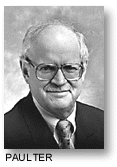
The book is "Workforce Education: Issues for the New Century" (Prakken, 1999), edited by Albert J. Pautler, Jr., UB professor of educational leadership and policy and one of the leading scholars in the field of vocational education.
The authors say that this produces an enormous drag on the American economy because young people fail to develop workplace skills needed by business and industry. Nor does the business sector do enough to promote on-the-job skills development, making it difficult for workers to update their training to keep pace with changing technologies.
And because of an inadequately prepared workforce, federal and state governments and industry itself have had to spend billions of dollars over the past few decades to teach "catch-up" skills to underemployed, unemployed, untrained individuals who have poor skills, not only in specific technologies, but in math, science and even basic reading and writing.
The workers themselves suffer serious consequences as well-a poor lifetime-earnings potential, poor self-esteem, low sense of competency and little personal job satisfaction.
Pautler, a professor in the Graduate School of Education, says that although the problem is obvious and widespread, far too little is being done to address it.
Reading, writing, math and science proficiency is required today, says Pautler, "not just for college, but for most skilled jobs and even many unskilled jobs.
"In New York as in other states," he says, "compliance with new academic requirements for graduation is the subject of concern and debate among school administrators, politicians, parents, students and teachers. It also has been subject to extensive news coverage on the national, state and local levels.
"At the same time, very little effort or money has been expended to upgrade standards for technical and vocational programs on any level. Nor does the subject excite much discussion in the public forum," Pautler says, "although it is precisely that technical readiness that will have the greatest impact on the economic success of most students."
Pautler says what is needed is a greater emphasis on career awareness at the grade-school level. He says that from kindergarten on, career-exploration activities based upon sound principles of career- and vocational-development theory need to be incorporated into school curriculums.
Couple these with strong academics and actual skills-training, he says, and the result is students who become more satisfied, career-directed employees who represent a good match between the skills and interests of the workforce in a particular region and the needs of the businesses and industries that operate there.
"We need more and better training in electrical technology, the metal trades and health sciences, for instance," Pautler says, "not so we can slot kids into specific jobs while still in grammar school, but because these skills will help them to make better life choices."
Whether they end up as electrical technicians or electrical engineers, industrial technologists or machinists, medical paraprofessionals or physicians, Pautler wants students to be introduced early to the many possibilities open to them to test their interests against different career fields and be given the social, academic and vocational skills to pursue their goals.
"Like our high schools, and even our elementary schools," Pautler says, "technical schools and community colleges, too, must learn to respond more quickly and appropriately to the ever-changing demands of the nation's labor force."
He says the unmet need for relevant vocational-training programs also extends to the workplace, where on-the-job training could continually upgrade the skills of employees, thus economically empowering young workers.
What's the solution?
The contributors to "Workforce Education: Issues for the New Century" propose numerous solutions to give students a leg up in the workplace. Among them are:
- Major emphasis at the elementary level-beginning in kindergarten-on the systematic provision of knowledge and skills through curriculum and extensive cooperation of teachers and counselors; career guidance that prevents premature closure of future options; positive attitudes toward self and opportunities; feelings of competence and exploration and preparation for the future. Also, emphasis on the relationships between work habits and attitudes developed in elementary school and work habits in adulthood.
- Major emphasis at the high-school level on three basic qualities-generic, universal skills-that form the foundation of the five broad basic competencies that apply to most jobs. They are: basic reading, writing, math, science and social skills; thinking skills that include creative thinking, decision-making, problem-solving, abstract visualization of problems, knowing how to learn and reasoning.
- Teaching workplace skills likely to be required in the upcoming decades and the kind of training that will best develop those skills.
- Effectively integrating vocational education with academic and career education. Methods include "career academies," school-to-work programs, vocational-education undertakings, technical preparatory programs and technology education.
- A closer relationship between schools, local chambers of commerce and area employers, which is necessary to identify and predict the work skills-especially technical expertise-that local employers will be seeking.
- The recruitment of new teachers who speak the languages of the new workplace and understand the kinds of training programs that will serve it.
- Cooperative involvement with local businesses to conduct an ongoing assessment of the skills their employees will need now and in the future.
Contributors to the book, edited by UB's Albert J. Pautler, Jr., include Kenneth B. Hoyt, the father of the career-education movement.
Besides Pautler, contributors from the UB Graduate School of Education faculty include Stanley Cramer, professor in the Department of Counseling and Educational Psychology, and Conrad Toepfer, a professor in the Department of Learning and Instruction and a widely recognized middle-school expert.
Several contributors have studied under Pautler at UB: Michelle Sarkees-Worcenski, a professor at North Texas University; Cheryl Hogg, a doctoral candidate in educational leadership and policy at UB and a school counselor on leave from the Buffalo Public Schools, and John Craig, also a doctoral candidate at UB and a tech-prep coordinator for Orleans-Niagara BOCES
Students may face uncertain futures, experts say

News Services Editor
 It maintains that the anachronistic U.S. educational system fails to teach necessary academic skills and technical workplace skills to the 70 percent of American high-school students who will not graduate from a four-year college. Furthermore, virtually nothing is being done about it.
Front Page |
Top Stories |
Photos |
Briefly |
Q&A |
Transitions |
Electronic Highways
Kudos |
Jobs |
The Mail |
Events |
Current Issue |
Comments? |
Archives |
Search
UB Home |
UB News Services | UB Today