| VOLUME 31, NUMBER 2 | THURSDAY, September 2, 1999 |


By JENNIFER LEWANDOWSKI
David Schmid admits to having an obsession with serial killers. But his obsession doesn't bother him-his work depends on it.
Schmid, an assistant professor of English, has been working on "Mad, Bad And Dangerous to Know: Serial Murder and Contemporary American Culture" for several years. The book, Schmid says, examines how and why the serial killer has emerged as a popular cultural figure in America, and takes a look at the consequences of the public's fascination with these criminals.
What was unique about the case, Schmid says, was the public's response to the killers.
"The female was much more condemned. She seemed to violate certain expectations about conventional femininity," he says. "The condemnation told us, in a way, that society expected a certain amount of violence (from men). It was almost excused."
The assumed birthright of men "to have that kind of power and independence," Schmid says, figured into his research at Stanford University, where he enrolled in the Modern Thought and Literature Program, a degree-granting, interdisciplinary program.
"The program...was very rare in that they encouraged you to do quirky projects," he says, which allowed him to delve deeper into the serial-killer phenomenon. Schmid became particularly enticed after reading Anne Rule's "The Stranger Beside Me," a book devoted to serial killer Ted Bundy.
"Bundy seemed to embody a lot of things American culture cherishes and holds dear to itself," he says. On the other hand, "he seemed to...expose the underside of the American dream. He could not practice deferred gratification. He saw what he wanted, and went after it."
In 1991, the film "Silence of the Lambs," based on the novel by
Thomas Harris, was released, a movie that vilified the fictional serial killer Buffalo Bill while portraying Anthony Hopkins' character of Hannibal Lecter as intelligent and culturally refined.
That same year, Jeffrey Dahmer was exposed to the public as a cannibal killer. Schmid was taken with the media frenzy surrounding these events, as well as the public's increasing interest in the lives of such individuals.
"Something was happening in America in the 1990s that was making the serial killer into this influential and popular cultural figure," he says. "We're cheering on the one hand, booing on the other."
While the media has played a large part in stirring interest in serial murderers, the FBI had its own agenda as well, Schmid says. In the mid-1980s, federal law enforcement agencies were looking for ways to attract more funding and expand their sphere of influence, Schmid says. The FBI's way to get more money was to create a problem where one didn't exist, Schmid says, "and serial killers fit the bill." He says it wasn't the attention to the subject that was bothersome, but rather, that the FBI acted irresponsibly in feeding the public inflated figures on how many serial killers actually were in the country at the time.
Bundy, whose killings spanned the 1970s, became the "poster boy" for the FBI, Schmid says. "He traveled from state to state, was very prolific, was a sexual sadist (and was) the most attention-grabbing, headline-grabbing killer there is."
The FBI, as well as the media, capitalized on the public's fascination, Schmid says. The handsome, articulate Bundy was "mediagenic," Schmid says, attaining a sort of celebrity status. The underside of the American dream, the killer's disregard for consequences, was appealing in a warped way, Schmid says. "We are told we can have everything-we should have everything. And yet, every day, we experience life very differently," he says. "The public sees (serial killers) as liberated. They've given into their more primitive urges."
It's the combination of closeness and distance that serial killers have to the public that is so crucial, Schmid says. "If we don't manage to persuade ourselves that they're different, then we lose the ability to identify," he says. "(The killers) are just different enough to be titillating and exotic, but the same enough to be identified with."
Schmid recalls the fear generated by Son of Sam killer David Berkowitz, explaining that while Berkowitz's identity was unknown, the public imagined a monster. But Berkowitz appeared relatively normal. "We see this short, pudgy postal worker who looks like Neuman on 'Seinfeld.' This is Son of Sam?" The public had to convince itself that Berkowitz wasn't normal.
Schmid points out that the public's perception of what is normal creates another danger: Domestic and other forms of violence may receive far less attention because they're too close to home. Schmid believes the American public needs to refocus on these other forms of violence, which he says "are far more serious than serial murder, but...less 'mediagenic.'"
In preparing his book, Schmid has written chapters on the FBI, Jack the Ripper, true-crime books, Bundy and Dahmer, serial-killer films and authors Harris and Bret Easton Ellis, who wrote "American Psycho."
"It's a loose, baggy monster of a book," Schmid says, and finding an endpoint hasn't been easy, but he's ready to move on. He wonders, though, if the era of public fascination is over, or if it's merely dormant.
"You almost worry that you're going to turn on the news and see another Dahmer, and that would mean another chapter in the book," he says.
Schmid is sure of one thing. "These cases and obsession give us a window into how the culture works," he says. "We're always haunted by the fact that they (serial killers) are not so different after all."
Forthcoming book looks at public fascination with serial killers

Reporter Staff
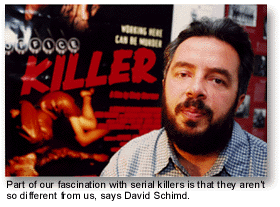 Schmid, who has been a UB faculty member for five years, first became acquainted with serial killers while working on his master's thesis at the University of Sussex in England in 1988. One of Britain's most celebrated cases involving a couple known as the "Moors Murderers" piqued his interest.
Front Page |
Top Stories |
Photos |
Briefly |
Q&A |
Transitions |
Electronic Highways
Kudos |
Jobs |
The Mail |
Events |
Current Issue |
Comments? |
Archives |
Search
UB Home |
UB News Services | UB Today