| VOLUME 31, NUMBER 16 | THURSDAY, January 20, 2000 |


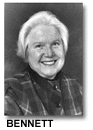
Helju Bennett, associate professor of history, specializes in imperial Russian history. A native of Estonia, she received her doctorate from the University of California, Berkeley.
I'm sure the health issue was one consideration. He also made a deal to have what amounts to immunity from prosecution for various misdeeds and corruption that might be found if he were investigated by a hostile party. The immunity apparently applies also to his family. He was given various perks, pensions and other benefits. What is equally important is his expectation that the man he picked will be his successor. I'm not so sure that he was motivated by the problems with the economy.
Who is Acting President Vladimir Putin and how do you think he will govern?
He is young. He has the old Soviet secret police background and served in the foreign intelligence section. So he seems to know more about Europe and how it works than other candidates. That is a hopeful sign. How will he govern? As we have heard in his "I will not be lectured" speech, he also is trying to prove that he will stand up to the United States. He already has indicated that he will continue with the reforms, and made some speeches that indicate that he will try to get out from under subsidizing the obsolete, Soviet-era, militarized industry.
Putin appears to be the leading candidate in the March presidential election. What would his election mean for U.S.-Russian relations?
Since Putin is trying to prove that he will stand up for Russia's "great-power" status, he probably will be more confrontational.
Will Yeltsin have any role in the future of the country?
I do not think Yeltsin will have a role in government. He probably will be in public as a curiosity, as he has been on his pilgrimage to the Holy Land.
What are the conditions like for ordinary Russians now, as opposed to life under Communism?
There are many very poor people, especially mothers who lost their jobs, and older people living on pensions that are worthless and sometimes not paid. They must pay market prices for things. But there was much poverty in Soviet times, but it was better hidden. Some people are better off though, and at least they can help themselves. And it is now legal to "start things"-that is to buy, sell, start a business, become entrepreneurs. The old bureaucrats are still there trying to force everyone to get permits for doing anything, though, and that makes self-help harder. And the Mafia is insisting on getting its share. The old Soviet era "economy of favors" is still functioning. There is much reliance on kitchen gardens that many people cultivate for themselves, and much bartering. People get paid in goods but they must find buyers for themselves. I hear that some teachers, for instance, who get paid in vodka are well-off. It is a liquid currency, very desirable. Others who get paid in gravestones have fewer takers. And illness is pervasive.
Could you briefly outline the reasons for the conflict in Chechnya? Does the U.S. have a security interest here?
Chechnya is next to, and even sitting astride, very significant oil reserves. Russia does not want to lose access to those resources. It is something the world market is willing to buy. Also, Chechnya is a minority region with proud ethnic minorities who do not want to be ordered about. So this is an area where the Russian leaders, who want to prove they are macho-men, think they can prove they are tough. That pleases the wounded pride of the Russian people who long for the old "empire." U.S. security interests are involved, it appears, whenever violence occurs that might spread. And the supplies of oil nearby does potentially affect the U.S., although the U.S. seems to be trying to secure access to oil in the general region via a pipeline built across Turkey.
What question do you wish I had asked, and how would you have answered it?
The question that needs to be explored is: why it is so difficult to change Russia? The answer, however, requires that we explore the nature of the Russian past and Soviet institutions that made it illegal for people to solve their own problems without first asking for, and getting permission from, the government. How much of this old system is still in place has taken me a year's survey course to deal with. We'd better leave it for another time.

 What's your take on the resignation of Boris Yeltsin? Was it prompted by Yeltsin's poor health, or the country's poor economic condition?
Front Page |
Top Stories |
Briefly |
Q&A |
Transitions |
Electronic Highways
Sports |
Obituaries |
Exhibits, Notices, Jobs |
Events |
Current Issue |
Comments? |
Archives
Search |
UB Home |
UB News Services | UB Today