| VOLUME 31, NUMBER 13 | THURSDAY, November 18, 1999 |


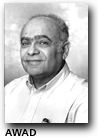
Atif Awad is associate professor of nutrition and biochemistry, and director of the Nutrition Program in the School of Health Related Professions. His research interests include the links between dietary fat and colon cancer, obesity, and signal transduction, phytosterols and cancer.
Yes. The United States is a rich country, and people overdo it. We have all the technology, and thus lead a sedentary lifestyle. With a less-physical lifestyle, people eat more. Roughly one-third of the population is either overweight or obese. Someone is considered to be overweight if his or her weight is 10 percent or more above the ideal body weight. Someone is considered to be obese if they weigh more than 20 percent above the ideal body weight. There are numerous health problems associated with obesity, including diabetes, heart disease, arteriosclerosis and kidney disease.
In your opinion, what is the worst thing about the American diet?
High fat and calories. About 37 percent of the average diet comes from fat calories. The American Heart Association, the American Diabetes Association and the American Cancer Society all suggest a more reasonable diet would be one in which no more than 30 percent of calories come from fat. But it is hard for Americans, who are used to spreading butter on their food, to lower fat in their diets. While fat-free products may appear to be the answer, manufacturers have to substitute something in these foods in place of the fat. That usually is carbohydrates. If you increase carbohydrates, you increase triglycerides, or fat in the blood, which leads to arteriosclerosis and contributes to obesity. Moreover, fat-free products do not fill you up like products that contain fat. So you eat more of them, consuming more calories. It is best to have a balanced diet that cuts the total number of calories. And the way to cut calories is to eat less or expend more energy by exercising. But we all know that's easier said than done!
What do you think of the high-protein diet controversy?
The diet has problems. It is a high-fat diet, which could contribute to atherosclerosis. It puts too much stress on the kidneys. It lacks several essential nutrients, such as vitamins and minerals. The elimination of carbohydrates from the diet induces ketosis and acidosis, which could affect the function of several tissues. Diets rich in proteins are more expensive than balanced diets. The diet lacks fiber, which plays a role in protection from colon cancer and diverticulosis. And it induces gas in the gastrointestinal tract due to the high fermentation of protein, which could cause some discomfort in some patients.
If you could get people to change just one thing about their diets, what would it be?
I would have them lower the total number of calories they consume.
Your research has shown that plant-based fats can inhibit the growth of prostate, colon and breast cancer cells. Should we consume more plant-based fats? If so, what foods should we eat?
Yes, we should consume more plant-based fats. Foods rich in phytosterols are plant foods. The best sources are unrefined plant oils, such as soybean, peanut oil, sesame oil and virgin olive oil. The second-best sources are nuts, such as peanuts, and peanut products, such as peanut butter and peanut flour.
Are vitamins and other supplements necessary if you eat a balanced diet? What do you consider to be a balanced diet?
You do not need supplementation if you have a well-balanced diet. The latter implies that the diet has all essential nutrients.
Do herbal supplements, like St. Johns' wort and echinacea, really work?
There hasn't been enough research done in this area yet to make a determination. So for now, you either are wasting your money or you could be putting your health in danger by taking these supplements.

 Recent studies have asserted that obesity is our most pressing nutritional problem today. Do you agree?
Front Page |
Top Stories |
Photos |
Briefly |
Q&A |
Kudos |
Electronic Highways
Sports |
Obituaries |
Exhibits, Jobs, Notices |
Events |
Current Issue |
Comments? |
Archives
Search |
UB Home |
UB News Services | UB Today