| VOLUME 30, NUMBER 21 | THURSDAY, February 18, 1999 |


You have won six prestigious awards from Dance Masters of America, including the Ivy Hall Foundation Award, also won by Gene Kelly. What does it take to get this kind of recognition in the dance world ?
What type of dance do you enjoy most?
What is your most memorable performance?
What is the most challenging aspect of putting on a Zodiaque performance?
What question do you wish I had asked, and how would you have answered it?
 Tom Ralabate, assistant professor in the Department of Theatre and Dance, is co-director of the department's Dance Program and director of the Zodiaque Dance Company, which will present Silver Anniversary, its spring concert, this weekend.
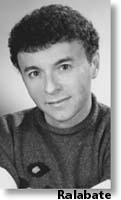 How did you first get involved in dance?
As a youngster, I would come home from school every day to view Dick Clark's "American Bandstand." The show was taped in Philadelphia, where after school they would bring in local high-school students to dance. My cousins, who lived in Philadelphia, would often appear on the broadcast. As I looked for my cousins on the dance floor, I found myself imitating the movements to the popular rock 'n' roll sounds. My sister, who is 22 months younger than I, was a perfect partner to play and fool around with the Jitterbug dances that were popular at the time. Having little interest in sports, I asked my Dad if he would send me to dance school to learn how to do that which I was watching on TV. To my surprise, he started my sister Kippy and me in tap and jazz-dance classes. About the same time, my parents began taking group ballroom-dance classes with friends and decided that we should also learn how to do more social-type dances like the Waltz, Foxtrot and Cha Cha. Little did any of us know, this would lead to a competitive Ballroom and dance career. Despite the teasing of my peers for studying dance, I never deserted my dream, knowing it would always be a major focus in my life. Being blessed with supportive parents made it easier to pursue this goal.
Being a recipient of any award has always given me cause for humble reflection. For these achievements are never the result of a single person, but the collective influence of many talented individuals. Surrounding myself with exceptional teachers, artists and colleagues in my field has allowed me to grow and mature as an artist. You take all of this knowledge and talent and apply it consistently throughout one's career, always striving to make a difference, creating the opportunity to set higher standards. Perhaps consistent hard work is 99 percent and talent is merely 1 percent of the equation. The Ivy Hall Foundation Award was awarded to me for outstanding contributions in the establishment of educational standards for dance. Creating a jazz dance syllabus and jazz exam for teacher certification into Dance Masters of America entailed all of the components previously mentioned: hard work, life experience and taking a chance by making others aware on a national level of the growing need for educational standards in dance education.
I truly enjoy all types of dance and respect the different approaches and journeys one takes to discover movement. Jazz dance, however, embodies a spirit which is free and rich in tradition. I see Jazz dance as a multi-ethnic ballet heavily based in African and Euro-American traditions. Its colorful terminology borrows from historic roots, vernacular dances, social dances, tap, ethnic, American modern dance and musical theatre dance. It connects socially and politically to the pulse of the time. Since Jazz dance and Jazz music evolved together, this style of dance allows for a marriage between music and movement. Being a musical person, my choreography and classroom instruction tend to utilize this type of union.
As a performer, my most memorable performance was with my sister Kippy at the North American Latin Ballroom Dance Championships. Being the youngest couple competing in what was our first exposure to an international competitive performance, we were not expecting to win. The evening was magical. Our dances were executed as close to perfection as possible. When we were announced as the winners, my eyes shifted to my dance coaches, Barbara Cameron and Jeff Hensen (former Canadian professional dance champions), whose faces were ecstatic with joy and approval of our performance and accomplishment. The full year of preparation paid off. And while I will always remember the look of joy and approval on their faces, the real value of what I learned was the importance of process and preparation, and that winning a trophy is just frosting on the cake. As a choreographer, I have had many memorable moments. If I had to pick one performance, it would be a duet I choreographed in 1993 titled "LOVE GIFT." Stephen Hunneshagen and Martin Nagel, performing members of the Zodiaque Dance Company, performed the male pas de deux for a spring concert titled "International Affairs." A month before beginning this project, I viewed a new play presented by the Department of Theatre at the University of Maryland entitled "The Quilt: A Musical Celebration." The play is based on the individual stories of love, pain, fear and compassion that comprise the many stories from the Names Project AIDS Memorial Quilt. The subject of AIDS inspired me as a vehicle for a piece of choreography. This performance became memorable when I heard an array of bravos at the curtain call for the two performers. Of course, along with the bravos came the objections and disdain for this controversial subject matter, and the choreographic choices I made to present this work. Being able to move an audience to such heights on so many emotional levels was a first for me. This experience opened a door for me to explore and take risks with my work, and integrate more controversial topics with dance.
The most challenging aspect is creating a repertoire that challenges the company members on a technical, artistic and educational level. The performing and educational focus of the participants has from its inception been a strong tradition established by Linda Swiniuch, founder and director of Zodiaque and the UB Dance Program. As the newly appointed director of Zodiaque, my challenge is to hold onto this established tradition and move the company forward with a promise for the future. This semester, I feel I have met this challenge, inviting for the first time two distinguished Zodiaque alumni as guest artists: Jeffry Denman and Jon Lehrer, who have choreographed works for Silver Anniversary, our 1999 spring concert.
This spring semester, we will accept our first candidates into our newly approved degree programs: BA in dance, BFA in dance and theatre, and a BFA in music theatre. In offering a professional-type degree program such as the BFA, I wish you would have asked what makes one a professional? To be a professional, you need to ask yourself, "Do you love what you do?" If the answer is yes, then it is expected that you take responsibility for the well-being of your professional life. As a professional dance educator and company director, a part of my professional life is the type of instruction and program that I provide to students. It's paramount for me to make sound choices, taking a strong look at myself and asking what have I done to ensure that the teaching methods and programs I helped institute are the best they can be. My actions indicate the value I place on my profession. In doing so, I become a role model and exemplar of responsibility for students.
Jobs | Obituaries | Y2K@UB |
Current Issue | Comments? |
Archives |
Search
UB Home |
UB News Services | UB Today