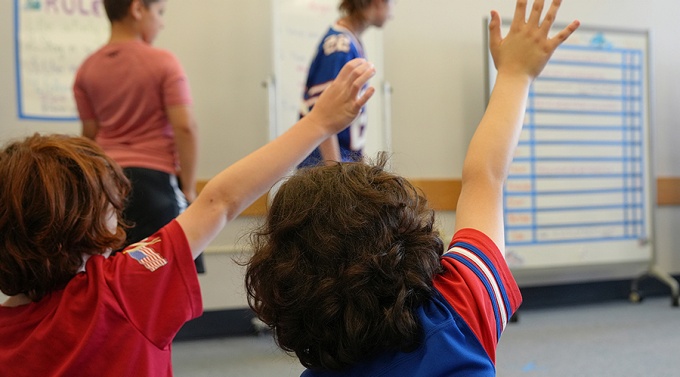
Intervention program for children living with autism and with no intellectual disability significantly improved their social performance.
The event will address the displacement of former Yugoslavian feminists and LGBTQ+ individuals.
Experts from Harvard and Human Rights Watch are among the presenters at the annual event honoring the memory of the UB-affiliated historian.
Ekaterina Noyes was honored by the Association for Clinical and Translational Science.
Presented with the Folger Shakespeare Library, the event will explore the playwright’s role in reinforcing and contesting questions of race, class and culture.
The UB alum and director of the Center for Tobacco Products explained his roadmap to successful tobacco regulation.
The big data study found excess risk of blood clots was 1.4 cases per 1 million people vaccinated, far fewer than cases caused by COVID-19.
“Six Triple Eight” dramatizes the Women’s Army Corps (WAC) 6888th Central Postal Directory Battalion, the subject of Brenda Moore’s book.
The $1.5 million NIH award to UB and partners will train 10 Jamaican scientists focusing on emerging and chronic viral infections.
Susan Clark and Nicholas Rajkovich have been tapped for a NYS series exploring extreme heat and climate change.
The symposium hosted by the Center for Information Integrity brings UB and visiting scholars together to address the problem of misinformation.