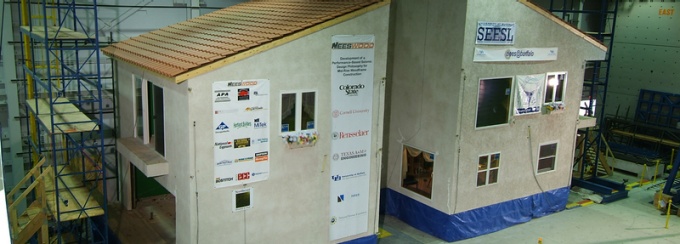
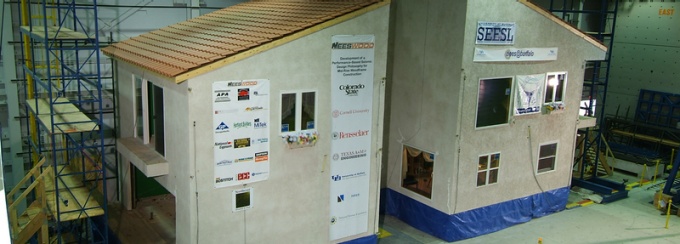
Over the years, SEESL has conducted research projects with university faculty and students, as well as working with groups such as NEES and MCEER. Below you will find current and past research projects that have been conducted here at SEESL.
A real-time hybrid fire simulation algorithm is developed and tested to capture the expected behaviour of a steel column within a structural frame, considering the slow thermal expansion of the stiff steel column at early stages of fire, followed by a dynamic failure when it buckles.
Recent studies have shown that the seismic load case can substantially increase the overnight capital cost (OCC) of safety-class equipment in advanced nuclear power plants.
This experimental program focuses at development, implementation, and validation of a novel control design strategy, based on impedance matching, for executing real-time hybrid simulations
An experimental program using a 6 degree-of-freedom earthquake simulator at the University at Buffalo was executed to generate data for supporting validation of numerical models for seismic fluid-structure interaction analyses of conventionally supported and base-isolated advanced reactor vessels.
Seismic design, qualification, and risk assessment of liquid-filled advanced nuclear reactors will rely on verified and validated numerical models for seismic fluid-structure interaction (FSI) analysis.
There is a growing interest in using coupled composite plate shear walls/ concrete-filled (CPSW/CF) for high-rise building construction, particularly to optimize the design for wind and/or seismic load combinations. This test series investigated the inelastic cyclic response of C-Shaped and T-Shaped walls typically used in core-wall structures.
A three dimensional seismic isolation system was developed and experimentally validated for high-voltage electric power transformers of weight in the range of 300 to 800kip. Although the validation concentrated on electrical transformers, the system is currently (2019) under construction in a hospital in California.
A novel configuration for damping devices with the main advantage of preserving open space within the frame of installation was developed and tested. The acquired test data were used for validating analytical and computational models.
Research was conducted on concrete filled steel sandwich panel walls (CFSSP-Walls) in order to investigate the ductility and seismic performance of this structural system under in-plane flexure.
SEESL is equipped with many large-scale, high-performance, dynamic and static actuators. These actuators provide the ability to conduct dynamic, pseudo-dynamic, and hybrid pseudo-dynamic testing. Find out more about our actuator capabilities.
Furnace
1/8/24
The electric furnace has a maximum operating temperature of 1,000°C (1,800 °F) and is designed to accommodate a fast ramp-up heating rate. The furnace roof is removable and includes a central closure hole to allow placement and force loading of vertically oriented element. The closure hole on one side allows for placement and loading of a horizontally oriented element. Learn more about it.
The multi-fan wind tunnel is is controlled by 64 inertia array (8x8) of small axial fans. These fans can be controlled individually or in groups using the the supplied software. Each individual fan can reach a maximum of 5,500rpm (rotations per minute). Learn more about it.
For earthquake simulations, one of the services we provide are shake tables. Currently, there are two, relocatable 7.0m x 7.0m platforms with six-degrees of freedom. Each table is capable of 50 tons payload. Find out more about our shake tables.