Over the years, SEESL has conducted research projects with university faculty and students, as well as working with groups such as NEES and MCEER. Below you will find current and past research projects that have been conducted here at SEESL.
Buckling Restrained Braces application to provide more resilient bridges have been subjected to cyclic displacement histories representative of yearly thermal demands and of earthquake excitations. One of SEESL’s shake-table was used to apply displacement histories.
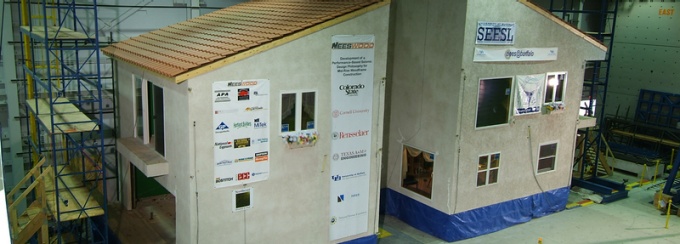
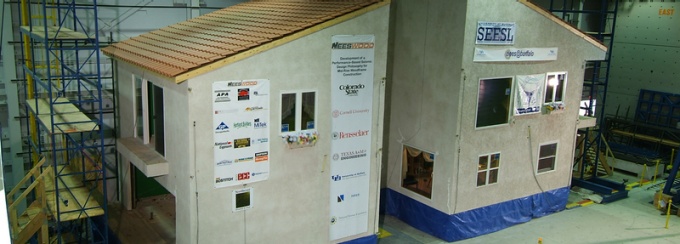
A full-scale, two-story, light-frame wood townhouse building, designed according to modern US engineered seismic design requirements, was tested on two tri-axial shake tables operating in unison, as part of the testing program defined for the NEESWood Project.
As part of an analytical and experimental study on a proposed self-centering steel plate shear wall (SC-SPSW) system, the behavior of SC-SPSWs was developed investigated using one-third scaled single-bay three-story frames subjected to quasi-static cyclic and dynamic shake-table testing.
The main goal in this project was to study the behavior of Concrete-Filled Double-Skin Tube (CFDST) columns subjected to fire following earthquake scenarios. For this purpose, the behavior of CFDST columns with various degrees of simulated seismic damage was examined under the standard ASTM E119 (ASTM 2012) fire, using both experimental and numerical approaches.
Towards the goal of protecting acceleration-sensitive equipment, isolated floor systems were subjected to earthquake excitations as well as story level horizontal excitations from representative floors in buildings having been retrofitted using structural fuses.
A novel damage-resistant system that combines accelerated bridge construction (ABC) with seismic resilience and is suitable for applications in seismic areas.
An innovative structural system was proposed as a measure to provide on-demand protection against floods. Fundamental concepts were evaluated and a structural prototype was built to conduct experimental and analytical studies. This project served as the base ground for ongoing research sponsored by the National Science Foundation.
Cold formed steel studs (CFSS), typically used in nonstructural partition walls, were studied to determine if they could be used to laterally restrain braces against buckling and thus enhance their seismic performance.
This research project carried out an extensive experimental program to evaluate the seismic response, failure mechanisms, and fragilities of full-scale steel-studded gypsum partition walls. In addition, this research aimed at developing protective technologies and design details to enhance the seismic performance of nonstructural partition walls.
Seismic response and failure mechanism of ductile iron push-on joints retrofitted with two different types of cured-in-place-pipe (CIPP) liners are investigated to verify and quantify the contributions of the liners to the seismic performance of the buried pipelines.
For earthquake simulations, one of the services we provide are shake tables. Currently, there are two, relocatable 7.0m x 7.0m platforms with six-degrees of freedom. Each table is capable of 50 tons payload. Find out more about our shake tables.
SEESL is equipped with many large-scale, high-performance, dynamic and static actuators. These actuators provide the ability to conduct dynamic, pseudo-dynamic, and hybrid pseudo-dynamic testing. Find out more about our actuator capabilities.
The multi-fan wind tunnel is is controlled by 64 inertia array (8x8) of small axial fans. These fans can be controlled individually or in groups using the the supplied software. Each individual fan can reach a maximum of 5,500rpm (rotations per minute). Learn more about it.
Furnace
1/8/24
The electric furnace has a maximum operating temperature of 1,000°C (1,800 °F) and is designed to accommodate a fast ramp-up heating rate. The furnace roof is removable and includes a central closure hole to allow placement and force loading of vertically oriented element. The closure hole on one side allows for placement and loading of a horizontally oriented element. Learn more about it.