Starlight Studio Writers


Communities of Care project co-leader, Michael Rembis, met with a group of writers at Starlight Studio and Art Gallery in downtown Buffalo weekly from August through October 2025. Each week, Rembis and the group of writers discussed themes and possible writing prompts that related to the Communities of Care project. After lively discussion, the group spent about an hour writing and sharing their work. Writers shared stories about living in group homes, caring for a pet, the importance of family and friends, and the importance of living independently. At the end of the writing process, each of the writers shared artwork that they believe speaks to the concerns and issues addressed in their writing. Below, you will find a brief biography of each writer, their writing and artwork, and an essay about Starlight Studio and Art Gallery written by its founder and director, Carrie Marcotte.
January 27, 2026
About the Writers
The Advocate
The Advocate is very proud of the fact she has self-published seven of her own novels. Her creative writing is directly linked with her visual work. From these novels she has created drawings of each of the characters. These characters go on journeys of self-discovery together within her novels. The Advocate describes them as coming of age stories. Each drawing of the characters has unique fashion sense that identifies with their personalities. The Advocate continues to work on this series creating new characters and bringing them to life with her drawings.
Alex
Alex loves to draw cartoons that are funny and a little bit scary. Her art is inspired by Japanese culture, especially styles called anime and manga. She often draws magical things like dragons, flaming horses, unicorns, and Pegasi in her sketchbooks. When she works on bigger projects, she pays a lot of attention to details and uses many colors to make her art even better. Alex enjoys using glitter-watercolor, acrylics, and colored pencils to create her special and magical artwork. Her talent for art comes from her family, and she loves to show it in her drawings.
Janet
Looking at the interaction of colors and the complexity of line in her work, one will discover a lot about Janet Harrison. She likes to create, as she puts it, “something that’s not there.” Janet loves to travel and meet people. She grew up in the Bay Area and has been all over the U.S. and has visited Mexico, Bahamas, the Cayman Islands, and Vancouver. Her work embodies her experiences, conveying her own sense of fun, mystery, spirituality, and nostalgia within the fantastic landscapes and figures.
Janet is enthusiastic about art and enjoys incorporating various designs into her drawings and paintings, including Celtic patterns, stained glass and fantasy illustration. She finds French Impressionism, Van Gogh and Chagall beautiful and inspiring. This free-thinker is also a strong self-advocate who speaks her mind.
Kelly
Kelly brings raw inquisitiveness to her artistic expression. She is quietly observant, astute, and guileless in her approach. Kelly’s explorations, many in the form of portraiture and often in reference to pop icons, utilizes a combination of words and image. Her art has an emotional quality—written all over the subject’s face or in the subject’s posture.
Kelly also writes poetry. Themes present in her visual art are apparent in her verbal expression
Melanie
Melanie developed a love of art in high school that continues today; she is excited to paint and draw. Her fondness for animals is evident in her art. Her style for painting animals is distinct, charming, and engaging. Melanie’s consistently sunny disposition lights up the Starlight Studio as does her kindness toward others. When asked what she loves? She responds with a warm smile and says “my family, friends and especially horses!" Melanie has since joined the writing group at Starlight Studio. Her most recent completed story is about her dog, Molly.
on this page


Frasquita Orchid, 8x4, Acrylic on canvas
Living the American Dream
Just because someone is born with a disability doesn’t mean they can’t have a life that is fulfilling. While my life hasn’t been perfect, I can’t really say anyone has a perfect life. I’d like to talk about some of the good things I’ve experienced to show that people like me can truly live the American Dream.
I will start by talking about home ownership. Many struggle to own homes in today’s economy. I own my own condo. I highly recommend condos for those who are ready for home ownership. Condos are like apartments that you own. Condos are also great because you have neighbors so even if you do live alone, you aren’t so alone that you feel isolated. You can decide how you want your home to be furnished and remodeled. Having my own home gives me a great sense of accomplishment.
I enjoy making art at Starlight Studios. I find making art to not just to be relaxing, but also to be a good outlet for creativity. As a child sometimes my creativity was not always appreciated. At Starlight Studios I feel I found a safe space to create; and good environment to encourage creativity. In the past I felt like I could create more at Starlight Studios than at home, especially before becoming a homeowner. I have been slowly branching back into being more creative at home by writing and drawing at home. I feel like when you have others to support you and uplift your work it can make being creative more appealing. I often used to fear sharing things I created with my parents because they didn’t have the same views I had on everything. I worried they would be insulted by what I had written even if it was fiction. If I could tell a young artist today what I know now I’d say don’t be afraid to share your work with people you love. My parents have passed, which has left me with some regret. I do feel though if they could see me now, they would be proud as I have had my work featured in several art shows at Starlight Studios and have even had my own art show dedicated to my work. I feel like being featured at Starlight Studio has made me feel more accomplished as an artist.
I have many hopes for the future. I’d love to have my own cartoon show someday based on a script I had written myself. I’d love to be able to travel to many places. I’d love to just keep learning to be honest, as I truly believe that as people we are always growing and changing. I want to live in a world with more peace where others spread love and share in each other’s joy.


Stanhopea Eburnea Orchid, 8x4, Acrylic on canvas
Having an Emotional Support Animal
Many people with disabilities enjoy the love they can get from being an owner of an emotional support animal. Caring for a pet can give you a sense of accomplishment as well as relive stress. I think it would be great if more supported and supervised apartments allowed pet ownership. If you are caring for someone who has an emotional support animal, please keep in mind this special pet may mean the world to the person you care for. In case of fire make sure you have stickers on the bedroom or apartment window to let rescue personnel know there is a pet inside the building.
People with disabilities are very capable of caring for pets. Always make sure to provide clear instructions on feeding and waste clean up. If your resident wants to have a pet, it should be explained that it is a commitment and that the pet’s needs will need to be provided for with the person’s spending allowance. It is important that when your resident has a pet that you assist them with budget regarding vet bills and, food and cleaning supplies needed to care for the pet. Your resident may need reminders to clean up after their animal if they are no longer able to recognize the smell of the pet’s waste. This can happen with pet owners as they get used to owning a pet. It is important not to threaten to remove a pet unless the resident is refusing to take proper care of the pet.
Most people with disabilities enjoy pet ownership after requesting to have a pet. I very much remember the joy of returning home from program to find my cat waiting for me. The sweet way he was always happy to see me with his green eyes and his happy smile. His soft black and white fur always felt nice to touch. Being able to entertain him with cat toys and being able to hold him close made life very enjoyable. He was a sweet cat, loving and usually looking for attention.
Being a pet owner can be a fun experience. It can be even more fun if your roommate has a pet too. Often two pets can become a bonded pair and become good friends. They can also be a way for you and your roommate to bond, especially if you both enjoy having a pet. I remember how sometimes the cats in my apartment would have little fights and would get into a little bit of trouble together. Cats will do whatever they want when you aren’t watching but that’s kind of a part of the fun. Cats don’t respond to discipline, but they do respond to treats for good behavior. It was wonderful having a cat and while my cat recently passed due to illness, I very much miss him and often volunteer taking care of cats at a shelter for the time being until I am ready for pet ownership again.

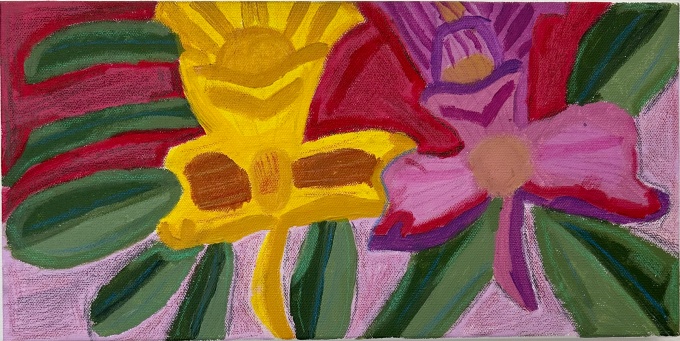
Stanhopea Orchid, 8x4, Mixed media on canvas
Self Advocation
Most of my childhood I feel like my peers had underestimated me. Often other kids in my class thought the teachers would hand me A’s and B’s grade wise and that I didn’t deserve them. I knew this because they would openly say so right in front of me. Young children and teens in general can often have no filter and say whatever they want even if it might be hurtful to others. I often found myself having to stand up to bullies who would pick on others for their differences. I was called many times retarded to my face or would hear those in school who considered themselves to be normal say others were retarded. Even if they were to say it to one another I often felt the need to interrupt and correct them which would catch them off guard. Sometimes they would get defensive and say well I didn’t mean you” and I would say that doesn’t matter, don’t call anyone retarded. It wasn’t just disabilities the school I went to had issues with racism, sexism and homophobia as well. I think it had a lot to do with people just not caring if they offended someone or just wanting to get a raise out of others for the sake of starting arguments. There really isn’t a good reason to pick a fight with someone when you just try to be a friend instead and yet the kids often would try to make enemies anyway. I can’t say I was perfect in this as I dealt with internal homophobia. I had trouble accepting who I was and at times said some mean things behind others backs in middle school and by the time high school came around I tried to be a better person, but it wasn’t always easy me to express that others that people that are a part of the LGBTQIA deserved respect. It often led to comments from others that I must be LGBTQIA because I was advocating for them. I would have to deny these accusations.
I felt like for about 5 years that I was lost in a sea. I felt pulled around by those around me and it was like my decisions didn’t ever lead to anything good. I felt like I was constantly judged for small decisions and told everything I did was wrong. By the time guardianship was filed on me I felt as though that was the last straw. I had been slowly becoming more independent before the papers were filed. I was getting to be a better worker. I had my own home, but I felt like control over my life was still not mine. My family had tried to take full control over every aspect of my life. I was starting to feel underestimated, and it was leading towards resentment. Fighting guardianship is something I am very proud of. I never really believed I needed guardianship, and I often felt that someone having control over all my major decisions like medical, housing and employment was not right for me. I was able to show the courts that it was completely unnecessary and the family member who filed had to pay to retract the proceedings. It is important not to underestimate someone you care for. do not ever assume someone wants guardship as it is very damaging to someone who is highly capable of making decisions. Guardship was always intended to be a last resort if no other type of care works for the one you care for. It is not supposed to be filed until you have tried every lesser resistive measure. Guardship takes away a person’s right to make all major decisions and should not be requested without good reasonable cause.
I believe being an artist is being creative and what you want to be as a person. By expressing yourself in a creative way and having other people know you as that.
Some people in the world have disabilities. Disabilities doesn’t mean you are broken. It means you are different in your own way and that is not a bad thing. You’re smart in your own way. Normal is overrated. No one is perfect. There will be some people who will not understand what disabilities is. Don’t let that define you who you are. Don’t let people tell you otherwise. We can make a difference in the world for people who have disabilities. People with disabilities can get married or have kids just like normal people can. People with disabilities can live independently. People with disabilities can have a job.
I like being creative- it's deep rooted.
My friend learned about an advocacy group and the group came to talk to me and a few peers and then I joined the group and started learning the right way to say things and how to stand up for myself as well as others, especially people with disabilities. So, in 2004, I started with I-Voice and have been with them ever since. I have also been a part of Freedom; as well as regional meetings and I try and attend as many conferences as I can. I am proud to be a part of this. When someone says we can’t do something, I try to prove them wrong. I feel this way after the way I was treated in a group home and now I feel like I can do whatever I want to do and I can make my own decisions. I encourage you all to join I-Voice. I would love to see this group grow back to how it used to be.
It's great, I like to make artwork and create different things in my art. It is an honor to have someone enjoy my work and have my artwork out in the community.
My experiences in group homes have been wild to say the least. I have been in 3 different homes so far. The first was awful and the staff were terrible. They would treat me like I was simple minded, like I was stupid. I felt like I couldn’t do anything because I had certain disabilities. My first group home I lived with my sister, but other than her I had no friends there. And it was really lonely. I just slept a lot because I had no time alone. I started self-harming because I felt helpless and felt like I had no control over anything. That was the first time that I received mental health treatment. And it seemed to help a little. I started a new school at this time and for the most part I enjoyed it.
I think my high school experience helped in some ways. I learned new ways to socialize and to understand social cues. A few teachers were helpful with this.
Being away from my parents finally let me experiment with new things. I like to reinvent myself and this freedom was good for me. Even though I felt like a troubled teen, I got to meet interesting people.
When I went to my second group home, I encouraged staff to do a lot more things. I was able to walk independently in the neighborhood to get snacks. I was in great shape from all the walking. I even got a pet bunny and a goldfish. The staff helped me understand what I had to do to take care of an animal. One of the highlights of this time was going with my friends to see Boy George, that was exciting.
At this time, I was being encouraged to live more independently and move to another group home. I chose to make this change. I moved to an apartment that I live alone in and have more privacy, I also have staff there to help with things I may need assistance with. I have been here for a few years now. I hope to take the next step with learning skills to move out to a more independent living experience.
Overall, I want to think positively and look to the future hopefully. I want to learn new skills and meet new people.
Lost Heart
Abusive words can keep silent
Accused of being wrong
Daddy soft, Mommy rough
I thank her,
I thank her
I thank her now
But white diamonds
Don fill the empty cracks
Of a lonely heart
Lost heart, a 1970s sitcom, sink right through
The gun shots go off
Blood stains like water, flow
Framed in shame for life
I pray for you, even though we never met,
I would never want to forget to meet you by fate
And learn every trait
Deep down
Hope now that you are in peace in heaven and God
God forgives you all you have done,
Mommy, Mommy thick as statue
But your heart is burning and hurting inside
Cupid lost his
Where has it gone?
Invisible soul has a second chance
Don’t squander it or let it wander
Sunday Morning
Soft runaway been self-taught
I learned to walk many miles
If not so it could be my trial day
Think I’m crazy
Think I’m mad
Maybe sad
But Im so very penned
No true friend
To talk to
The shadow on my shoulder
No true lover
Sitting in a room
Assuming that they are well
But you can’t tell
The elderly at a play of cards
A dark cup of coffee,
Its so simple not to see
A prisoner of your own.
My art is reflective of my life's stories and sparkles like the glitter in my artwork.

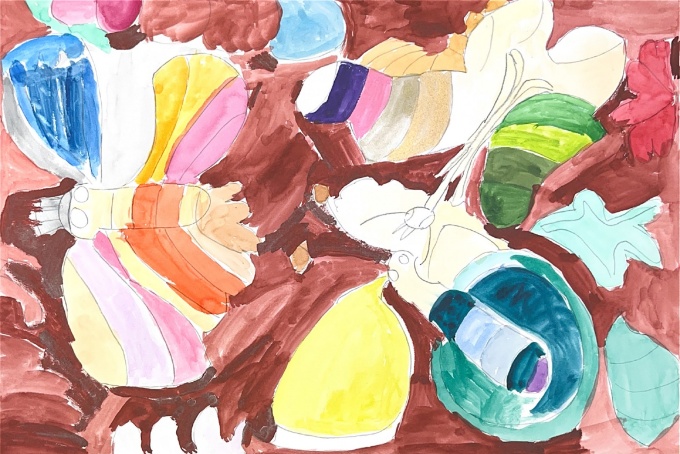
Moth Dance, 11x17, Watercolor on paper
Fall Season
Fall watching and feeling rain fall down on your face.
Leaves change colors
Fall is my favorite time of year
Mom and me watching the flowers and colors change
My mom is always with me


Fox At Night, 12x12, Watercolor on paper
I remember
I remember her everyday
And every night
I dream about her
My Mom
Holiday cookies and Birthdays
I miss her
Every new season
My art makes me proud of myself and I stick with it all the time!
Related Information
Starlight Studio and Art Gallery
Carrie Marcotte
In a setting such as Starlight Studio and Art Gallery, founded in Buffalo, New York in 2005, artists with disabilities are creating and learning in close proximity to their peers and the teaching artists. Starlight proves that creative self-expression and art is an option for every human. Starlight is a place where people get support to explore the ideas and media that interest them.
A strong sense of community quickly develops at Starlight Studio. The artists experiment and make art right next to a peer; some spontaneously solicit feedback throughout the process of creating. This atmosphere contributes to a sense of intimacy and safety. The artists often express a feeling of pride and loyalty for the program.
A studio program such as Starlight also helps individuals to get exposure for their art if this is something to which they are not opposed. The Studio also gives the artwork context for those visitors who have not enjoyed art by people with disabilities.
Support from the larger community comes in many forms: viewership, patronage, hands-on help, demonstration and facilitation of creative arts, and financial support. The presence of Starlight Studio helps society to learn more about people with disabilities. This supported and encouraged creative self-expression leads to people with disabilities having a stronger voice and a stronger sense of self. The Studio, as an established location, attracts an audience to experience that voice.
The idea for Starlight emerged from a brainstorming session with the self-advocates of Learning Disabilities Association of Western New York (LDA) who meet once a month. Marc Hennig of LDA had great knowledge and familiarity with Creative Growth in California, perhaps the best-known art studio for people with disabilities in the country. Marc asked the self-advocates to explore what they wanted more of in Buffalo, and of course, he had the studio concept in mind. This conversation led to the design of the Starlight proposal. Exhibitions on- and off-site, hosting visiting artists, and selling art work were integral to the program design.
Starlight’s beautiful 5,000 square foot studio is woven into the Buffalo Arts Community. It is ideally located in the most vibrant arts community in Buffalo, directly across the street from Hallwalls Contemporary Art Center, which is in an old church renovated in 2005 by the recording artist Ani DiFranco. The church, known as Babeville, not only houses Hallwalls, but it also offers a large venue for performances and other events. DiFranco’s record company, Righteous Babe Records, also owns the building in which Starlight Studio and Art Gallery is located.
The original Starlight proposal was written for 19 people to attend five days per week of “Day Habilitation” service. However, after opening it became apparent that the artists were better served by having various part-time schedules. The Studio currently supports 42 people who come as little as two days a week for at least four hours each, to as many as five days a week. In addition to attending the Starlight program, many of the artists work in competitive employment or other supported employment situations. Participants live in a variety of settings from their own apartments to group homes.
Grants that have been awarded to Starlight over the years have prompted the program to develop rich collaborations and create deeper connections in the Buffalo community. Starlight has enjoyed three formal collaborations with Squeaky Wheel Media Arts Center. Each has provided an opportunity for self- expression through new media and techniques. Stop-action animation was one of the techniques that were learned. The second meaningful partnership with Squeaky Wheel resulted in short documentaries about being an artist; the third, Of One Mind, actually involved the taping of the Starlight artists in conversation about their art and process with artists from the community. Another grant opportunity has resulted in the Starlight artists working with second and third graders in a Buffalo Public School to explore strength through difference. Other grants allowed for a Starlight artist to design and assist in building a sculpture of a full-size woolly mammoth in Buffalo. Still another grant provided for the artists to tour, photograph, and exhibit photos of Buffalo’s architectural treasures. Starlight’s Side by Each exhibition series features five exhibitions in the calendar year that pairs a Starlight artist (or two) with a community artist. Co-artifact, Starlight’s signature fund-raising event, formalizes this connection between community artist and Starlight artist; together the two artists create finished pieces of art that go up for auction. In 2018, with oversight by a playwright, a Starlight artist wrote a play that was staged at a local theater.
When the Starlight artists were presented with the question “What’s the best thing about attending Starlight?” they wrote their answers quite spontaneously and rapidly. In reviewing and categorizing the answers from 26 of the 42 Starlight artists, the responses coalesced around specific themes of experience, artmaking, social support, positive emotions, stimulating new and free thinking, having opportunities to share talents with others, selling and exhibiting art, enjoying ancillary activities, and liking staff. The details and diverse answers, including quotes for each theme, are listed next:
Artmaking
Having access to supplies and a multitude of different media.
“Being able to do pretty much any kind of artwork.” Alison Mantione
“Exploration of a variety of techniques: painting; drawing; embroidery;
quilling; clay; needle point; and, animation.” John Budney
Attending art demonstrations
“We work with professional artists.” Janet Harrison.
Stimulating New and Free Thinking
“I feel artistic freedom.” Kelly Evans
“I can create what I want.” Steven Borgisi
“The teaching artists help me work through my ideas.” Debbie Medwin
“I think of having a pet bunny when I paint.” Mathew Sharp
“The teaching artists really challenge me in a very productive way which
enables me to put my best foot forward.” Andy Calderon
“This place has provided me an arena that I can explore all creative, artistic
and poetic concepts and ideas I have.” Andy Calderon
Liking Staff
“The teaching artists give me good advice to help me do other things
instead of the same old things.” Margaret Meiller
“The staff is friendly and helpful and help me work through my ideas.
Debbie Medwin
“They help me adapt things to work with my visual impairment.” Debbie
Medwin
“I like the staff.”
After the number of comments regarding the value of artmaking, people spoke mostly of the social supports they experience at Starlight Studio.
Social Supports
Making friends
Seeing friends
Getting out of the house
Attending parties at Starlight
“It’s my home away from home.” Andy Calderon
“It feels good to be around others.” Janet Harrison
Positive Emotions
“I feel proud of myself to see my paintings hanging.” Mathew Sharp
Margaret Meiller and Andy Calderon spoke of setting new goals for
themselves and “trying new challenges.”
Two artists spoke of the value in being able to express oneself through art,
and Andy Calderon added, “there’s value in self-expression.”
Another referred to it as a “release of feelings” (Debbie Bowers) and another
said it “relaxes my mind.” Margaret Meiller
Debbie Bowers also noted that she can see her potential growing as she
witnesses progress in her art skills. She also added, “I’m showing others
my abilities not my disability.”
Debbie Medwin and others noted not feeling judged at Starlight.
One described feeling proud to set a schedule and successfully stick to it
(Sonya Lewis).
Jocelyn Triggle described gaining confidence to take on bigger projects
outside Starlight and to try new media.
“I love my art!” declares Michele Miller.
“I’ve gained confidence,” says Shirley French.
“I feel peace of mind without pressure to produce,” said John Budney.
John Montedoro proclaimed that he has “learned how to calm himself
down” at Starlight Studio.
Having Opportunities to Share Talents with Others
Presenting at conferences either about themselves as artists or about the
Starlight program.
Conducting art making demonstrations to peers and children.
Selling and Exhibiting Art
“It was amazing when I sold my first piece of art,” claimed Shirley French.
Mathew Sharp was pleased that “Mom and Dad can come and see what I
made.”
Others are pleased that postcards are made and the exhibit is listed in the
papers and sometimes on television.
Others note that their art has been on display in different galleries.
Enjoying Ancillary Activities
Many listed the numerous “extra” activities that they enjoy in addition to making art at Starlight, such as seeing movies; attending the writing group (“expressing my thoughts through poetry”); attending the reading group; meditation; running the Starlight snack shop; cooking demonstrations; field trips to galleries and other community locations; sign language classes, “I was able to teach sign language to my peers,” said Shirley French.
“Starlight was the best decision I made!” proclaimed Shirley French.
Carrie Marcotte is the founding director of Starlight Studio and Art Gallery. Carrie has a Master of Arts degree in art therapy with a concentration in addictions treatment from Buffalo State College. After working as an art therapist in various treatment settings, she then worked as the coordinator of the Matter at Hand program at the Albright-Knox Art Gallery in Buffalo.


Starlight Studio and Art Gallery is a cooperative environment that supports adults with intellectual and developmental disabilities in their artistic development.