Undergraduate Overview
Understand our world. Help shape what comes next.
Geography connects people, places, technology and the environment. At UB, you can explore everything from climate and cities to international trade, mapping, spatial data and artificial intelligence. Choose the path that fits your interests and build skills you can use to understand complex challenges and help solve them.
Where should cities grow? How can communities prepare for climate change? How do global trade networks affect people and places? What can satellite data and AI tell us about the world around us?
Geography gives you the tools to explore questions like these from multiple perspectives. You will learn to analyze patterns, interpret data and understand the relationships between people and their environments.
At UB, you can shape your education around your interests, whether you want to focus on environmental systems, urban issues, geospatial technology, international connections or emerging applications of AI.
Whether you are interested in the environment, cities, global economies or geospatial technology, UB offers several ways to make geography your own.
Your experience will depend on the program you choose, but geography students learn to look at problems from multiple perspectives and understand how location shapes our world.
Depending on your interests, you may learn how to:
- Analyze relationships between people, places and environments
- Work with maps, spatial data and geospatial technologies
- Examine environmental and climate processes
- Understand cities, regions and global economic systems
- Collect, interpret and communicate geographic data
- Use technology to investigate real-world problems
- Think critically about complex social and environmental challenges
Learn by doing
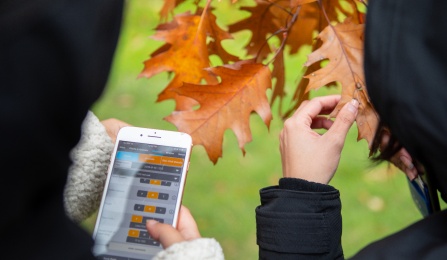
Geography is something you investigate, map and experience. At UB, you can apply what you learn through research, fieldwork, data analysis and hands-on projects.
You may work with geographic information systems, analyze satellite and sensor data, investigate environmental change or study the forces shaping cities and global economies. These experiences help you connect classroom learning with questions that matter beyond campus.

Geography prepares you to work across disciplines because nearly every major challenge has a geographic dimension. Depending on your degree and interests, you can build a path toward careers in areas such as:
- Geographic information systems and geospatial analysis
- Environmental and sustainability work
- Urban and regional planning
- International trade and business
- Data and spatial analysis
- Government and public policy
- Transportation and infrastructure
- Climate and environmental research
- Public health
- Technology and GeoAI
You can also continue your education through graduate study in geography, planning, environmental science, economics and related fields.
Ready to see where geography can take you? Explore our undergraduate programs, learn about admission requirements or connect with us to find the path that fits your goals.
