Research Centers and Labs

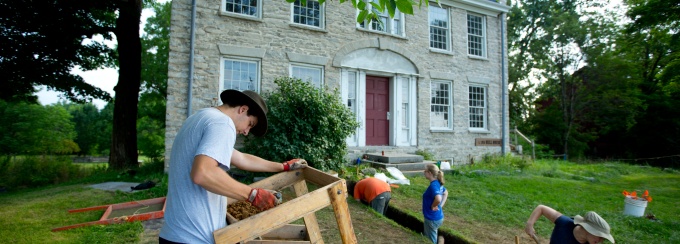
Members of Archaeological Survey excavate at the Hull House site in Lancaster, NY.
Explore anthropology through hands-on research and collaboration
Anthropology at the University at Buffalo is shaped by active research, fieldwork and collaboration. Our research centers, labs and institutes give undergraduate and graduate students opportunities to work with faculty, engage with collections and data, and contribute to ongoing scholarship in archaeology, biological anthropology and sociocultural research.
From museums and archives to field sites and labs, these spaces connect students to real research.
Anthropological Archaeology Lab
The Anthropological Archaeology Lab focuses on long-term dynamics of social inequalities in a global perspective. Using comparative approaches to material culture and spatial dynamics of human activity, research in this lab examines social, economic, political and ideological organization in the past.
Faculty and students in this lab draw from a wide range of analytical specialties to design and execute research projects focused on the complex relationship between human experiences and structural institutions in societies in the past. Members of this lab have ongoing research in the archaeology of Europe, Near East and North America.
Anthropology of Europe Research Group
The Anthropology of Europe Research Group brings together faculty and graduate students interested in the social and cultural study of Europe. The lab serves as a forum for sharing research ideas, discussing fieldwork and developing scholarship.
Buffalo Human Evolutionary Morphology Lab
The Buffalo Human Evolutionary Morphology Lab focuses on understanding how human and primate form evolves over time. Research in the lab combines evolutionary theory, quantitative genetics and advanced statistical shape analysis.
Faculty and student researchers examine patterns of morphological variation shaped by both neutral processes and selective forces. Graduate and undergraduate students gain experience with analytical methods, data interpretation and research design in biological anthropology.
Marian E. White Research Museum and Resource Center
Formally opened to the public in 1979, the Marian E. White Research Museum and Resource Center houses more than one million artifacts from over 1,500 archaeological sites. It is one of the most extensive collections of Pre-Contact artifacts and site records in the Western New York region.
The associated Resource Center is a public academic library dedicated to preserving and studying the region’s deep archaeological and anthropological heritage. Students use these collections to gain hands-on experience with material culture, archival research and museum-based scholarship.
The Applied Primate Behavioral Evolution Lab
The Applied Primate Behavioral Evolution Lab investigates the evolution of nocturnal primate behavior and uses that knowledge to inform conservation. Through field-based research on activity patterns, social behavior, communication and ecology, we seek to uncover how nocturnal primates navigate their environments and respond to ecological change, while advancing practical solutions for conserving these remarkable and understudied species.
The Medical Anthropology Research Group
The Medical Anthropology research Group provides a forum for undergraduate and graduate students and faculty interested in medical anthropology to discuss ideas and share their research.
Quaternary Paleoecology and Pollen Analysis Laboratory (QPPAL)
The QPPAL is a state-of-the-art wet lab for the analysis of paleoenvironmental proxy data - including pollen, plant macrofossils, charcoal, environmental magnetism, sedimentology and geochemistry - from archaeological and paleontological contexts including lake, wetland and alluvial depositional settings. The QPPAL is focused on understanding dynamic interactions between humans, the environment, and climate change over the course of the Quaternary period, with a regional focus on the Northeast and Great Lakes regions of North America.
UB Archaeological Survey
The UB Archaeological Survey is a not-for-profit research and applied archaeology institution within the Department of Anthropology. For more than 30 years, the survey has conducted cultural resource management projects across New York State.
Students involved with the survey gain exposure to professional archaeological practice, including fieldwork, documentation and applied research that connects archaeology with public policy and heritage preservation.
Across these centers and groups, students have opportunities to:
- Work alongside faculty on active research projects
- Gain hands-on experience with artifacts, data and field methods
- Build technical and analytical skills valued in graduate study and professional careers
- Present research through papers, exhibitions and conferences
Many students combine research center involvement with coursework, internships, field schools or independent study.
Research is at the heart of anthropology at UB. Whether you are just beginning to explore the field or preparing for advanced study, our centers and groups offer meaningful ways to get involved and build your experience.