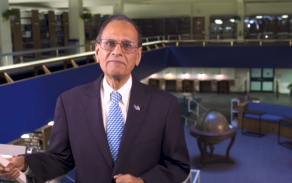

Research conducted by Satrajit Sinha, PhD, and collaborators at
Princeton may provide new avenues to pursue diagnostic tools and
treatments for breast cancer.
Lactation Protein Inhibits Tumors and Metastasis in Breast Cancer
Published
October 25, 2012
A protein necessary for lactation in mammals inhibits the
critical cellular transition that is an early indicator of breast
cancer and metastasis, according to research conducted at UB and
Princeton University.
The breakthrough finding is highlighted as the cover
paper in the November issue of Nature Cell
Biology.
“This is the first confirmed report that this protein,
called Elf5, is a tumor suppressor in breast cancer,” says Satrajit
Sinha, PhD, UB associate professor of biochemistry and
corresponding author with Princeton’s Yibin Kang, PhD.
The research, which includes findings from animal and human
breast cancer models, provides new avenues to pursue in treating
and diagnosing breast cancer—and possibly cancers of other
organs as well, researchers note.
Minus Elf5, Epithelial Cells Morph, Migrate
Under normal circumstances, Elf5 is a transcription factor that
controls the genes that allow for milk production.
But when UB researchers developed knockout mice in whom Elf5 was
removed, the team found more than just an inability to produce
milk:
Epithelial cells in the mammary glands also became more
mesenchymal—an early harbinger of cancer.
“We found that when Elf5 levels are low or absent,
epithelial cells become more like stem cells, morphing into
mesenchymal cells, changing their shape and appearance and
migrating elsewhere in the body,” Sinha says.
“This is how cancer spreads.”
Detecting Protein Loss in Breast Cancer
During the research, lead author Rumela Chakrabarti, PhD, found
that Elf5 suppresses the epithelial-mesenchymal transition (EMT) by
directly repressing transcription of Snail2, a key regulator
of mammary stem cells known to trigger EMT. This process keeps
normal breast cells in their current shape and restricts their
movement.
“Elf5 keeps Snail2 repressed, but once Elf5 is lost, there
is nothing to repress Snail2,” Chakrabarti explains.
Elf5 loss is frequently detected early in the disease, at the
breast hyperplasia stage, when the number of cells increases, the
authors note.
In experiments conducted by the Princeton scientists,
researchers also found that little or no Elf5 in human breast
cancer samples correlates with increased morbidity.
“It seems that loss of Elf5 is an initial event in the
disease, so it could also be an important diagnostic tool,”
Sinha says.
The UB-Princeton team is currently focused on how early Elf5
loss occurs and whether it could serve as such a tool.
Their collaboration began when Chakrabarti, originally a
postdoctoral researcher in Sinha’s laboratory, took a
position researching breast cancer metastasis in the laboratory of
Kang, Princeton’s Warner-Lambert/Parke-Davis Professor of
Molecular Biology.
Targeting EMT-Snail2 Pathway for Cancer Intervention
The team’s finding reveals the complex pathways through
which breast cancers develop while providing new avenues to pursue
diagnostics and treatments.
“Our research shows that the EMT-Snail2 pathway is a
valuable one to target for early breast cancer intervention,”
Sinha says, “possibly by designing something to recapture the
repressive effect of Elf5 or a drug that could mimic Elf5
activity.
“And this is just one molecule, part of a big network.
That’s why we are now creating a detailed map of this
molecule and its associated partners in order to give us a better
idea of what to look for.”
Research Supportd by NIH, DOD, Others
The team’s research was supported by the National Institutes of Health, the
Department of Defense, Komen for the Cure, the Brewster
Foundation and the Champalimaud
Foundation.
Other UB co-authors on the paper are Rose-Anne Romano, PhD,
research assistant professor in biochemistry, and Kirsten Smalley,
research technician.
Co-authors from collaborating institutions are:
- Julie Hwang, Mario Andres Blanco, Martin Lukacisin and Yong Wei
(Princeton)
- Song Liu (Roswell Park
Cancer Institute)
- Qifeng Yang and Bruce F. Haffty (Department of Radiation
Oncology in the University of Medicine and Dentistry of New Jersey
and the Cancer Institute of New Jersey)
- Toni Ibrahim, Laura Mercatali and Dino Amadori (Istituto
Scientifico Romagnolo per lo Studio e la Cura dei Tumori)