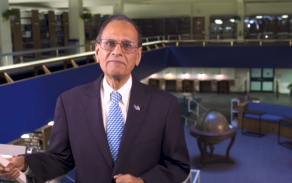

BUFFALO, N.Y. -- Steve Kurtz, professor of visual studies at the
University at Buffalo, a social critic known for his work in bio
art and electronic disobedience, has had a busy summer in Europe
where he has been involved in three high-visibility projects.
Most notable is "A Public Misery Message: A Temporary Monument
to Global Economic Inequality," an installation for the exhibition
Documenta 13 in Kassel, Germany, a cultural event of world
standing.
Documenta, which runs this year from June 9 to September 16, is
presented every five years in an effort to offer a snapshot of the
global state of contemporary art. It features 100 international
artists for whom inclusion is a major distinction.
Kurtz's work for Documenta 13 and his other exhibitions feature
the Critical Art Ensemble, which he co-founded 25 years ago. This
collective of five tactical media practitioners from across the
U.S. and with various specializations famously operates at the
intersections of art, technology, radical politics and critical
theory.
"A Public Misery Message" consists of a vertical bar graph the
height of a crane, which depicts global wealth disparity. It
represents the economic wealth of the world population in quintiles
(that is as fifths of the whole) with each .39 inch representing
$100 in U.S. currency. The top one percent owns more than 15 times
more wealth that of the rest of the world combined, an amount so
great, that, if depicted graphically, would require the graph to be
738 feet tall. So the CAE employs a helicopter that rises 738 feet
into the air, a point at which it represents, hyperbolically, the
top one percent of us. A photo of "A Public Misery Message" is
available here: (insert link).
On June 9, opening day, a red carpet stretched along the grass
of Kassel's Orangery, and the first 50 people who could afford to
buy tickets for the helicopter flight lined up. The other 99
percent could a purchase a lottery ticket in any currency for a
chance to win a ride.
From September 20 to October 21, Kurz and the CAE will present
"New Alliance" as part of a year-long eco art project with Parco
Arte Vivente Center for Contemporary Art in Turin, Italy. It will
address the question, raised in CAE November workshops at the PAV,
of whether plants and men can be allies. The group will present
in-house research and the methodology developed in the field during
the production process.
"Seized," a June 13-29 exhibition at the Aksioma Contemporary
Art Institute in Ljubljana, Slovenia, is the work of the CAE and
the Institute for Applied Autonomy, a group of anonymous artists
known for employing technology in protest.
The complex installations in the exhibition grew out of Kurtz's
infamous 2004 arrest and the FBI seizure of his art materials,
books, archives, as well as his wife's corpse. These were used as
evidence to support allegations of bioterrorism against him.
After the raid, CAE artists confiscated pizza boxes, Gatorade
bottles, hazmat suits, biological sample bags, written notes and a
single cigar butt -- all left behind at Kurtz's home by the FBI as
they collected the evidence ultimately presented against him. This
material is presented in an installation at Askioma along with
critical text. The artists call it "a subversive strategy of
counter-appropriation" and a window into the anatomy of this
infamous "bio-terror" investigation as it was opening up.
The exhibition screened "Strange Culture," Lynn Hershman
Leeson's award-winning film about the Kurtz ordeal.
The exhibition also featured the installation "True Crime."
Grounded in the assumption that everyone occasionally breaks the
law, even if only in small ways, Kurtz et al invited the public to
send in painted, drawn, photographed, scanned or output images of
illegal objects, an object obtained illegally or any illegal act in
which the individual was specifically connected. The stated purpose
of this effort (and subsequent exhibition of the images) was "to
make visible this secret structure of everyday life and in some
cases, to even celebrate moments of resistance to authority."