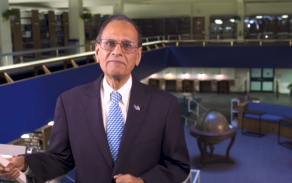

IT Transformation Town Hall Meeting
November 21, 2008
Downloads
- Strategies for file service consolidation are being redeveloped
- A Shared IT Service Desk pilot implementation is being planned
Read on for more information...
“We have made tremendous progress on projects,” Elias Eldayrie, associate vice president and chief information officer, said to kick off the Nov. 21 Information Technology Strategic Transformation (ITST) Town Hall. He talked about the challenging times the world is experiencing and assured the more than 100 IT professionals in attendance that producing efficiencies will continue to be a collaborative effort at UB. Elias’ comments set the stage for project team leaders to present updates on the current UB 2020 ITST projects.
Voice Over Internet Protocol (VoIP)
Barbara Vasbinder, project leader and assistant director of operational support services, opened her presentation by thanking the team leaders and members for their participation and efforts. “The project is approaching the halfway mark to completion and increasingly gaining momentum,” Vasbinder said. At the start of the project, UB had approximately 5,000 Centrix lines and 8,000 phone sets; as of today, she reported, 1,087 of the Centrix lines have been converted, which represents a large cost savings to the university, as well as 22 percent of the line-conversion goal. Vasbinder also reported that 3,324 phones have been converted to VoIP, representing 40 percent of the overall goal.
Vasbinder explained the tasks of the infrastructure team that occur behind the scenes, the meaning of the deployment charts that are displayed on the UB 2020 IT Strategic Transformation Web site and the planning procedures that take place prior to installations. She commented on the implementation schedule, emphasizing that the buildings that are “in progress” will be completed by January 2009. After installation, she continued, the team works very diligently to leave only working lines and a completely cleaned-up communication room behind. Old systems are boxed and sent to Cisco for trade-in value.
The training provided to the departments is being complemented with the use of live phones. The training session is in the process of being video-captured and soon will be available here as an added resource.
Looking ahead, a Unity voicemail upgrade is planned at the end of January 2009.
For the detailed slide presentation, click here.
Servers and Services Consolidation
Saira Hasnain, project leader and director of enterprise infrastructure services, provided updates on the ongoing consolidation efforts, including Microsoft Exchange and Unix messaging, file services, WSUS patch management and database services.
Exchange Messaging
To date, 1,163 Exchange mailboxes have been migrated in the areas of Research, Office of the Provost, CIT and UB Business. University Residence Halls, University Facilities and Architecture and Planning are next in the queue. “All migrations are expected to be completed by June/July 2009,” projected Hasnain. Additionally, the contract with Google to outsource student email is close to being signed.
Unix Messaging
Although CSE and SENS are the only major areas taking part in this consolidation, the efforts are challenging due to the large number of mailboxes and ensuing resource issues. Hasnain estimates the work will be completed by Spring 2009.
Hasnain disclosed that a contract authorization is imminent that will begin implementation of student email using Google Gmail services. A project will be organized for a possible Fall 2009 target date, but many details must be determined at this time. This service change likely will be an opt-in service for students during this pilot phase of the project.
Additionally, the Unix Oracle calendaring environment is up and running in the College of Arts and Sciences, and efforts now are focused within the School of Management.
Hasnain also explained that a software problem was found with Exchange 2007 email and Oracle that must be addressed for the upcoming medical school migration.
File Service
Hasnain presented a major obstacle for moving forward with the File Service consolidation: More file space is needed than the 70TB that originally was estimated. CIT, Facilities, Business and the School of Architecture already have consumed 23TB, and it’s estimated that 100TB might be the real need. Hasnain reported two strategies for moving forward: Retention policies must be addressed to properly manage this service and a reassessment of true need must be completed to better proportion provisioning capacities.
WSUS Patch Management
Consolidations have been piloted with the College of Arts and Sciences and the School of Management, and progress is being made with Microsoft to address reporting tools and needs.
Database Services
Hasnain reported that the team has made considerable progress with MS SQL in the Provost area and looking ahead to University Facilities. Progress with Oracle consolidation has slowed down and there is currently no activity to report on the MYSQL consolidation project.
Audience members inquired about Microsoft Sharepoint consolidation planning. Hasnain replied that the next version of Microsoft Office reportedly includes massive Sharepoint integrations. Discussions are under way concerning any planned deployment.
Student Services Transformation
Elias Eldayrie, project leader, reported that the Student Services Transformation Project is moving forward and continues to be a priority for UB. Financing for the project has come under discussion in light of the budget situation, with the funding timeline being increased to 36 months from 24 months. “This project is very important to the institution,” said Eldayrie. “It provides many service improvements, increased system integration, extended real-time access and a flexible system that supports needs and growth.”
The discovery phase is expected to be completed on time by the end of December 2008. In January 2009, the project will move into the configuration phase. The fit/gap sessions that began in July—where product features are compared to customer needs to identify deficiencies—have been completed and will guide the team in determining if any necessary customization will be needed. Strategies will be drafted for data conversion, data access/reporting, environment instances, etc.
Purchase of the hardware has been delayed and will be done in pieces, as required; third-party tools for document management, electronic payment, etc. also will be addressed as required. “We know we need CRM [Customer Relationship Management], but we are not sure if we are going to use PeopleSoft’s version. We may have to look at different alternatives,” Eldayrie said.
The next steps:
- Complete the project charter.
- Continue staff training.
- Finalize strategy on the CRM module.
- Complete the discovery phase by December 2008.
- Finalize a new project timeline.
- Begin the configuration phase in January 2009.
Eldayrie concluded his presentation by commending Sue Huston and Kara Saunders, the main leaders of the Student Systems Transformation project.
For the detailed slide presentation, click here.
Workstation Standardization
“Workstation standardization is now part of how we conduct business, not so much a project per se,” said Peter Rittner, project leader and assistant dean for educational technology, College of Arts and Sciences, “and we now manage the process that resulted from the project work.” This project leveraged expertise from across the campuses and produced UB 2020-standards workstations for faculty and staff. Rittner reported that there are several issues currently being addressed, including a smoother transition of models offered by Dell and the currency of the image on the machines.
“You’ll soon see the e-family of notebooks being offered and the 755 desktop,” said Rittner. The e-family will have some notable improvements, particularly in energy savings. The only known negative is that the ultralight model is about 3 oz. heavier than the previous ultralights. The planning process with Dell to ensure the transition to new models has not provided enough advance notice to make the necessary adjustments. The imaging process has become increasingly cumbersome and the image is not refreshed often enough. A meeting with Dell resulted in a mutual understanding and goals. “We understand this is a problem for people and we want to fix it,” Rittner emphasized.
After one year, the workstation standardization project has theoretically saved UB approximately $3 million. Additionally, the project goal was to provide 80 percent of the university’s needs, with 90 percent of the needs having actually been met.
A challenge that has emerged from the project is that UB leadership wants the capability to do conferencing from anywhere at any time as part of the IT strategic planning process. The workstation standardization team can address part of this, but only with computer models that have built-in microphones and Web cameras. It’s projected that the next series of models will include the equipment with minor cost changes. Also, new Apple devices will be made available on the UB 2020 IT Strategic Transformation Workstation Standardization Web pages. For more information, click here.
To address the availability and efficient interaction of team resources, Rittner has designated a point person to keep communication flowing.
Shared Service Desk
Matt Stock, project manager for the Shared Service Desk Implementation project and manager of enterprise research computing services, updated the audience on the Shared IT Service Desk Project:
- The history of the ITST Service desk was reviewed, starting from August 2006 and including the product evaluation process and selection of CA Service Desk as the “right answer for the time.” To view the ITSTSD committee report, click here.
- The key recommendations of ITSTSD: improve communication between IT units, using common tools and consistent practices (document work, etc); improve communication with IT customers regarding the services we provide and better interfaces for addressing customer needs (avoid redirecting process, for example); provide better self-service tools, such as a public facing knowledge base and password reset tools; and offer better extended coverage hours for user support, possibly 24/7.
- Implementing the vision is a large, complex endeavor, so a rational incremental process was devised. Much of the work involves planning and design, which relies on understanding how to apply the ITSTSD vision to the work we do.
- A pilot implementation will address limiting the number of units involved up front and engaging the design committee. Pilot units will be CIT, the School of Management and the School of Social Work. The pilot will focus on intake processes, knowledge base and basic workflow-escalation processes, which will reveal the size of a full campus rollout.
- The pilot has two phases: Discovery, from November 2008 through May 2009, will develop a system design using CA expertise and create a sand-box environment; Phase 2 will move units into the production environment using the finalized design.
- Post-pilot project work will continue to migrate additional IT areas through November 2010, expand the SSD toolset to include modules where necessary (perhaps Inventory management) and standardize workflow and reporting/dashboards.
- The core project team of Matt Stock, Rick Lesniak, Dave Costello and Richard Amantia is focused on project implementation. An advisory committee composed of some members of the ITSDD committee will be developed to ensure consistency with the vision and to continue presentations and updates. From an executive standpoint, we will rely on the Educational Technology Advisory Group to ensure we are aligned with UB strategies and goals.
For the detailed slide presentation, click here.
Reorganization of IT Management
At the end of project presentations, Eldayrie addressed questions concerning the proposed reorganization of IT management. He reviewed the basic goals of the reorganization and updated everyone on reorganization strategies, which had been communicated to IT managers via email earlier in the week.
Eldayrie thanked attendees and project contributors. “UB is resilient; it’s been here since 1846,” he said, indicating that the university can handle these challenges, but it won’t be easy. The strategy is to be proactive and there is a lot of flexibility to manage these problems. The top goal is to protect the workforce, consistent with the overarching UB 2020 goals to grow and improve.
Check the UB 2020 IT Strategic Transformation Web site for information on the next IT Town Hall, scheduled for a date to be determined.
We hope you found this UB 2020 IT Transformation Project Update useful and informative. We are always interested in hearing from you. | Contact Us
UB 2020 IT Transformation Project Communication Team