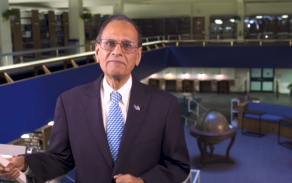

The new bill passed by the New York Senate today in support of
the UB 2020 strategic plan will benefit students, families and the
economy of Western New York, said University at Buffalo President
John B. Simpson, who praised members of the Western New York
legislative delegation for their ongoing commitment to the
community and to public higher education in New York State.
The bill, which passed with overwhelming bipartisan support
(55-1), would give UB the opportunity to create a tuition policy
that is fair, responsible and predictable, Simpson said. It would
enable UB to use tuition revenue to pursue the UB 2020 plan for
academic excellence while protecting students' access to
high-quality education, especially for the state's neediest
students.
The bill also proposes giving UB relief from outdated state
regulations on procurement and would enable creation of
public-private partnerships like UB's partnership with Kaleida
Health, which has led to the construction of a new medical care and
research building in downtown Buffalo.
UB's state funding has been cut $63 million over the past two
years, with $17 million in additional cuts expected this year. The
cuts have severely impacted the university's efforts to implement
the UB 2020 plan for academic and research excellence.
Introduced by Sens. Mark Grisanti, George Maziarz, Patrick
Gallivan, Michael Ranzenhofer and Timothy Kennedy, the "UB 2020
Flexibility and Economic Growth Act" proposes reforms to New York
law. The reforms will provide UB with the tools to move forward
with its ambitious UB 2020 plan, particularly in downtown Buffalo.
The UB plan has earned widespread support throughout the region
because of its potential to spur regional economic development and
create jobs over the next several years.
"We are very grateful to Sens. Grisanti, Maziarz, Gallivan,
Ranzenhofer and Kennedy for their steadfast support of these
forward-looking policy recommendations," Simpson said. "Today's
action will focus the legislature's attention on how these reforms
are absolutely necessary as a way to provide the state's students
with access to world-class public higher education and give UB the
opportunity to help revitalize the Western New York economy through
academic and research excellence."
A companion bill has been introduced in the state Assembly. Gov.
Cuomo's executive budget announced last month calls for similar
reform of state regulations regarding SUNY procurements and
public-private partnerships as a way to produce significant revenue
growth opportunities for SUNY schools.
The UB 2020 bill would give UB the ability to propose and set
tuition rates for undergraduate and graduate programs, upon the
approval of the SUNY Board of Trustees. To assure UB remains
affordable for students, the bill mandates that between 15 and 20
percent of tuition revenue generated by the increases be used to
fund scholarships for financially needy students. These
scholarships would be used to provide financial aid to the neediest
of students; in 2011 that would mean students with family incomes
less than $60,000 annually would receive aid and not feel the
effect of a tuition increase. Approximately 30 percent of UB's
19,395 undergraduate students currently would qualify for aid using
this standard.
According to the bill, undergraduate tuition for UB programs
could not increase by more than $375 per semester, and tuition for
UB graduate and professional programs could not increase by more
than 15 percent a year. UB's undergraduate and graduate program
tuition could not exceed the average tuition charged by public
universities in the Association of American Universities (AAU),
putting UB tuition on par with peer AAU institutions.
SUNY tuition historically has been increased in tough economic
times, sometimes unpredictably and dramatically -- by 14 and 28
percent the last two times tuition was raised. Such increases,
however, were used to fund state budget shortfalls instead of
funding improvements to SUNY programs and campuses.
The state in 2008 suddenly raised SUNY tuition by 14 percent but
kept 90 percent of the revenue to offset budget shortfalls.
"Passage of these reforms remains very important to our
university and our community," Simpson said. "They should be
extended to all SUNY institutions as a way to preserve academic
quality, protect students from erratic and irresponsible tuition
increases and help spur statewide economic development through the
pursuit of academic and research excellence."
The SUNY Student Assembly, a state-wide student government
organization representing SUNY's 435,000 students, this month asked
Cuomo to raise SUNY tuition in order to generate revenues needed to
protect SUNY education programs from further cuts and continue to
provide students with access to quality education.
"We feel keeping tuition at the current level is simply not
sustainable, and does not support access and affordability in the
long-term, said Student Assembly President Julie Gondar in the
statement. "For over three years now, the Student Assembly has
proposed a rational tuition policy that would ensure annual,
predictable increases that are fair, equitable and responsible.
"By leaving tuition unchanged, students are destined to enter
yet another cycle with years of stagnation followed by
unmanageable, harsh increases to compensate for the irresponsible
past. Rarely do you hear students advocating for any kind of
tuition policy other than lowering it. But the reality is that we
see rational tuition as a rational way of thinking, and a critical
safety net for the protection of students and their families."
The UB 2020 bill's reforms are similar to those contained in
2009's UB 2020 Economic Growth and Flexibility Act, which passed
the Senate, and were drawn largely from recommendations by the
state's Commission on Higher Education. The reforms also provided
the foundation upon which the Public Higher Education Empowerment
and Innovation Act (PHEEIA) was drafted.
Implementation of the UB 2020 plan has become a community-driven
initiative in Western New York. It is supported by the Buffalo
Niagara Partnership and the Buffalo Building and Construction
Trades Council, which has over 10,000 members. More than 30
business, labor, community and university groups support the UB
2020 initiative. They include the Amherst Chamber of Commerce, the
City of Buffalo, Erie County and Town of Amherst; Kaleida Health,
Buffalo Niagara Medical Campus and Roswell Park Cancer Institute;
the Board of Block Clubs, United Way and Oishei Foundation; and the
UB Undergraduate Association, Faculty Senate, Professional Staff
Senate and UB Parent Council.
"During our campaign we championed for the passage of UB 2020,
and job creation," said Grisanti. "I am humbled that this is my
first sponsored piece of legislation that will help the people of
the 60th District and Western New York. Bringing resources and jobs
back to Western New York is my No. 1 priority while in office. I
hope that this will be a catalyst to start the conversation with
the Assembly and governor, and move us closer to getting these
important reforms passed."
Maziarz said the Senate is committed to doing everything it can
to fulfill the UB 2020 vision for Western New York -- "a vision
that is built around jobs, education and economic development."
"With the passage of this legislation, we are reiterating our
firm support and our desire to partner with the Assembly and the
governor to enact our goals. We are moving the ball forward toward
a successful outcome," he said.
Ranzenhofer noted he was "proud to co-sponsor and support this
legislation."
"As a graduate of the UB Law School, I understand the positive
impact UB has in our region and how critically important UB 2020 is
to our community. UB 2020 will modernize and expand the University
at Buffalo and, at the same time, create opportunities and provide
research and technology for businesses and institutions in our
community. The passage of UB 2020 today in the state Senate is the
first step to making this a reality. For over two years, I have
been a believer in UB and after today, the entire New York State
Senate is a believer too."
Gallivan called the UB 2020 plan "one of the most promising
economic development initiatives for Western New York in
generations."
"Through enactment of this legislation, UB will have the tools
necessary to implement its bold vision -- a vision that invests in
our region's students, its neighborhoods, its infrastructure and
its future," he said. "UB 2020 has broad support from the Western
New York delegation and from the community. This legislation was
among the first I sponsored as senator and I am excited to see it
pass the Senate today with overwhelming support."
Sen. Timothy Kennedy said, "The UB 2020 plan presents a
substantial opportunity to turn our regional economy around. It's
often during times of economic and fiscal crisis that we find the
united energy and groundbreaking innovation to rebuild our economy
stronger than it ever has been. A day after we hear of a report
that ranks our region as the second-most-difficult place to find a
job, it is fitting that we pass a piece of legislation that, if
approved by the Assembly and signed by the governor, will spark the
ignition of a job creation machine for Western New York. The
hardworking men and women of Western New York are hungry for the
jobs that UB 2020 will create. We've passed this plan early with
statewide, bipartisan support to signal to the Assembly and the
governor that it's time we delivered UB 2020, a job-creation plan
critical to the economic future of Western New York."
Assemblyman Robin Schimminger noted that "the report that
Buffalo is one of the worst cities in which to find a job
highlights the need for bold and strong initiatives to get our
region moving again."
"Certainly, one such initiative is UB 2020," he said. "In
addition to cementing UB's place as a major research university, UB
2020 would create thousands of jobs. The passage of this bill in
the Senate is but a first step toward reaching the final goal. With
many of UB 2020's provisions contained in the governor's proposed
budget, I am hopeful that we will see all or a good measure of UB's
bold plan enacted soon."
Assemblyman Sam Hoyt said, "With state support for SUNY and UB
declining dramatically over the last several years, UB needs
flexibility in the form of these policy reforms in order to provide
its students with the excellence they deserve and to become a
world-class public research university."
Assemblywoman Crystal Peoples-Stokes said that given the fiscal
climate of the state, "UB 2020's public policy reforms make sense
for UB, the State University of New York and, most importantly, for
the communities in which they reside and impact."
"It is the perfect opportunity to invest in infrastructure and
development projects that allow the creation of jobs, boost the
local economy and attract high quality professionals. We need for
progress to happen for Buffalo and UB without burdening parents and
students," she added. "The implementation of a rational tuition
policy will help students and parents, especially middle income
families, to be able to plan in advance for the school year
costs."
Assemblyman Dennis Gabryszak noted that with the passage of the
UB 2020 bill in the Senate, the measure "is one step closer to
becoming a reality. I urge my colleagues in the Assembly to pass UB
2020. This legislation is evidence that New York legislators
believe in and have not overlooked the importance of upstate. UB
2020 will help position Western New York for success and innovation
in industry and education; the possibilities are endless."
Paul Brown, president of the Buffalo Building and Construction
Trades Council, praised "the hard work, dedication and leadership
demonstrated by Sens. Grisanti, Maziarz, Kennedy, Gallivan and
Ranzenhofer" in passing the new Senate bill.
"With this bill, these senators are helping move the promise of
UB 2020 forward; they, like us, believe strongly that UB 2020 will
be a pivotal catalyst for economic growth and job creation in
Western New York," Brown added. "I call on the state Assembly to
immediately pass these critically important public policies to help
Western New Yorkers get back to work."
Andrew J. Rudnick, president and CEO of the Buffalo Niagara
Partnership, said the bill's introduction "puts into motion what
could be the most economically transformative event to occur in
Buffalo Niagara: the implementation of the ambitious UB 2020 growth
plan. Now, just as our five senators came together from different
parties and different communities to introduce this bill, our
region must come together to rally for UB 2020."
Colleen DiPirro, president and CEO of the Amherst Chamber of
Commerce, commended the Senate for passing "this critical component
for the future of Western New York. As an organization representing
over 2,500 members of the business community, we will continue to
work with the university and our state representatives to bring the
legislation to its full potential."
The University at Buffalo is a premier research-intensive public
university, a flagship institution in the State University of New
York system and its largest and most comprehensive campus. UB's
more than 28,000 students pursue their academic interests through
more than 300 undergraduate, graduate and professional degree
programs. Founded in 1846, the University at Buffalo is a member of
the Association of American Universities.