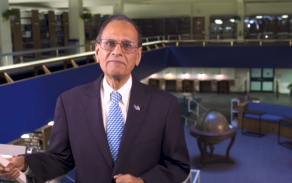
As Satish K. Tripathi begins his second academic year as
president of the University at Buffalo, he is working with faculty,
staff and students to move ahead with the next phase of the UB 2020
plan for academic excellence.
With support from NYSUNY 2020, Gov. Andrew Cuomo’s
historic higher education bill signed into law last year, the
university plans to hire 250 additional faculty over the next five
years, is creating new programs to enrich students’
educational experiences and is implementing a number of efforts to
transform the physical campus climate, including finalizing plans
to relocate the medical school to downtown Buffalo.
Below, Tripathi answers a few questions about UB 2020 and NYSUNY
2020, and their transformative impact on the university.
Q: There are many ways of defining the UB 2020 vision. How do
you define it?
UB 2020 is our long-range vision of excellence, focused on
raising the bar for UB in quality, stature and impact. We are a
very fine institution with the potential to be truly great -- to be
recognized as one of the leading research universities in the
nation and world. UB 2020 is our roadmap for getting there.
Ultimately, this vision is about unleashing the power of what
our exceptional faculty and students can achieve and contribute
together, given the right environment and the right opportunities.
It’s about the synergy and the possibilities created when
different minds and perspectives come together to tackle societal
challenges, to make a positive difference for the bigger
communities they share.
Q: What will it take to make this vision a reality?
Achieving this vision really comes down to three key objectives,
all very closely connected.
First, we need to focus on building faculty strength across the
disciplines: attracting more of the top scholars who are leading
today's global conversations in their fields, and nurturing their
discoveries and ideas.
Secondly -- and strongly tied to faculty excellence -- is
student excellence: educating bright, globally minded leaders who
are committed and prepared to make a difference.
Finally, we must work to create the 21st-century campus
environment that brings these exceptional faculty and students
together in powerful ways and allows their excellence to achieve
its full impact.
Q: Can you give us a quick progress report? How well is UB
performing with respect to these objectives?
UB 2020 is not just a plan on paper; it’s in full motion.
This is a time of tremendous momentum and energy at UB, and we are
making tangible progress every day.
Our outstanding faculty body continues to grow in size and
stature. This fall, 85 leading faculty joined our academic
community -- these are faculty at the forefront of their respective
fields and they represent tremendous breadth and depth of scholarly
achievement.
Bringing even more top-ranked faculty to UB will have a critical
impact on our ability to recruit the best and brightest students,
and we are already seeing this impact reflected in the quality of
our incoming students at every level. Our students are competing
with increasing success for national honors like Fulbright, Udall
and Goldwater scholarships. We’re working to attract even
more top students through increased support for student
scholarships. And we are focused on making it easier for these
students -- especially undergraduates -- to engage directly with
our distinguished faculty. For example, Discovery Seminars allow
freshmen and sophomores to work directly with leading faculty in
small-seminar groups, and our Undergraduate Academies provide
students an opportunity to explore timely, interdisciplinary topics
in depth with leading faculty and experts in the field.
And in just over a year, UB has opened six major facilities on
our three campuses. Downtown, the medical school is planning for
its new home, where it will be strategically aligned with hospitals
and research partners.
Q: What do you think are the main reasons for this progress?
What do you see as the major hurdles, and the major opportunities,
for the success of UB 2020?
All of this progress is the outcome of our long-range,
comprehensive strategic vision; none of these outcomes were
achieved overnight. But we could not have achieved this success
without the strong support and advocacy we have received -- from
our higher education partners in SUNY and across our region, our
alumni and university friends around the world, local business and
community organizations, and elected leadership in our region and
state.
Right now, we’re fortunate to have state leadership that
recognizes the vital role that research universities play in
building thriving communities -- and is willing to invest in this
impact. While this is unquestionably a time of nationwide economic
challenges, for UB and Buffalo it is also a time of unprecedented
opportunity. For decades, UB and our fellow SUNY institutions have
been saying that long-term state investment is critical to
realizing our full potential. This principle was at the heart of
the historic NYSUNY 2020 legislation that the governor signed in
2011. This legislation provides critical higher education policy
reforms, including a fair and responsible tuition plan for SUNY
that ensures educational quality and access for our students, while
enabling students and their families to plan for the cost of higher
education with confidence.
This legislation has provided a vital path forward for UB during
a period of declining state funding. With the historic NYSUNY 2020
legislation and related challenge grant, we now have the ability to
plan on a five-year horizon for the first time in our history as a
public institution, rather than on a year-by-year budget cycle that
makes long-range planning difficult. This has the potential to
transform the way we plan for our collective future and invest in
our academic mission.
Q: How is UB investing the revenues from the NYSUNY 2020
legislation to advance its vision of excellence?
The NYSUNY 2020 Challenge Grant revenues are being used to
advance two critical arms of the next phase of UB 2020 -- investing
in faculty strength across the disciplines and moving the medical
school downtown. We’re already making significant progress on
both fronts. Plans are moving forward with the medical school move
with the identification of world-class architectural firm HOK to
design the facility. Over the next five years, we aim to hire 250
additional top faculty using revenues generated by this
legislation, and we are already on our way. Some of this
fall’s faculty hires were made possible by the NYSUNY
legislation, and these revenues will play an increasingly important
role in the years ahead. These investments also play a vital role
in enriching the educational experience we provide our students.
Since the plan was implemented, UB has added more than 300
undergraduate course sections -- creating 12,000 more seats -- in
the highest-demand course areas than were available in the 2011-12
academic year. We’ve also been able to hire more instructors
and create more graduate teaching assistant lines to teach these
new course sections.
These investments are transforming academic planning across the
university. Last year, I charged our deans and vice presidents with
leading efforts within each of their units to develop strategic
three-to-five-year plans that advance our larger institutional
goals of excellence. We also initiated the “E Fund,”
which uses new revenue from NYSUNY 2020’s rational tuition
program to invest in interdisciplinary projects that advance our
academic vision. We’ve already had two rounds of funding that
generated tremendous interest from across the university. Some of
the proposals selected for funding include interdisciplinary
academic projects, from an energy-diversification program and a
Center for Excellence in Writing to an innovative Arts and Emerging
Technologies program; as well as academic support initiatives that
will transform the student experience, including a diversity
recruitment program, the Finish in Four program and an e-textbooks
pilot program in the University Libraries. I know Provost Zukoski
is very excited about the great opportunities before us, and under
his leadership we will be working together as an academic community
to build upon our university's excellence and impact.
Q: What are your goals for the future? What's the next
chapter of UB 2020?
Speaking generally, I believe we always need to be focused, as
an institution, on where we want to be in five, 10, 50 years, and
we need to define, collectively, what are the most effective
strategies that will take us there. And that's exactly what we've
been doing.
We are committed to being responsive to ever-changing societal
needs and challenges, and that means we always need to be examining
the purpose, relevance and impact of our work in the classroom, the
lab and community.
Today, we have many exciting opportunities before us, and we are
actively seizing them. Downtown, the medical school is actively
planning for its new home, where it will be strategically aligned
with area hospitals and research partners. Just to name a few
examples, we are making exciting progress with our newly designated
New York State Center of Excellence in Materials Informatics, a
research center that will establish UB as a worldwide hub for the
discovery and commercialization of new materials. We're launching
two new Undergraduate Academies -- one this fall focused on
entrepreneurship and one next year in the area of sustainability.
And we continue to welcome more of the best and brightest faculty,
staff and students, who are increasingly drawn by all that UB has
to offer.
It's a great time to be at UB, and I truly believe the best is
yet to come.