
Archives
Spintronics is focus of lecture
By ELLEN GOLDBAUM
Contributing Editor
How would you like a truly “cool” laptop that runs without generating all that useless heat? Or an iPod with many times more memory than is possible now?
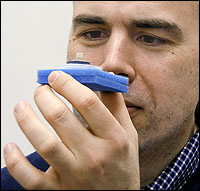
ZUTIC
These are a few of the possibilities that will be discussed at 7:30 p.m. March 6 in a public lecture, “Putting Spin into Electronics: Vision for the Future,” to take place in 112 Norton Hall, North Campus. It will be free and open to the public.
The talk will focus on spintronics, a subfield of physics, in which UB is an international leader.
It is part of "Magnetic Excitations in Semiconductors: Bridges to the Next Decade," a fest-symposium honoring the career of Bruce D. McCombe, SUNY Distinguished Professor in the Department of Physics, and dean of the College of Arts and Sciences. Click here to read more about the fest-symposium.
Igor Zutic, assistant professor of physics and a pioneer in the field, will explain how spintronics could revolutionize the way we live, much the way transistor electronics did more than 50 years ago.
According to Zutic, conventional electronics rely on an electron’s charge, but don’t do anything with its spin. Spintronics, on the other hand, exploits an electron’s spin, an elusive property responsible for the intriguing magnetic behaviors of many materials.
“Think about a kitchen magnet: It hangs onto the refrigerator door without consuming any power,” said Zutic. “If we can combine spintronic or magnetic properties that, like the kitchen magnet, don’t need any power to function, with electronic properties in the same device, then we would only need a fraction of the power we use today for laptops, iPods and many other devices.”
Zutic’s talk will discuss all of these possibilities, as well as some intriguing manifestations of magnetism, from levitating trains to bacteria. His talk will include demonstrations.
For more information on the lecture, contact Chris Gleason at 645-2017, ext. 117, or cg57@buffalo.edu.