
Archives
Conference to honor McCombe
By ELLEN GOLDBAUM
Contributing Editor
Some of the world’s biggest names in condensed matter physics, including two Nobel laureates, are converging on Western New York March 6-8 to celebrate the scientific contributions—and the birthday—of Bruce D. McCombe, dean of the College of Arts and Sciences and SUNY Distinguished Professor in the Department of Physics.
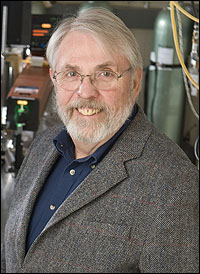
Some of the biggest names in condensed matter physics
are coming to UB to honor Bruce McCombe.
PHOTO: DOUGLAS LEVERE
“Magnetic Excitations in Semiconductors: Bridges to the Next Decade,” a two-day scientific conference at the Ramada Hotel and Conference Center in Amherst, is being held to honor McCombe and the scientific—and highly collegial—collaborations he has organized over the years, both at UB and around the globe.
More than 20 outside speakers will attend, focusing on topics ranging from quantum computation to spintronics and nanotubes to photonic crystals and magnetism.
Nobel laureates who will attend include Horst Störmer, professor of physics and applied physics at Columbia University, and Klaus von Klitzing, a director of the Max Planck Institute for Solid State Physics in Stuttgart, Germany.
The event will be attended by leading scientists in the field, many of whom are colleagues or former students and postdoctoral researchers of McCombe.
“One of the many remarkable things about Bruce is that throughout his career he has been an integral force in defining, stretching and redefining the field of magnetic excitations in semiconductor heterostructures,” noted Satish K. Tripathi, provost and executive vice president for academic affairs.
“His body of work reads as a chronology of disciplinary breakthroughs, spanning from fundamental research in spin-dependent phenomena in semiconductors to the development of new spintronic technologies that have the potential to replace silicon-based electronics and/or enable quantum computing. This chronology is further highlighted by the many doctoral and postdoctoral students who are now, in their own right, acclaimed faculty and researchers.
“What is absolutely stunning is that throughout much of Bruce’s tenure, he has taken on—quite deftly—senior academic leadership positions,” Tripathi added. “Even today, as dean of UB’s College of Arts and Sciences, Bruce is an active researcher and a key figure in the evolution of this exciting field. His research and administrative acumen, coupled with his keen sense of humor and unique approach to life, have truly made him a great colleague”
The fest-symposium will highlight the achievements of McCombe and his colleagues at UB, who have long been a major force in semiconductor physics, the field that has brought the world everything from transistor radios to the information technology revolution.
Along with UB colleagues Athos Petrou and Bernard Weinstein, who also came to Buffalo in the early 1980s, McCombe helped establish semiconductor physics as a particular emphasis in the Department of Physics, an expertise that continues to this day and helps to recruit young and established theorists and experimentalists to UB.
“Bruce has been a pioneer in the physics of two-dimensional electron systems, a field that emerged in the 1960s that had enormous impact on electronics and photonics, and also led to very fundamental discoveries,” said Störmer, the 1998 Nobel laureate in physics and a close friend of McCombe’s.
“Bruce has been influential in all aspects of this progress, from basic research to actual devices,” Störmer continued. “He is able to combine his very productive research work with several important administrative and managerial duties and—in spite of it—has never lost his exquisitely dry sense of humor.”
Colleagues say that sense of humor, combined with his gift for establishing efficient research groups across disciplines, institutions and even continents, has allowed him to achieve a strong record of scientific success and collaboration.
McCombe’s contributions range from verifying theoretically predicted spin effects in semiconductors as far back as the late 1960s to researching the quantized electronic states of “quasi-two-dimensional” systems realized in silicon metal-oxide semiconductor devices and in narrow “sandwiches” of compound semiconductor materials called quantum wells from the mid-1970s through the 1990s.
He also has studied and designed new materials and structures that have the “right” properties for ultimately developing spintronic devices and the electronic and vibrational properties of quantum dots and nanoparticles.
Spintronics is expected to lead to dramatic improvements in electronic systems and devices, including faster processing speeds with less power consumption; non-volatility, where turning off the power doesn't "turn off" the information; and possibly the development of quantum computers.
But neither spintronics nor semiconductors were on McCombe’s mind while he was growing up in the small New England town of Sanford, Maine, the son of a U.S. postal worker and a secretary-accountant.
In high school, he planned to be a chemical engineer, but that changed forever when he got to Bowdoin College and took his first physics course.
After completing his doctorate in physics at Brown University, McCombe headed to Washington, D.C., to work in the Solid State Division and the Electronics Technology Division at the U.S. Naval Research Laboratory, later becoming director of that division and supervising more than 100 technical and scientific personnel.
During that stint, he realized he could not do the job and continue his scientific research. So NRL’s loss became UB’s gain.
A faculty member at UB since 1982, McCombe has been instrumental in hiring a number of faculty members in the area of condensed matter physics.
He has served in numerous administrative posts at UB, including chairing the physics department, co-directing the Center for Electronic and Electro-Optic Materials, and serving as deputy director for the New York State Institute for Superconductivity, associate dean for research and sponsored programs for the College of Arts and Sciences, vice provost for graduate education, dean of the Graduate School and director of the Center for Advanced Photonic and Electronic Materials.
McCombe subsequently formed and directed UB’s Center for Spin Effects and Quantum Information in Nanostructures.
McCombe was named dean of the College of Arts and Sciences in March 2007 after serving as interim dean since July 1, 2006. He also holds an appointment as adjunct professor of electrical engineering in the School of Engineering and Applied Sciences.
The symposium will kick off on March 6 with a free, public lecture, “Putting Spin into Electronics: Vision for the Future” by Igor Zutic, assistant professor of physics at UB. For further information, click here.