
| |
 |
| |
TREVISAN |
| |
|
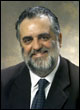
Maurizio
Trevisan
is interim dean of the School of Health Related Professions and professor
and chair of the Department of Social and Preventive Medicine in the School
of Medicine and Biomedical Sciences.
Now
that you've settled in as interim dean, what is your assessment of UB's
School of Health Related Professions? Strengths? Weaknesses? How do we
compare academically to other schools of Health Related Professions?
The School of Health Related Professions has a distinguished record. Our
founding dean, Dr. J. Warren Perry, was one of the leaders in establishing
the allied-health professions—another term used to represent health-related
professions. Because of Dr. Perry's leadership, our School of Health Related
Professions was the first school of its kind within the SUNY system and
New York State, not to mention one of the first half-dozen allied-health
schools in the country. The major strength of the school clearly is its
dedicated faculty and staff. This dedication is reflected in the excellent
national ranking that the school enjoys—both in terms of its teaching
and research missions. A particular strength of the School is the Center
for Assistive Technology (CAT). The center is aimed at finding solutions
to many of the day-to-day problems that challenge the life of one of the
most vulnerable segments of our society—individuals with disabilities,
those with special needs and our aging population—and in doing so,
they often greatly improve the independence and the quality of life of
these individuals. With regard to weaknesses, we need to consider both
general weaknesses of the allied-health field and those specific to the
school here at UB. Allied-health schools are plagued, at least in my opinion,
by two major weaknesses, both of them related to the fact that these schools
are formed by a combination of diverse training programs in the health
professions. This diversity threatens these schools' identities and imposes
high operating costs to teaching programs faced with accreditation needs
of separate professional organizations. The major weakness of our school
is the relatively low morale of faculty and staff due to the continued
lack of permanent leadership. I am the sixth in a long series of interim
deans since the last permanent dean retired in 1995 (This does not include
Dr. Frank Brady, who was hired as permanent dean in 2000 but died suddenly
after only two months in office). These interim deans have been devoted
to the school and have been good gatekeepers, but they did not have the
opportunity, due to the nature of their job, to provide long-term vision
and planning.
Are you still
serving as chair of the Department of Social and Preventive Medicine?
Yes, I divide my time between my "permanent" job as department chair and
my "interim" position as dean of HRP.
Isn't
this a rather unusual arrangement?
This is clearly an unusual arrangement, and one that could not be sustained
in the long term. The reason I have maintained both jobs and have accepted
the "interim" leadership of the school is due to my plan and vision for
future HRP public health here at ub
What
are your plans for HRP?
The most immediate plan for the school is to merge the departments of
Occupational Therapy and Physical Therapy into a new Department of Rehabilitation
Sciences. We have just received approval from the university for this
merger, and are starting the search for the chair of this new unit.
There's
also been talk of UB creating a School of Public Health. Where does this
stand?
The plan is to expand the mission of HRP and create a School of Public
Health and Health Professions. We have just started the process and are
exploring options.
Can
you provide any details about how the school might be organized? A timetable?
While the plans still are being defined and refined, the current thinking
is to have a number of departments—those currently in HRP and new
ones that will cover the public-health disciplines like public-health
practice and health policy, social and health behavior, biostatistics
and epidemiology. But most importantly, the school would be organized
around interdisciplinary centers that would focus on areas of public-health
relevance and would build on the strength of the UB faculty, both within
and outside the school (e.g., environmental health, chronic diseases,
maternal and child health, obesity, etc.). It is a bit too early to provide
an exact timetable, but I have received enthusiastic support from both
the faculty and the administration at UB and we now are in the process
of looking at the details of the implementation plan and at sources of
funding.
What
is the Master of Public Health (M.P.H.) program?
The Master of Public Health Program (M.P.H.) is a new professional degree
program we initiated last fall in the Department of Social and Preventive
Medicine aimed at training public-health and other professionals in the
public-health areas. Traditionally, M.P.H. focuses on five concentration
areas—epidemiology, biostatistics, environmental health, health behavior
and health administration. The UB program offers opportunities in only
three of these areas—health administration, epidemiology and biostatistics—but
we are working to expand our offerings.
What
types of careers would this degree prepare a student to pursue?
The M.P.H. degree offers a broad range of career opportunities. These
are linked to the concentration area chosen by the student, but include
working for county or state health departments, hospitals and other health-care
providers, federal and non-federal agencies, pharmaceutical industries,
health-research institutions, international health organizations, etc.
In addition to representing a professional terminal degree, the M.P.H.
program represents an opportunity for health and non-health professionals
to acquire the skills and knowledge to advance their careers in the health
arena. Our plan is to create an M.P.H. program that will be able to serve
other professionals and have in place joint programs through which students
pursuing a professional education can pursue additional training in public
health. We have in place M.D./M.P.H. and J.D./M.P.H. degree programs that
allow medical and law students to expand their training to incorporate
public health, and we are exploring other such opportunities.
What
question do you wish I had asked, and how would you have answered it?
I wish you would have asked me about recent successes of HRP. For example,
HRP received the prized SEFA Chair's Cup for the 2001 campaign. Last fall
we inducted the first class of the newly established doctoral program
in physical therapy. We are in the process of developing of a new professional
program at the graduate level in occupational therapy. New York State
has accredited our biotechnology program, which offers opportunities for
internships in biotech companies. Our B.S./M.S. program in exercise science
(athletic training) has been approved by the state Department of Education.
These are all clear indications of HRP's growth and quest for excellence.
Front
Page | Top Stories
| Briefly
Electronic Highways
| Kudos | Mail
| Q&A
| Sports
Exhibits, Notices, Jobs | Events
| Current
Issue | Comments?
| Archives
Search |
UB Home
| UB
News Services | UB
Today

