Biologist
finds lakes not freezing
By ELLEN
GOLDBAUM
Contributing Editor
In
30 years of studying the freeze-thaw cycles of lakes throughout New
York State, Kenton Stewart, professor emeritus of biological sciences,
has never seen some lakes in his lake-ice network stay unfrozen for
an entire winter, unless it was an El Nino year.
| |
 |
| |
Using
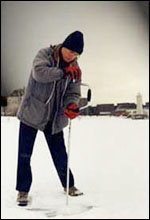
an ice auger, Kenton Stewart tests the thickness of the ice on Lake
LaSalle during a past winter when the lake froze. |
| |
|
Until
now.
"The
majority of the lakes in the state still froze, but a surprising number
that developed ice covers in previous winters had only a partial skim
of ice this winter, or did not freeze at all," said Stewart, who studies
the freeze-thaw cycles of more than 250 lakes in New York State.
The
current season reinforces a hypothesis Stewart and other lake-ice scientists
made in a paper published in the journal Science in September
2000: that lake-ice dates are proxy indicators of climate change.
"One
surprising thing about this unusually mild winter is that while it was
as mild as some of the strong El Nino events that we've seen, it was
not associated with an El Nino event in the Pacific Ocean that can have
an atmospheric influence," said Stewart. "It also was not foreseen by
the Climate Prediction Center of the National Oceanographic and Atmospheric
Agency."
In
fact, Stewart said, as of last November, the Climate Prediction Center
was forecasting a colder-than-normal winter for the Northeast and the
Upper Midwest and Great Lakes regions.
"The
complete opposite has happened," said Stewart.
"This
winter is particularly noteworthy," he continued, "in terms of the number
of lakes that did not freeze because many of the lakes that froze during
the strong El Nino winter of 1997-1998—which was especially mild—did
not freeze this year."
According
to Stewart, the amount of solar radiation increases as spring approaches,
making it less and less likely that lakes that have not frozen so far
will freeze so late in the season.
"Such
late freezes have happened, but they are rare for deep lakes, which
require many days of sustained, sub-freezing temperatures," he said.
"Just two to three cold days won't do it."
Among
the lakes in New York State that usually freeze completely but have
not done so this winter are Irondequoit Bay in Rochester, Cross Lake
west of Syracuse, Onondaga Lake in Syracuse, Hemlock and Canadice lakes
south of Rochester, Otisco Lake west of Syracuse, Big Green Lake in
Green Lake State Park east of Syracuse and Ashokan and other water-supply
reservoirs north of New York City.
The
lakes in Stewart's ice network that did freeze this year did so roughly
one to three weeks later than usual. Some lakes already have lost their
ice, and he expects others to lose their ice about two to three weeks
earlier than in most years. He cautioned that because of the temperature
gradient across the state, there is no average freeze-up or break-up
date that would hold true for the entire state.
Stewart
said that the lake-ice data provides additional evidence for the unusual
warming this winter because they are independent of air-temperature
records.
In
September 2000, Stewart and other lake-ice scientists from around the
world published a paper in the journal Science in which they
drew the first global picture of trends in the formation and dissolution
of ice on lakes and rivers in the Northern Hemisphere during the past
150 years.
That
paper proved the hypothesis of Stewart and his co-authors that lake-ice
dates are proxy indicators of climate change.
"The
current season seems to reinforce that point, and it demonstrates how
unexpected some freeze-thaw events may be," he said.


