| VOLUME 33, NUMBER 22 |
THURSDAY,
March 21, 2002 |
 

World-renowned
historian to speak at UB
Campus visit by alumnus James Oliver Horton to
include lectures, exhibit, Web site
By DONNA
LONGENECKER
Reporter Assistant Editor
The
College of Arts and Sciences has put together a series of events next
month in honor of James Oliver Horton, a noted historian and UB alumnus
who will receive a Distinguished Alumni Award from the Alumni Association
on April 19.
| |
 |
| |
In
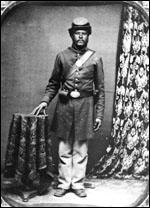
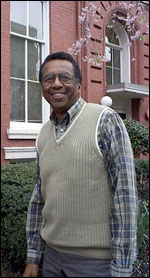
conjunction with a visit by James Horton (below) the UGL will display
an exhibit curated by Horton that includes a photo of a black Union
soldier (above). For more images, click here. |
| |
 |
| |
|
Horton,
the Benjamin Banneker Professor of American Studies and History at George
Washington University and a world-renowned scholar in the field of African-American
history, will deliver two lectures while at UB. In addition, the Undergraduate
Library will host "Free at Last: A History of the Abolition of Slavery,"
a traveling exhibit curated by Horton for the Gilder Lehrman Institute
of American History.
In
conjunction with Horton's visit, the University Libraries have developed
a Web site devoted to the multitude of materials available at UB on
subjects related to the Civil War. The site, at http://ublib.buffalo.edu/libraries/units/lml/Collections/
docs/slavery.html, is scheduled to go live next week.
Horton
will kick off his visit to campus by speaking with students about the
"Free at Last" exhibit at 10 a.m. April 19 in 31 Capen Hall, North Campus
The
documents on display as part of "Free at Last," which can be viewed
from April 8-28 in the UGL, trace the political, moral and religious
aspects of the debates over slavery that took place from 1780 to 1865.
The exhibition is comprised of 22 freestanding panels, a video and interpretive
and educational materials, including personal letters, documents, cartoons,
photographs and broadsides, drawn in large part from the Lehrman collection.
"The
purpose of this exhibit," says Horton, "is to raise many of these important
and perhaps disturbing issues so that we aren't talking about contemporary
racial concerns in a historical vacuum. These things have a history,
and that history is important. It informs what needs to be said and
what needs to be understood about race and American society at the end
of the 20th century, and it prepares us to deal with issues of race
and American society in the 21st century," he says.
Later
that day, Horton will discuss "The Tough Stuff: Interpreting Slavery
at Historic Sites," which also is the topic of his upcoming book, at
2:30 p.m. in 225 Natural Sciences Complex, North Campus.
A
1964 graduate of UB, Horton received a bachelor's degree in history
and a doctorate from Brandeis University. In addition to his academic
duties at George Washington University, he also serves as director of
the Afro-American Communities Project of the National Museum of American
History at the Smithsonian Institution.
Horton
has authored, co-authored or co-edited many books, several with his
wife, sociologist Lois E. Horton, also a UB graduate whom James Horton
reportedly met in the dining hall of a UB dormitory.
In
conjunction with the Horton visit, CAS has invited several of its faculty
to lecture on related topics:
- William
Evitts, visiting associate professor of history, will discuss the
decisions of Millard Fillmore, the 13th president of the United States,
that led to supporting the Fugitive Slave Law of 1850 at 4:30 p.m.
April 9 in 218 Norton Hall, North Campus.
- Peggy
Brooks-Bertram, adjunct assistant professor of African-American studies,
will discuss the life of Rev. William Dungy, a former Virginia slave
who escaped to Canada, at 4:30 p.m. April 11 in 108 Baldy Hall, North
Campus.
- Evitts
will introduce and host a discussion for the viewing of the film "Glory,"
for which Horton has provided commentary on the DVD version at 6:30
p.m. April 17 in the Screening Room of the Center for the Arts, North
Campus.
- Kevin
E. Cottrell, a lecturer in the Department of African-American Studies,
will discuss the Underground Railroad and issues involving the presentation
of slavery and American history at numerous local sites, at 4:30 p.m.
April 23 in 218 Norton.
- William
Tojek, president of the Colonel John B. Weber Association, Lackawana
Historical Society, and civil war re-enactor, will discuss Weber,
a local figure and Western New York's forgotten hero, at 4:30 p.m.
April 25 in 108 Baldy. Weber was the youngest colonel of the Civil
War and was commissioned to lead the 89th U.S. Colored Troops.
|